Letting some of it trickle out while trying to soak it all in

Sunday, January 29, 2023

Can cutting down trees save Great Salt Lake?

There are two ways to solve a water shortage: decrease consumption or increase supply. A century of trial and error in water security indicates that we should always start with the former option. The global water expert Dr. Rhett Larson recommends the following, prioritized approach:

1.     Study the water system

2.     Maximize conservation

3.     After exhausting steps 1 and 2, augment flow as little as necessary

There are literally hundreds of reasons to follow this sequence, but here are three: conserving water is faster, more cost effective, and much more resilient to future changes than trying to increase supply. Compare this with augmenting water supply, which takes decades, almost always goes over budget, and is often obsolete before coming online (think about how well the Lake Powell Pipeline has aged).

It sometimes feels like we are committed to anything but solving the problem at its root.


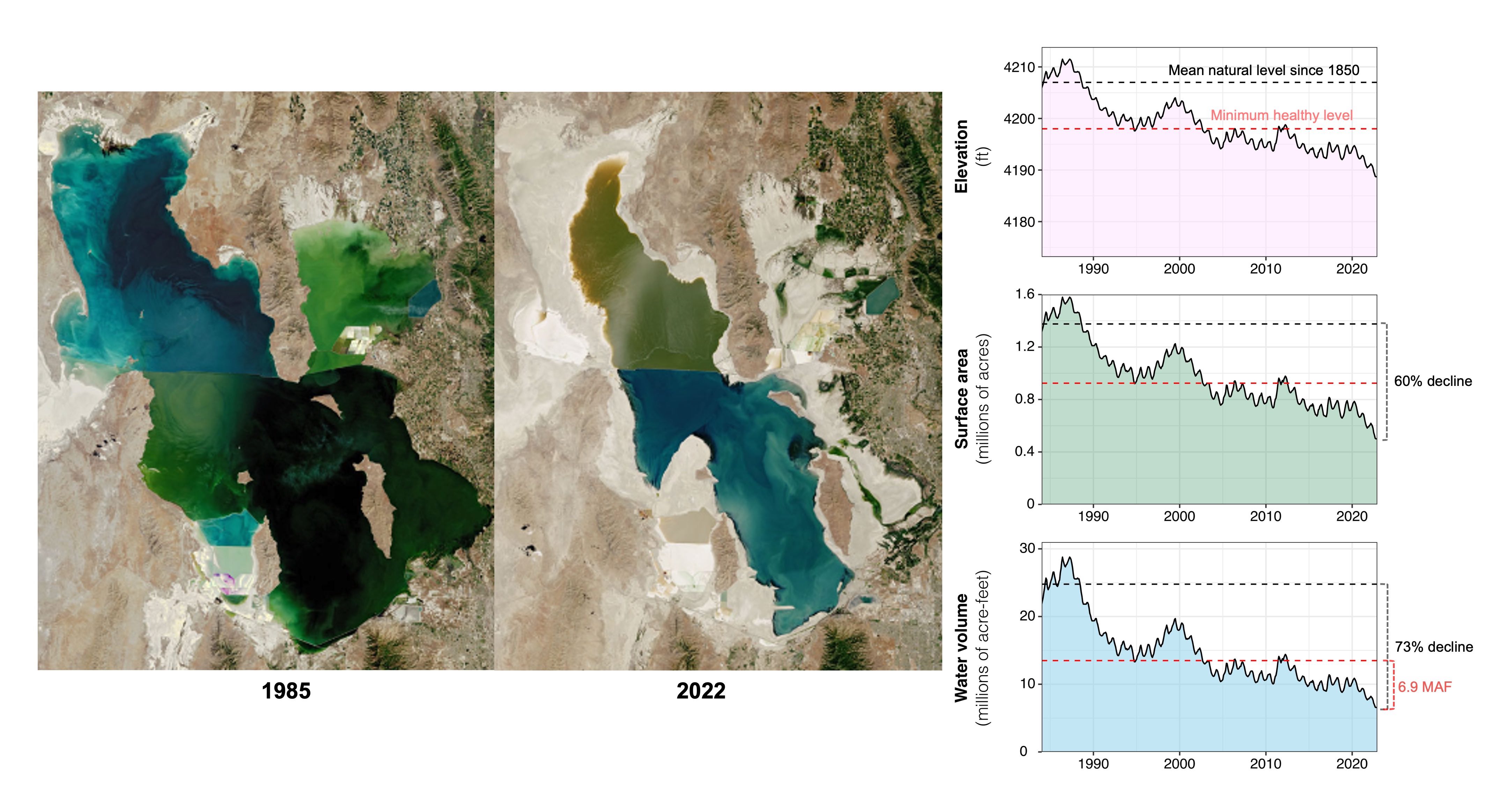
For decades, researchers and managers throughout Utah have been calling for more conservative water management. They have been warning us that we have been living beyond our means—using more water than is sustainably available. Great Salt Lake has been our line of credit, and we have been firmly in the red since my parents moved our family back to Utah in 1987. Years of kicking the conservation can down the road have put us in a situation where we need to rapidly reduce our water consumption by 30-50%. Otherwise, our debts will come due, and we will suffer the consequences of losing Great Salt Lake (see our recent report for an overview of that grim scenario).

Thankfully, we have a veritable cornucopia of common-sense conservation options at our fingertips. We can reduce agricultural water waste through new irrigation techniques and crops, update water laws to encourage conservation, and reduce the area of turf grass—currently the largest irrigated crop in the U.S. As one of states with the highest per-capita water use (~300 gallons per person per day), we have a lot of room for improvement.

Comparison of Utahn's water use with other arid and semiarid regions globally (Null & Wurtsbaugh 2020).

But why reduce waste if we could just change nature instead? That is what a recent water augmentation pitch seems to propose. A Salt Lake County councilmember is suggesting that we wouldn’t need to reduce water use at all if we just made some changes to forest management. According to this councilmember, burning and logging the forests in the Great Salt Lake watershed could increase streamflow by 1.5 million acre-feet a year. Don't get distracted by overuse of water by agricultural and urban areas, the real problem is trees.


One of several headlines covering the proposal to increase river flow to Great Salt Lake by removing trees (Jan. 14Jan. 19, Jan. 20)

We addressed several counterproductive “solutions” in our recent rescue report. We recommended against building more dams, sacrificing the north half of the lake, ramping up cloud seeding, or artificially reducing evaporation of natural lakes. Unfortunately, most of these nonsolutions are still being actively considered or pursued. We didn’t address the “trees are the problem” proposal, and so I’ll do that now. If you want the in-depth treatment, check out Dr. Sara Goeking’s dissertation, which includes a meta-analysis of 78 studies, including 159 watersheds. If you prefer the op-ed format, here is a short article by Brian Moench. Read on if you want something in between ðŸ˜Š.

Here is a summary of Dr. Goeking’s work:

1.     The prediction that streamflow would increase with reduced forest cover seems intuitive and is sometimes true. Paired watershed studies from the eastern US have shown that in humid watersheds with dense forest cover, streamflow often goes up following logging, wildfire, or herbicide treatment.

2.     However, flow increases following thinning are neither guaranteed nor permanent without perpetual intervention. This is especially true in arid and semiarid watersheds (like the basins of Great Salt Lake), where loss of trees causes increased soil evaporation from loss of canopy shade and rapid shrub regrowth.

3.     In regions like ours, forest thinning could reduce streamflow, as has happened in forests affected by recent pine beetle epidemics. Water will evaporate from soil, with or without trees present, and in warm and dry environments, the hydrologic value of trees as shade often offsets the amount of water that they transpire.

4.     Even in humid watersheds where this technique sometimes works, tree thinning is rarely used to increase streamflow. This is because decreased forest cover often triggers major water pollution from erosion, ecosystem nutrient loss, and habitat degradation. Additionally, the flow response is extremely unpredictable and can cause flood damage.

5.     There are viable reasons to thin forests, such as to reduce risk of severe fire, maintain habitat quality, and increase forest resilience to climate change. Natural or prescribed wildfire is the best way to achieve these goals.


There is another reason to question this proposal that only comes into play when you think outside the watershed. The idea that trees “use” water has been widespread in forestry for over a century. In some ways, this is perfectly reasonable when thinking about a single tree, but it is fundamentally incomplete when thinking about a region. For an inland area like Utah, trees are not a net loss of water, they are the proximal source. Most of the water that reaches the Great Salt Lake watershed only makes it this far thanks to upwind vegetation. Multiple hydrological research and management teams including ours have called for a paradigm shift.

Conceptual figure showing the importance of upwind water "use" by vegetation in regulating climate and ensuring continued downwind precipitation (Keys et al., 2019).

Vegetation is crucial to “continental moisture recycling”. If you chop yours down in a misguided attempt to temporarily increase streamflow, you could reduce precipitation downwind. Human alteration of forests and grasslands has already weakened India’s rainfall, changed wind direction in the Amazon, and modified the extent of the Sahara. 

Illustration of the precipitationshed concept (Keys et al., 2019). For Great Salt Lake, the forests within and around the watershed are key sources of water vapor that ensure continued rainfall and snowfall.

Trees do not “use water”, they structure the global hydrological cycle and ensure watershed health. Everything from groundwater recharge to prevention of catastrophic flooding and drought depends on trees. Preserving natural vegetation will become even more important to maintaining secure food and water supplies in our time of rapid environmental change.

Schematic representation of the importance of tree cover for nearly every aspect of the terrestrial water cycle (Ellison et al., 2019). If you were thinking of cutting down trees to increase river flow, you wouldn't be the first. However, you also wouldn't be wise.

Ultimately, forest thinning to increase streamflow is very similar to cloud seeding. They both are unproven techniques that are unlikely to yield sustainable increases in water yield. But even if they were successful, they would simply be scavenging moisture from downwind, nullifying their effect at the scale of a watershed as large as Great Salt Lake’s.

Call me conservative, but given the stakes of losing the lake, I think we should use an approach that is proven and much more affordable: use less water.

Wednesday, January 25, 2023

The end of the Utah Lake lawsuits

The final hearing in the LRS vs. Abbott lawsuit was today at 2.

Last night, I couldn't fall asleep. I texted my friend Greg Carling to see if he wanted to go for a morning ski tour to clear my mind and calm my heart. He said yes, and we met up at 5:30 this morning. There had been about 4" of new snow overnight, and the clouds were still thick and low.


We climbed 3,000 feet up Big Baldy's pyramid ridge. The snow in front of us and the trees in the mist were all we could see.


As we approached the summit, we knew the sun must be coming up, but it was actually getting darker as the clouds converged. Ridges are places of turmoil and twisting tides. Good places to reach, bad places to stay.


We took off our skins and dropped down an absolutely ridiculous run. A natural halfpipe of powder, pine, and peace.


As we skinned back up, the clouds started to part. However, it wasn't until we reached the ridge that we could see what was actually happening.


The ceiling had dropped, and the valley was blanketed wall to wall with clouds. We were just above it.


I said a prayer of gratitude to witness such beauty and power. We are surrounded by light, though we can't always see it.


We had to descend through the blanket to get back to the road. It felt like rewinding time. Spooling back from midday to early morning. With the remembrance of day in our hearts, the cool, powdery dark was a comfort.

At the hearing, the judge ruled that LRS had no basis in law or fact for suing me. In addition to being ineffective, LRS' tactics to silence me and other whistleblowers were illegal. For the first time in more than a year, I can see over the clouds.


After the hearing, I ran into a student who said she had emailed last year to join my lab. The missed opportunities, stolen time, and list of disappointments weigh down my body and soul. I am sincerely sorry for those I have let down. I am sorry to have emotionally and physically missed a year of my children's childhood. I am sorry for being short, cynical, and erratic.


I am grateful for God's grace and all of your sacrifices. You have tolerated my moods, unavailability, and utter failure to stay on top of basic responsibilities. Thank you for your generosity of spirit, your patience, and your companionship. Not even the darkest path can quench the light when we walk with friends.

Sunday, January 8, 2023

Thoughts on our Great Salt Lake report

This week, we published an emergency briefing on the collapse of Great Salt Lake. We worked hard to get the content and wording of the report right, so I won't restate the details here. However, I wanted to provide some context about the report's origin, purpose, and reception so far.

Why another GSL report now?

If all the ink spilt writing about Great Salt Lake could be transmogrified into water, we wouldn't be in such a bind right now. Just in our "Additional resources" section, we link to 19 articles and reports on the lake, many of which contain detailed analyses and actionable recommendations. We did not write our report to supplant those documents or act as the final word going into the future.

We started working on the report after the Salt Lake County Watershed Symposium in November. The presentations and conversations at that symposium made it painfully clear that the lake was getting worse much more rapidly than expected. The biologists, ecologists, and hydrologists who study and manage the lake kept on emphasizing the risk of dramatic change in the next 12 to 18 months. Every function and service of Great Salt Lake is threatened, from preventing toxic dust storms to providing critical minerals. 

This "next few months" timeline was very different than the "next few decades" framing that has dominated policy discussions (for example, this article from 3 weeks ago). Leaders from my church and university who attended the symposium asked for an emergency briefing to make sense of the scale of the problem and window of opportunity for implementing solutions.

We dropped our other projects and assembled an interdisciplinary team to create the report. There was a huge range of disciplinary expertise and political backgrounds among the contributors. We had conservative economists, moderate ecologists, and liberal historians (among others) discussing the conclusions in long email threads and phone conversations. This was one of the most stimulating and productive aspects of the project. Every interpretation and recommendation was questioned from three different angles.

In addition to our coauthor list of 32 researchers, managers, and community organizers, we had over a dozen external reviewers who provided detailed feedback on the report prior to publication. This added another level of assumption checks and reconsiderations. We didn't agree on every detail, but we integrated every critique and comment.

Are you saying the lake will be gone in 5 years?

Much of the media coverage has focused on a hypothetical analysis we include in the second point of the executive summary. Prior to publication, we discussed at length whether to "connect the dots" between the current rate of decline and the remaining water in the lake. Ultimately, here is what we wrote:

"The lake’s drop has accelerated since 2020, with an average deficit of 1.2 million acre-feet per year. If this loss rate continues, the lake as we know it is on track to disappear in five years."

We were not and are not making a prediction that the lake will be completely dry in five years. Indeed, most of us believe that emergency conservation measures and stabilizing feedbacks in the lake system will prevent that from happening. We were pointing out the simple hydrological fact that if the current rate of loss continues, the lake is on track to disappear within five years and experience devastating symptoms even sooner. We could think of no better way to communicate how rapid and serious the lake's loss of water was than by using this simple hypothetical.


One of the main data figures from the report showing the accelerated loss of water since 2020.


There has been some pushback, including a major state agency calling our hypothetical "unlikely." I think it is really helpful to have open dialogue, and I appreciate all critiques and responses.

In defense of our general timeline, I point out that we're not just talking about the dramatic loss of water or surface area that would occur without dramatic changes. Those are important metrics, but the effects of unsustainable water use are hitting the lake long before its total disappearance. The main body of the lake is sitting at 19% salinity right now, almost 6-times saltier than the ocean. At these salinities, the lake's food webs are breaking down. We're not just talking about another foot of elevation loss. We are talking about whether or not there will be food for the millions of migratory birds who depend on Great Salt Lake this spring and summer.

Similarly, we discussed at length whether to make specific flow recommendations. We did not (
and do not) want lawmakers to feel that we are trying to do their job. Additionally, we recognize that the state has an ongoing process in place to estimate minimum flows and establish a long-term recovery plan. Here is an excerpt from one conversation on this topic:

"I think this document will be even more useful to lawmakers and the governor's office if it is unambiguous about ecological targets and the flows needed to achieve them in 2023. I think it's a great opportunity to "cut to the chase" and put those numbers on the table for consideration in the upcoming legislative session."

We ultimately decided to treat everyone like adults. We would share our frank and unfiltered conclusions based on our analysis of publicly available data and trust our readers to use it as intended.


We recommend establishing a minimum flow of at least 2.5 million acre-feet per year.


Is the state going to look like Blade Runner 2049?

Within days of the report going live, I got several messages from friends and strangers asking if it was time to pack up and leave Utah. This is one of the most serious threats we have faced as a state, and I understand the fear and instinct to give up. The risks are real, and we need to take them deadly serious. Nature doesn't negotiate or grade on a curve. We either get this right or suffer the consequences.

Last summer, Joel Ferry, a former state representative and current executive director of the Utah Department of Natural Resources expressed the risk bluntly. “We have this potential environmental nuclear bomb that’s going to go off if we don’t take some pretty dramatic action,” Ferry told the New York Times.

I do not think it is time to throw in the towel. In fact, I am quite optimistic that we will rise to this challenge and bring our water use to sustainable levels. As humans, we have an amazing ability to live in denial until the last minute, but we also have an enormous capacity for rapid change. Comparing this to the Utah Lake island debate of the past few years, we are in a much better position with Great Salt Lake. There is nonpartisan consensus around this issue, the state has already rejected proposals to take more water from the lake, and we are in action mode with legislation and executive movement. As Tim Hawkes says (one of the most effective legislative leaders on the lake), we are pulling emergency levers real quick.

The emergency language that we use throughout our report is based on our scientific assessment of the risk. We hope that it can spur solidarity and action in some small way.

Taking an analogy from state history, the wagons and handcarts are stranded on the plains. We need to drop everything and send help. As one member of the governor's office told me this week, faith and works is kind of our brand. Let's keep praying for precipitation and work out butts off to bring our water use into harmony with the beautiful Great Basin. 


Links to news coverage:

  1. Washington Post
  2. CNN
  3. USA Today
  4. Guardian
  5. Atlantic
  6. High Country News
  7. NBC
  8. Smithsonian Magazine
  9. Fox 13
  10. KSL
  11. Access Utah
  12. NPR Here & Now
  13. NPR Morning Edition
  14. Deseret News
  15. Salt Lake Tribune
  16. Live Science
  17. Science Alert
  18. Common Dreams
  19. Weather Channel
  20. Axios
  21. Esquire
  22. KSL at Night
  23. IFLScience
  24. Standard Examiner
  25. LA Times
  26. Beau of the Fifth Column
  27. KUNC
  28. Real News Network
  29. CNN TV
  30. Mormon Land
  31. High Country News
  32. Triple Pundit
  33. Snow Brains
  34. NPR Up First
  35. ABC4
  36. Digital Journal
  37. Guardian (in greater depth)
  38. Vice
  39. The Week
  40. Living on Earth
  41. Radiowest
  42. Guardian (third)
  43. Writers on the Range
  44. CBS
  45. CBS TV
  46. Deseret News
  47. Salt Lake Tribune (Morales/Belmont)
  48. Bloomberg Law
  49. American Society of Civil Engineers
  50. AZ animals
  51. Radiowest II
  52. Science Friday
  53. Salt Lake Tribune (Tom Huckin)
  54. NBC (dumb comments by me)
  55. Deseret News (history)
  56. KSL (Cox comments)
  57. New York Times
  58. CNN
  59. Deseret News
  60. Washington Post
  61. Washington Post
  62. Ben Shapiro (just over an hour in)
  63. Newsweek
  64. Watts Up With That
  65. ABC4
  66. Outside Magazine
  67. Newsweek (disappearing lakes)
  68. Science News
  69. Powder
  70. Axios
  71. KSL
  72. USA Today
  73. EarthDate
  74. USA News & World Report
  75. Washington Post
  76. ABC4
  77. Utah Insight (PBS)
  78. Provo Tribune
  79. KRCL
  80. KSL
  81. Yale Environment 360
  82. 7NEWS Australia
  83. Salt Lake Tribune (Terry Tempest Williams)
  84. Salt Lake Tribune (John Dreyfous)
  85. Deseret News (Brian Moench)
  86. Salt Lake Tribune (Leia Stokes)
  87. NPR
  88. America Outdoors
  89. Mother Jones
  90. Newsweek
  91. KSL
  92. Standard Examiner
  93. Salt Lake Tribune
  94. All Things Considered
  95. Front page of Hacker News (for one day, screenshot below as evidence, thanks Jason)


Saturday, December 31, 2022

Water water everywhere

It has been a tumultuous year.


Peril for Utah and Great Salt Lakes. An illegal attempt to silence me and seize all my family's assets. A sick niece stuck in the hospital for Christmas. The stress of trying to get Taylor Swift tickets.


There has been a sense of scarcity. There has been a millennial drought. There has been the normal refusal to acknowledge that anything was wrong. 

I've been feeling wrung out.


December has been different. 

After holding back for twenty years, atmospheric rivers finally rushed over the orographic barricade. Storms came as they did when I was a boy. I put studded tires on my bike for the first time in four years. School was delayed.


The return of water to our catchment changed something in my heart. It felt alright to take an afternoon off. We spent a lot more time together as a family. I rode my bike across Utah Lake. Rolling on a brittle skin held up by 100,000 acres of still water. Inches from the 10 million fish biding their time.


My little brother Sam has a much better social life than me. He has slowly been initiating me into some of his traditions. He asked if I wanted to jump into the Provo River at "the rock" on New Year's Eve. Of course I did.


After skating across the frozen water, it felt amazing to be plunging into the flowing water. I got a brain freeze, but it didn't even feel cold. It just barely started to penetrate the numbness that has been so heavy this year. It reminded me of my smallness. The water is all connected through the channels and aquifers. All pushing towards Great Salt Lake. The same water.


We are ringing in the new year in the Provo River with snow falling all around. Not all the creatures are impressed. The trees don't care. But with the water, we will cycle through another year. Purified by vaporization. Transformed by adiabatic cooling. Reactivated by the fall. Seeping and rushing through the rheic and hyporheic to the endorheic. Thanks to the sun, all rivers flow back to the sky.


And take me disappearing through the smoke rings of my mind
Down the foggy ruins of time
Far past the frozen leaves
The haunted frightened trees
Out to the windy beach
Far from the twisted reach of crazy sorrow
Yes, to dance beneath the diamond sky
With one hand waving free
Silhouetted by the sea
Circled by the circus sands
With all memory and fate
Driven deep beneath the waves
Let me forget about today until tomorrow

Bob Dylan

Sunday, November 27, 2022

Five positive developments in the global energy system in 2022

The last five years have seen a tectonic shift in energy. The dominance of fossil fuels has been forever shaken by the rise of renewable energy. The International Energy Association (IEA)—long known for its dismissal of renewables—has finally acknowledged that we are experiencing peak fossil. From here on out, the share of fossil fuels in the global energy system will decrease. It’s just a matter of how quickly.

Things are changing so rapidly that it’s hard to stay up to speed. In addition to the dizzying rate of innovation, bad actors have ramped up their disinformation campaigns. Fossil fuel companies and petrostates can no longer deny the effects of climate change and air pollution, but they are now frantically trying to deny the viability of renewable energy. Just search “renewable energy” on YouTube to get a sense of the misunderstanding and disinformation. However, I think this hasty transition from problems denial to solutions denial is a sign that fossil fuel interests have seen the writing on the wall. Indeed, clean energy is extremely popular and non-partisan. Support for research and deployment of renewable technologies has a super majority in every county in the U.S.


In the midst of this war of words and tumult of opinions, renewable energy has quietly marched forward. While unqualified skeptics claim that renewables are a “failed path,” wind and solar have almost completed their takeover of global energy growth. Last year, renewables constituted just over 90% of all new energy infrastructure, and the IEA projects that 95% of all growth through 2025 will be renewable. We are experiencing an energy transition that is faster and more profound than the Industrial Revolution.

Russia’s invasion of Ukraine has supercharged the transition as more countries decide it’s not cool for a foreign dictator to be able to jack up their energy prices at home. For example, Europe’s early investment in renewables saved them $50 billion in fuel costs alone this summer as fossil fuel prices skyrocketed.

The transition to renewables is also creating stable, high-quality jobs in mining and manufacturing. Our energy workers have long been under-compensated and forced to absorb the economic shocks of OPEC and global oil markets. We are looking at tens of millions of career level jobs in the U.S. and globally.

Last December, we published a renewable energy report for some of Utah’s congressional delegation. We will update the report next month, but I wanted to share some of the most important research and market developments from the past 12 months. Here are five important "take-homes" about the clean energy revolution.


1. The bleeding is no longer getting worse

Two weeks ago, Pierre Friedlingstein and company released the 2022 global carbon budget. This is the most definitive assessment of what is going on with the Earth’s carbon cycle.


The panel on the left shows human carbon emissions and natural carbon sinks. The gray and orange wedges show annual greenhouse gas emissions from fossil fuels and land use. Check out the top of the chart over the past few years. The growth in emissions has stopped! This is thanks to the hard work of billions of everyday citizens, millions of activists and innovators, and thousands of companies and governments around the world. 

Before we declare victory, let’s look at the panel on the right. The cumulative amount of greenhouse gases in the atmosphere will keep on climbing until our emissions drop to zero. We are still a long way from that, but with emissions flat, we are poised for a rapid descent. If we keep the pressure on, ten years from now, the emissions figure will look like a boa constrictor that swallowed an elephant.


2. The energy system of tomorrow will be healthy and efficient

Last month, Tansu Galimova and team published an analysis of how the transition to renewable energy would affect air pollution. The short answer was, there won’t be any more of it. They predict a 97% decline in air pollution. 

Currently, 99% of the world’s population is breathing unhealthy air, with over 10 million premature deaths from fossil fuel pollution annually. That is more loss of life than all communicable diseases and nutrition deficiencies combined. The health and economic benefits of this transition are hard to fathom, but they surely exceed the operating expenses of the entire global energy system.

Clean energy isn't just good news for the climate. We are all going to be healthier, happier, longer lived, and less afflicted by heart disease, cancer, reproductive disfunction, and neurodegenerative conditions.


3. But how much is this going to cost?

That sounds great, but I’m sure some of you are asking, “can we afford such a dramatic transformation in the energy system?” Rupert Way and team answered this question in a groundbreaking study this year. They tallied up all the expenses of our current fossil-fuel based energy system and compared that to the cost of a global transition to renewable energy. How much is it going to cost? Negative $12 trillion.


Because renewable energy costs so much less than fossil fuel energy, a rapid transition saves the global economy trillions. Buying the coal, oil, and gas to run the current energy system accounts for 75% of total expenditures. Renewables cost money to install and maintain, but they don't consume any fuel. 

These new economics explain why every country in the world is investing so much in renewable energy. Whoever transitions fastest will have an enormous economic advantage.

These savings don't only exist at the macro-economic level. Conservative estimates indicate savings of several thousand dollars per household each year in the U.S.

Just to be clear, Rupert only considered the economic costs of running the energy system. They didn’t include the human health and environmental benefits. If you include those, the savings are closer to $50 trillion through mid-century. I thought this Voltz episode on the paper was well worth a listen.


4. But what about supply chains?

You may be thinking, “That’s great that the energy transition is economically and environmentally beneficial, but given the state of our global supply chains, we won’t be able to transition on schedule.” Two papers have recently come out on this topic. 

Lowe and Drummond tested the feasibility of “logistic substitution” of our current energy infrastructure with renewables. They found that there were no physical or raw material showstoppers to this transition. In fact, they projected healthy surpluses of all the critical minerals necessary for the transition and projected major reorganization of energy over the next two decades thanks to the incredible economics of wind and solar. Investment markets have come to the same conclusion, with lithium stocks sharply dropping after investors realized that supply was well ahead of demand

The second paper is by Christian Breyer and 24 other world-class energy researchers. They found that all the technological and supply chain provisions were already in place for a truly sustainable civilization. They summarized the research on the best economic and human rights policies to ensure a rapid and just transition.


The widespread claims that a large-scale energy transition isn't feasible are either misinformed or misguided.

5. What will the new energy system look like?

Dmitrii Bogdanov and a team of global energy researchers published a landmark study last year that used high-resolution energy system models to simulate the global energy system over the next 30 years. There are so many important messages in the paper, but here are two of the coolest IMO. 

First, by electrifying everything, we double efficiency. Currently, around 60% of the primary energy we get from fossil fuels is lost as heat. By using wind and solar to create electricity directly, and then using electricity in transportation, heating, manufacturing, and everything else, we will be able to supply reliable and affordable energy to every human on Earth for the same amount of primary energy we use today. Just like my grandpa always said, “there’s enough for everyone, if you don’t waste what God has given you.”


Second, the primary renewable energy source depends on where you are. Most of the world’s population lives in areas where solar can provide more than enough energy. Solar is already the cheapest energy source on earth. Because most energy consumption occurs during the day, the intermittency of solar is easy to manage with transmission and short-term storage. 

For areas farther from the equator, wind, hydro, and geothermal come into play. This map shows Dmitrii’s assessment of the least-cost and most-reliable renewable energy solution for every country on Earth.


Bonus: But why transition when China isn't doing anything?

This is one of the most common criticisms I hear when discussing energy policy. Besides being a bandwagon fallacy, it is patently false. China has read the tea leaves and is winning the renewable energy race. Indeed, China is deploying more renewable energy than the E.U., U.S., and India combined.


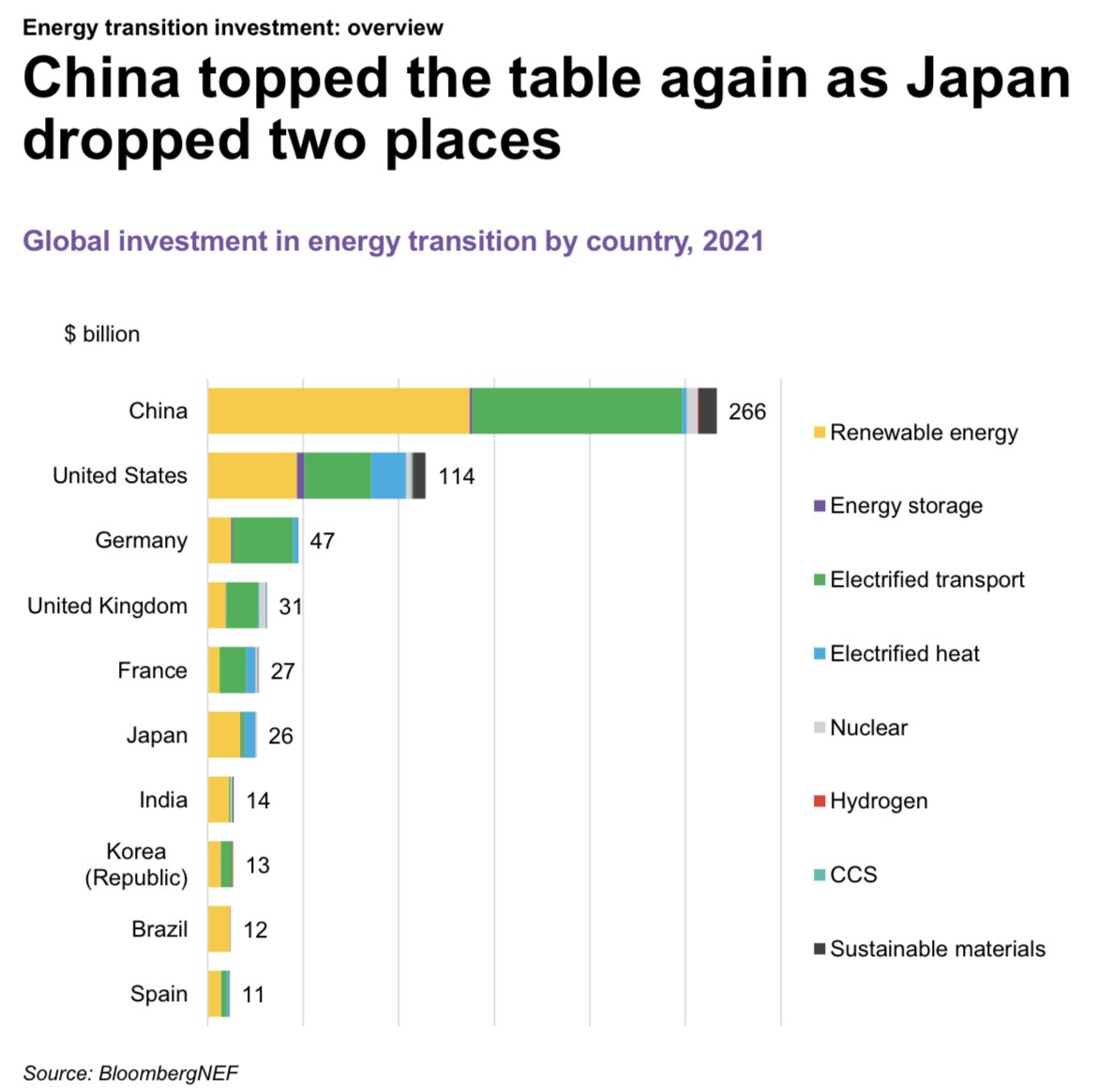
China is also dominating investment in the energy transition, more than doubling the U.S. showing. This is important because the countries who invest in cheap and clean energy now will have a major geopolitical advantage in quality of life, economic prosperity, and ideological competition.


My colleague Christian Breyer summed it up succinctly in a message to John Curtis' office a couple months ago:

The fundamental message is very simple: Any leading economy in 2030 has an energy system largely based on renewables, or it will decline and not be anymore a leading economy in the 2030s and 2040s. The reason is trivial: least cost. No other energy supply option is lower in cost. Clean air and phasing out of CO2 plus many jobs we get on top.


Conclusion

In summary, things are moving in a really positive direction. However, there remains a lot of work to do. In our report, we recommend the following:

  1. Talk with your friends, neighbors, and political leaders about the huge opportunities in renewable energy
  2. Put a price on pollution (reduce energy system externalities)
  3. Set binding renewable portfolio standards
  4. Provide support for energy workers, utility companies, and rural communities during the transition
  5. Cut red tape that currently slows the construction of renewable energy production and transmission infrastructure

Thursday, October 27, 2022

Utah Lake islands proposal rejected

Just a few hours ago, the state announced that they were formally rejecting the proposal to build artificial islands on Utah Lake. I was in a graduate student meeting when my phone started buzzing. The following headline popped along with a sideways picture of Lake Restoration Solutions' Army Corps application:


Utah Lake islands project is rejected by state officials 


It is just a stub of an article by Ben Winslow reporting that the Division of Forestry, Fire & State Lands had determined that LRS' proposal would "not pass constitutional muster and be detrimental to the citizens of the state of Utah." The other news outlets are now releasing their takes (Deseret NewsSalt Lake Tribune, Daily Herald, KSL, and Brig and Andrew).

The 94-page record of decision from the division has a lot more information. There is a play-by-play of all their interactions with LRS since 2017 and an extensive legal analysis explaining why they were cancelling the application.

From my perspective, the most interesting and important part of the rejection isn't the confirmation of the environmental deficiencies of the project. Those have been discussed at length elsewhere. What's really novel is that the division doesn't just reject this specific version of the project, they conclude that the premise of land transfers like this is unconstitutional. 

For those of you who have been following closely, this is not news. Nearly four years ago, a undergraduate environmental studies student named Andrew Follett laid this out clearly in the Hinckley Journal of Politics law review. However, the fact that the state is now saying it is really significant.

This only happened because of the intense and sustained involvement of thousands of everyday citizens in Utah Valley and across the state. The community organizing of the Utah Lake Conservation Coalition and the legislative leadership of Representative Keven Stratton were key to making this happen.

The question remains, will the legislature repeal the flawed 2018 law that started this boondoggle? They will have a chance in 2022, but it's unlikely unless they hear from us. Here is what we need to do:

  1. Look up your legislator here
  2. Send them a polite email or give them a phone call 
  3. Share with them the division's record of decision
  4. Ask them to sponsor repeal of 2018's HB272 (The Utah Lake Restoration Act) to restore full public trust protection to Utah Lake
For more info and updates, feel free to reach out or join the conversation on Twitter.

Friday, September 30, 2022

Overconsumption versus overpopulation

Too many people on the bus from the airport
Too many holes in the crust of the earth
The planet groans
Every time it registers another birth

Paul Simon 

Nobody goes there anymore, it's too crowded.

Yogi Berra

Back in the innocent days before the pandemic and the lawsuit, my college interviewed me about what individual people could do to live more sustainably. I told them my three recommendations, and they made this cute video a few months later:


While none of us can solve air pollution and climate change on our own, it is empowering to know that we can substantially reduce our personal contribution to these problems by making thoughtful changes in our transportation, diet, and public participation. Additionally, these individual choices contribute to systemic change through personal example, economic pressure, and the political process. I have seen this play out on issues ranging from protecting Utah Lake to accelerating the local transition to renewable energy.


I redrew this figure from Project Drawdown to show both of their sets of ranked climate solutions. The ongoing renewable revolution is making Scenario 2 (the better one) more likely. The conclusion is that we need to transition to renewable energy and sustainable agriculture.

A couple weeks later, I heard from a colleague who had seen the video. He said that he appreciated the thought but wondered why I didn't recommend the most effective way of reducing your environmental footprint: having fewer children. He cited what has become a highly-cited paper in sustainability circles, entitled: The climate mitigation gap: education and government recommendations miss the most effective individual actions by Wynes and Nicholas 2017

The paper has some valuable insights, including the titular conclusion that the effectiveness of various climate-smart choices is usually not reported in textbooks. I see this all the time in the real world (check out this pretty but useless animated infographic by Columbia University). Many people do not know what changes could effectively help us create a sustainable future, and most people do not know how to prioritize potential changes. For example, implementing a single meatless day a week has almost no effect on environmental footprint, while switching to a plant-rich diet reduces agricultural emissions and use of water, land, and nutrients by approximately 90%.

This cutting-edge paper by Kim et al. compares the greenhouse gas footprint of different diets for almost all countries (click for higher resolution version). In the U.S., you can reduce your dietary greenhouse gas footprint from around 2 tons to 200 kg of CO2 by switching to a plant-based diet. That means we could feed nine people with the resources we currently use to feed one. 

But as Mark Twain might have said, “It ain’t what you don’t know that gets you into trouble. It’s what you know for sure that just ain’t so.” Wynes and Nicholas conclude definitively that the most effective personal action is having fewer children. They rank this choice as 30-times more effective than the next recommendation of living car-free (60 versus 2 tons of CO2 saved). This conclusion was the perfect material for a whole constellation of smug infographics (good coverage by Vox here).

I teach all my students that the most important time to exercise their critical thinking is when they are confronted with information they agree with. It is so easy to welcome confirmatory evidence while dismissing data that doesn't match our prior beliefs. It is comforting and validating to collect numbers and arguments that we want to believe. However, if we are committed to learning, we should cultivate a taste for having our beliefs challenged. Whether or not Wynes and Nicholas' argument appeals to you, let's give their reasoning a real look.

One disclaimer before we dive in. Arguments about overpopulation have a long and troubled history that I can't unpack in a single blog post. Giorgos Kallis has a good book on the topic that is reviewed by the Inquisitive Biologist here. Rather than wrestle with the xenophobic and elitist worldviews of many population control advocates, I'm going to take Wynes and Nicholas' argument in good faith. Let's simply ask the question, is having one fewer child the most effective choice we can make to protect the environment?

Here is a figure of global fertility rate, expressed in the lifetime number of children per woman:


The fertility rate has halved in 50 years and is now approaching replacement (an average of 2 surviving children per woman). This reduction in reproduction is even more marked in the high-income countries that dominate carbon emissions and consumption generally. It appears that the recommended "change" is something that most educated, wealthy people are already doing. This decrease has happened much faster than predicted, and current population projections are half of what demographers used to expect: 9 billion by 2050. If you consider population growth a problem, it is well on its way to solving itself.

This figure shows the fertility rate versus per-capita wealth by country:

Notice that almost all industrialized countries are at or below replacement. This means that more than 80% of global greenhouse gas emissions are occurring in countries that are at or below replacement.

The global environmental footprint of humanity is the product of the number of people and the average per-person consumption. When we are talking about total amount, it's the mean that matters, not the median. For those of you who have taken math recently, you may remember that the mean is highly sensitive to extreme values. One very high number can outweigh thousands or millions of low numbers. 

The pattern of global consumption is a lesson in extremes. The wealthiest 2,200 people have more money than the 4.8 billion poorestLook at this intra- and international analysis of per-capita carbon emissions compiled by the Carbon Brief:


Everyone is not equally responsible for the planetary problems we are facing. The top 1% of emitters are responsible for a quarter of global emissions, and the top 10% of emitters account for well over half. It turns out that it's not primarily the number of people that is causing the problem, it's the amount of consumption per person that is driving global environmental degradation.

This led global ecologist Jonathan Foley to write in 2015"Instead of the 'Population Bomb' of the 1960s, we now have an even larger 'Consumption Bomb', and we don’t now how to diffuse it. And this bomb may well define our relationship to the environment for the 21 century and beyond."

Beyond the first-principles analysis of variation in fertility rate and consumption, there is a fundamental flaw in Wynes and Nicholas' method of calculating future emissions. To estimate the savings of having one fewer child, they use a method proposed by Murtaugh and Schlax in 2009. They apply a projected consumption curve that assumes stable or increasing per-capita consumption through 2100. They then  divide the summed emissions between the parents and call it a day.


There are at least two problems with this method. First, it doesn't reflect the actual trend of decreasing per-capita emissions. New technologies, increasing efficiency, and cultural changes have thankfully allowed us to now produce much more wealth per unit of CO2 than we did in the past. Indeed, normalized emissions have dropped by 50% since 1990, and the rate of decline is rapidly accelerating thanks to the renewable revolution. Second, if we accept their assumption that per-capita consumption is going to dramatically increase, we are toast no matter how few children we have. If everyone currently on the planet lived an American lifestyle, we would need 5.1 Earths to support the current 7.8 billion people. We can easily outstrip the capacity of the planet without adding any more mouths.


For moral and practical reasons, our focus should be rapidly decreasing per-capita consumption. We see this conclusion in thoughtful secular and religious teachings. Barry Commoner wrote in 1973, 

When any environmental issue is pursued to its origins, it reveals an inescapable truth – that the root cause of the crisis is not to be found in how men interact with nature, but in how they interact with each other – that, to solve the environmental crisis we must solve the problems of poverty, racial injustice and war.

The scriptures of the restoration laid out the same truth more than a century prior:

For it is expedient that I, the Lord, should make every man accountable, as a steward over earthly blessings, which I have made and prepared for my creatures. I, the Lord, stretched out the heavens, and built the earth, my very handiwork; and all things therein are mine. And it is my purpose to provide for my saints, for all things are mine.  
But it must needs be done in mine own away; and behold this is the way that I, the Lord, have decreed to provide for my saints, that the poor shall be exalted, in that the rich are made low.  
For the earth is full, and there is enough and to spare; yea, I prepared all things, and have given unto the children of men to be agents unto themselves. Therefore, if any man shall take of the abundance which I have made, and impart not his portion, according to the law of my gospel, unto the poor and the needy, he shall, with the wicked, lift up his eyes in hell, being in torment.
Doctrine and Covenants, Section 104, 1834


We need to replace the disproven consumerist model of humans versus the environment with the traditional ecological and Indigenous view of human society and economy as embedded components of the larger Earth system.


Are there limits to how many people the Earth can support? Of course. Are the current ecological threats to our civilization primarily caused by overpopulation? No. If we live within our means and sustain those who sustain us, the Earth will be perfected, and there will be enough and to spare for all human and nonhuman peoples.


Here is my response to my colleague about the paper:

Thanks for reaching out and happy thanksgiving. I saw this paper when it came out, but didn’t read it in detail until now. It’s an important study and a crucial question. Their point about most textbooks not focusing on what matters most is really important. However, I do have a few issues with their first recommendation and specifically with their method of assessing the CO2 footprint of having a child.

First, they apply average historical consumption rates to the child. The intra and international variation in per capita consumption ranges two orders of magnitude. If a family implements all (or even some) of the best available practices, the footprint of their child would be much smaller, and therefore the decrease of not having a child much less. More importantly, in my opinion, the influence of having a child in such an environmentally engaged and concerned family could accelerate the transition to clean energy that we desperately need. If that doesn’t happen quickly, then increasing consumption will push us past any climate targets even if no one else is ever born.

Second, the analysis thankfully is applied to developed countries, rather than across socioeconomic stages. Overpopulation has long been blamed for many environmental crises, though the argument is usually reserved for low and middle income countries, which have a fraction of the consumption of upper income countries. However, in the case of this study, the authors neglect the issue of immigration. They assume that if one less child is born in a developed country, then there will be one fewer consumer in that country. Recent trends in immigration show that isn’t the case (sustained immigration to developed countries has offset some or all of decreases in fertility).

Third, population growth has shown to basically scale negatively with socioeconomic development, dropping to replacement or below in the most developed countries. What scales in the wrong direction is consumption. Looking through time or across socioeconomic levels, the fewer children a family tends to have, the more that family tends to consume.

Together, this leads me to the conclusion that focusing on decreasing consumption and catalyzing the transition to renewable energy and sustainable lifestyles are much more important than trying to limit fertility. We have the technology and financing to implement a rapid decarbonization of our economy over the next 20 years (do you know Project Drawdown and Rewiring America?). My conclusion is that we need all hands on deck to make sure this happens rapidly and equitably. On a PR level, population control measures are a nonstarter for many conservatives. On a practical level, I don’t think they could ever be effective given rates of increase in consumption.

I talk about the population versus consumption focus some in this Kennedy Center lecture.