Letting some of it trickle out while trying to soak it all in

Sunday, April 30, 2023

Does nature deserve rights?

Over the past few weeks, I have drawn the ire of two national figures over my Great Salt Lake research and outreach.

First, Wesley Smith of the Center on Human Exceptionalism wrote a piece in National Review criticizing Terry Tempest Williams' essay in the New York Times. Smith called the idea of granting rights to Great Salt Lake radical and subversive. According to him, acknowledging the rights of any ecosystem would cause the end of human flourishing, though it would also be unenforceable.

In a less thoughtful but higher profile kerfuffle, Ben Shapiro mocked me in his podcast for our January report on the decline of Great Salt Lake. Responding to a headline in the Washington Post, Shapiro claimed that I and other environmentalists are alarmist and never admit we're wrong. In a rhetorical two-step, Shapiro seems to simultaneously take me to task for being a godless liberal while also criticizing my recognition of God's hand in the short-term rebound of Great Salt Lake.

Before discussing either critique, we should all take a deep breath and laugh that I'm the national discussion at all. As a baby professor who is not good at much besides bicycling long distances, I hope that this unexpected attention is as short lived as it is unlikely.

However, it does provide an opportunity to discuss a question I take very seriously: how are we supposed to relate to nature? This question has been important from the beginning oft Homo sapiens some 300,000 years ago, but it has become absolutely crucial over the last 70 years as humans have become the predominant force controlling many of the Earth's great cycles.

Shapiro's criticism is shallower than Great Salt Lake right now, so I won't take too much time on that, but Smith's ideas are interesting. His center puts humans at the center of the Earth system. I agree with him on that point, but there are several reasons why I think acknowledging the rights of ecosystems are profoundly pro-human and fundamentally conservative.

In my ecology classes, I teach two basic and important terms:

  • Population: the number and fitness of individuals of a single species in a given area.
  • Community: the number and interactions of all living things in a given area
I then show my students a picture like the following and ask them, "Does this picture show a population or a community?"


Most say that this shows a population. After all, they are all African elephants, right? Look a little closer.

Is this a group of elephants floating on its own, in the void? Look at the vegetation, the soil, the egret, the atmosphere. Imagine the microbiome on and in the elephants. When we overcome our bias towards moving organisms that could harm us or be a food source, we start to realize that there are trillions of organisms of thousands of distinct species that are interacting in this photo alone.

Even if my value system prioritized the wellbeing of elephants above all else, I need to take an ecosystem approach to protect those elephants.

Like Smith, I believe that humans have a special role and responsibility in the Earth system. Unlike Smith, I view it as fundamentally anti-human to deny the rights of our home. We will be tempted over and over to exchange long-term ecological integrity with short-term economic or political gain. It is one of the main narratives of the past century. Our continued flourishing depends on changing that narrative.

Dr. Robin Wall Kimmerer describes the Law of the Honorable Harvest in the lecture below. This Indigenous code could inform the practical and profound dimensions of our relationship with our home. 


One of the central tenets of the Law of the Honorable Harvest is to ask permission of the ones whose lives you seek and to abide by the answer. Think how respectful and serious this acknowledgement of rights is.

In my faith tradition in the Church of Jesus Christ of Latter-day Saints, we have a similar commandment in Doctrine and Covenants 59:
Yea, all things which come of the earth, in the season thereof, are made for the benefit and the use of man, both to please the eye and to gladden the heart…to be used, with judgment, not to excess, neither by extortion.

Whenever we forget to acknowledge the spiritual existence and agency of all parts of the Earth system, we are likely to slip into casual consumption and self-destructive exploitation. From my scientific training and religious beliefs, we must take a community approach that does not exclusively consider individual humans. To stand a chance at making it through the next hundred or even fifty years, we need to radically change our approach. We must expand our legal and moral frameworks to expressly include the Earth and all our community.


If we view economic growth or political success as competing with the environment, then we reveal our lack of understanding and foresight. A house that is eating itself cannot stand for long. You can call it radical and subversive, but I think it is profoundly conservative and sane.


Friday, March 31, 2023

Too much, too fast

It was a few weeks ago, but things have been so frantic that it feels like yesterday. I went to get donuts for my lab. I love the Provo Bakery, and their day olds are about the best deal in the county. The weather and the traffic signs conspired to teach me a lesson. I've forgotten how to stop.


From covid to Utah Lake to Great Salt Lake and back again. Things have been too much and too fast. I feel that it is so important to say yes when opportunities come up to advocate for our community and ecosystems. But it has been hotter and heavier than I can sustain.


My friend Greg has been a real savior for me this winter. We have been trying to get out and ski at least once a week. Earlier this month, we tried Greg's crazy idea to ski all four faces of Baldy in a day. Fueled by my mom's nut mix and mandarin oranges, we created a giant infinity sign as we looped down and up each face.


The descents were thrilling and extremely varied, but the long slogs back to the top felt the most important to me. They forced me to slow down. I wasn't feeling well, and I was climbing slow. I had to take the time to breathe, listen, and see.


Every climb was different. The same precarious and permanent mountain. Such diversity in the light, forest, and snow.


Unlike the snow-blasted stop sign, the mountain's lessons were more subtle. Like most important lessons, it wasn't clear what the mountain was trying to teach me. What parts of the parable applied to me, and what parts to my mountain of unfinished tasks?


I resolve to do less and to do it slower. There are so many people here to help. With better planning and coordination, we can protect what needs protecting without a wake of avalanches and debris flows.


I'm grateful for your patience and friendship. Thank you for your forgiveness and vision.


O Star (the fairest one in sight),

We grant your loftiness the right

To some obscurity of cloud –

It will not do to say of night,

Since dark is what brings out your light.

Some mystery becomes the proud.

But to be wholly taciturn

In your reserve is not allowed.

Say something to us we can learn

By heart and when alone repeat.

Say something! And it says "I burn."

But say with what degree of heat.

Talk Fahrenheit, talk Centigrade.

Use language we can comprehend.

Tell us what elements you blend.

It gives us strangely little aid,

But does tell something in the end.

And steadfast as Keats' Eremite,

Not even stooping from its sphere,

It asks a little of us here.

It asks of us a certain height,

So when at times the mob is swayed

To carry praise or blame too far,

We may choose something like a star

To stay our minds on and be staid.

Robert Frost, 1916

Thursday, February 16, 2023

We must save Great Salt Lake with mighty faith and works

This morning, I joined with religious leaders from across Utah to demonstrate solidarity and support our political leaders in taking dramatic action to save Great Salt Lake.

The interfaith crew gathers before the press conference. Photo by Marc Coles-Ritchie of the Mormon Environmental Stewardship Alliance (MESA).

I've participated in a fair number of rallies and press conferences, but this felt different. Like usual for February, The Capitol was abuzz with legislative activities and booths in the rotunda. It was boomy and hard to hear, but the messages moved my body and soul. We weren't complaining about the failure of the legislature to take next steps. We weren't railing against the shortsightedness that afflicts us all. We were coming together in communion and love. Here are the notes I used when addressing the crowd.

Rios Pachecho of the Northwestern Band of the Shoshone Nation kicks off the interfaith press conference. Photo by Alexis Perno, Great Salt Lake Collaborative.

Sunday, February 12, 2023

Anti-wildlife lobbyists ask for more of our taxes

The group called Sportsmen for Fish & Wildlife is seeking $500,000 from the Utah legislature. Along with its sister organizations Big Game Forever and Stag Consulting, this group has received more than $12 million from the state to politicize wildlife management while fighting in court to keep Utahns from knowing how they spent the funds. The group was the subject of a legislative audit for inappropriately commingling money from public and private sources, and there is a direct connection with the Utah Lake islands project (details below). They have been called out by multiple groups ranging from the National Rifle Association to Utah's Legislative Auditor General.

Starting tomorrow with the appropriations process, our legislators will decide whether to use more of our money to support this group. There are 20 legislators on the Executive Appropriations Committee. You can find their emails listed on pages 15 and 16 of the Great Salt Lake Audubon Society's legislative update. Please take a few minutes to email or text these legislators to refuse the "Hunter Nation" funding request. Many budget items only get a brief mention, and your message could make sure that our taxes are used for their best and highest purpose. The legislative update also recommends several good uses of funds, including water conservation for Great Salt Lake.

It doesn't come natural to many of us, but having the courage to send a short and polite message can make a big difference. Thank you for your concern and action at this important time.


Here is some background on these guys that I put together for my blog post last year:

Sunday, January 29, 2023

Can cutting down trees save Great Salt Lake?

There are two ways to solve a water shortage: decrease consumption or increase supply. A century of trial and error in water security indicates that we should always start with the former option. The global water expert Dr. Rhett Larson recommends the following, prioritized approach:

1.     Study the water system

2.     Maximize conservation

3.     After exhausting steps 1 and 2, augment flow as little as necessary

There are literally hundreds of reasons to follow this sequence, but here are three: conserving water is faster, more cost effective, and much more resilient to future changes than trying to increase supply. Compare this with augmenting water supply, which takes decades, almost always goes over budget, and is often obsolete before coming online (think about how well the Lake Powell Pipeline has aged).

It sometimes feels like we are committed to anything but solving the problem at its root.


For decades, researchers and managers throughout Utah have been calling for more conservative water management. They have been warning us that we have been living beyond our means—using more water than is sustainably available. Great Salt Lake has been our line of credit, and we have been firmly in the red since my parents moved our family back to Utah in 1987. Years of kicking the conservation can down the road have put us in a situation where we need to rapidly reduce our water consumption by 30-50%. Otherwise, our debts will come due, and we will suffer the consequences of losing Great Salt Lake (see our recent report for an overview of that grim scenario).

Thankfully, we have a veritable cornucopia of common-sense conservation options at our fingertips. We can reduce agricultural water waste through new irrigation techniques and crops, update water laws to encourage conservation, and reduce the area of turf grass—currently the largest irrigated crop in the U.S. As one of states with the highest per-capita water use (~300 gallons per person per day), we have a lot of room for improvement.

Comparison of Utahn's water use with other arid and semiarid regions globally (Null & Wurtsbaugh 2020).

But why reduce waste if we could just change nature instead? That is what a recent water augmentation pitch seems to propose. A Salt Lake County councilmember is suggesting that we wouldn’t need to reduce water use at all if we just made some changes to forest management. According to this councilmember, burning and logging the forests in the Great Salt Lake watershed could increase streamflow by 1.5 million acre-feet a year. Don't get distracted by overuse of water by agricultural and urban areas, the real problem is trees.


One of several headlines covering the proposal to increase river flow to Great Salt Lake by removing trees (Jan. 14Jan. 19, Jan. 20)

We addressed several counterproductive “solutions” in our recent rescue report. We recommended against building more dams, sacrificing the north half of the lake, ramping up cloud seeding, or artificially reducing evaporation of natural lakes. Unfortunately, most of these nonsolutions are still being actively considered or pursued. We didn’t address the “trees are the problem” proposal, and so I’ll do that now. If you want the in-depth treatment, check out Dr. Sara Goeking’s dissertation, which includes a meta-analysis of 78 studies, including 159 watersheds. If you prefer the op-ed format, here is a short article by Brian Moench. Read on if you want something in between ðŸ˜Š.

Here is a summary of Dr. Goeking’s work:

1.     The prediction that streamflow would increase with reduced forest cover seems intuitive and is sometimes true. Paired watershed studies from the eastern US have shown that in humid watersheds with dense forest cover, streamflow often goes up following logging, wildfire, or herbicide treatment.

2.     However, flow increases following thinning are neither guaranteed nor permanent without perpetual intervention. This is especially true in arid and semiarid watersheds (like the basins of Great Salt Lake), where loss of trees causes increased soil evaporation from loss of canopy shade and rapid shrub regrowth.

3.     In regions like ours, forest thinning could reduce streamflow, as has happened in forests affected by recent pine beetle epidemics. Water will evaporate from soil, with or without trees present, and in warm and dry environments, the hydrologic value of trees as shade often offsets the amount of water that they transpire.

4.     Even in humid watersheds where this technique sometimes works, tree thinning is rarely used to increase streamflow. This is because decreased forest cover often triggers major water pollution from erosion, ecosystem nutrient loss, and habitat degradation. Additionally, the flow response is extremely unpredictable and can cause flood damage.

5.     There are viable reasons to thin forests, such as to reduce risk of severe fire, maintain habitat quality, and increase forest resilience to climate change. Natural or prescribed wildfire is the best way to achieve these goals.


There is another reason to question this proposal that only comes into play when you think outside the watershed. The idea that trees “use” water has been widespread in forestry for over a century. In some ways, this is perfectly reasonable when thinking about a single tree, but it is fundamentally incomplete when thinking about a region. For an inland area like Utah, trees are not a net loss of water, they are the proximal source. Most of the water that reaches the Great Salt Lake watershed only makes it this far thanks to upwind vegetation. Multiple hydrological research and management teams including ours have called for a paradigm shift.

Conceptual figure showing the importance of upwind water "use" by vegetation in regulating climate and ensuring continued downwind precipitation (Keys et al., 2019).

Vegetation is crucial to “continental moisture recycling”. If you chop yours down in a misguided attempt to temporarily increase streamflow, you could reduce precipitation downwind. Human alteration of forests and grasslands has already weakened India’s rainfall, changed wind direction in the Amazon, and modified the extent of the Sahara. 

Illustration of the precipitationshed concept (Keys et al., 2019). For Great Salt Lake, the forests within and around the watershed are key sources of water vapor that ensure continued rainfall and snowfall.

Trees do not “use water”, they structure the global hydrological cycle and ensure watershed health. Everything from groundwater recharge to prevention of catastrophic flooding and drought depends on trees. Preserving natural vegetation will become even more important to maintaining secure food and water supplies in our time of rapid environmental change.

Schematic representation of the importance of tree cover for nearly every aspect of the terrestrial water cycle (Ellison et al., 2019). If you were thinking of cutting down trees to increase river flow, you wouldn't be the first. However, you also wouldn't be wise.

Ultimately, forest thinning to increase streamflow is very similar to cloud seeding. They both are unproven techniques that are unlikely to yield sustainable increases in water yield. But even if they were successful, they would simply be scavenging moisture from downwind, nullifying their effect at the scale of a watershed as large as Great Salt Lake’s.

Call me conservative, but given the stakes of losing the lake, I think we should use an approach that is proven and much more affordable: use less water.

Wednesday, January 25, 2023

The end of the Utah Lake lawsuits

The final hearing in the LRS vs. Abbott lawsuit was today at 2.

Last night, I couldn't fall asleep. I texted my friend Greg Carling to see if he wanted to go for a morning ski tour to clear my mind and calm my heart. He said yes, and we met up at 5:30 this morning. There had been about 4" of new snow overnight, and the clouds were still thick and low.


We climbed 3,000 feet up Big Baldy's pyramid ridge. The snow in front of us and the trees in the mist were all we could see.


As we approached the summit, we knew the sun must be coming up, but it was actually getting darker as the clouds converged. Ridges are places of turmoil and twisting tides. Good places to reach, bad places to stay.


We took off our skins and dropped down an absolutely ridiculous run. A natural halfpipe of powder, pine, and peace.


As we skinned back up, the clouds started to part. However, it wasn't until we reached the ridge that we could see what was actually happening.


The ceiling had dropped, and the valley was blanketed wall to wall with clouds. We were just above it.


I said a prayer of gratitude to witness such beauty and power. We are surrounded by light, though we can't always see it.


We had to descend through the blanket to get back to the road. It felt like rewinding time. Spooling back from midday to early morning. With the remembrance of day in our hearts, the cool, powdery dark was a comfort.

At the hearing, the judge ruled that LRS had no basis in law or fact for suing me. In addition to being ineffective, LRS' tactics to silence me and other whistleblowers were illegal. For the first time in more than a year, I can see over the clouds.


After the hearing, I ran into a student who said she had emailed last year to join my lab. The missed opportunities, stolen time, and list of disappointments weigh down my body and soul. I am sincerely sorry for those I have let down. I am sorry to have emotionally and physically missed a year of my children's childhood. I am sorry for being short, cynical, and erratic.


I am grateful for God's grace and all of your sacrifices. You have tolerated my moods, unavailability, and utter failure to stay on top of basic responsibilities. Thank you for your generosity of spirit, your patience, and your companionship. Not even the darkest path can quench the light when we walk with friends.

Sunday, January 8, 2023

Thoughts on our Great Salt Lake report

This week, we published an emergency briefing on the collapse of Great Salt Lake. We worked hard to get the content and wording of the report right, so I won't restate the details here. However, I wanted to provide some context about the report's origin, purpose, and reception so far.

Why another GSL report now?

If all the ink spilt writing about Great Salt Lake could be transmogrified into water, we wouldn't be in such a bind right now. Just in our "Additional resources" section, we link to 19 articles and reports on the lake, many of which contain detailed analyses and actionable recommendations. We did not write our report to supplant those documents or act as the final word going into the future.

We started working on the report after the Salt Lake County Watershed Symposium in November. The presentations and conversations at that symposium made it painfully clear that the lake was getting worse much more rapidly than expected. The biologists, ecologists, and hydrologists who study and manage the lake kept on emphasizing the risk of dramatic change in the next 12 to 18 months. Every function and service of Great Salt Lake is threatened, from preventing toxic dust storms to providing critical minerals. 

This "next few months" timeline was very different than the "next few decades" framing that has dominated policy discussions (for example, this article from 3 weeks ago). Leaders from my church and university who attended the symposium asked for an emergency briefing to make sense of the scale of the problem and window of opportunity for implementing solutions.

We dropped our other projects and assembled an interdisciplinary team to create the report. There was a huge range of disciplinary expertise and political backgrounds among the contributors. We had conservative economists, moderate ecologists, and liberal historians (among others) discussing the conclusions in long email threads and phone conversations. This was one of the most stimulating and productive aspects of the project. Every interpretation and recommendation was questioned from three different angles.

In addition to our coauthor list of 32 researchers, managers, and community organizers, we had over a dozen external reviewers who provided detailed feedback on the report prior to publication. This added another level of assumption checks and reconsiderations. We didn't agree on every detail, but we integrated every critique and comment.

Are you saying the lake will be gone in 5 years?

Much of the media coverage has focused on a hypothetical analysis we include in the second point of the executive summary. Prior to publication, we discussed at length whether to "connect the dots" between the current rate of decline and the remaining water in the lake. Ultimately, here is what we wrote:

"The lake’s drop has accelerated since 2020, with an average deficit of 1.2 million acre-feet per year. If this loss rate continues, the lake as we know it is on track to disappear in five years."

We were not and are not making a prediction that the lake will be completely dry in five years. Indeed, most of us believe that emergency conservation measures and stabilizing feedbacks in the lake system will prevent that from happening. We were pointing out the simple hydrological fact that if the current rate of loss continues, the lake is on track to disappear within five years and experience devastating symptoms even sooner. We could think of no better way to communicate how rapid and serious the lake's loss of water was than by using this simple hypothetical.


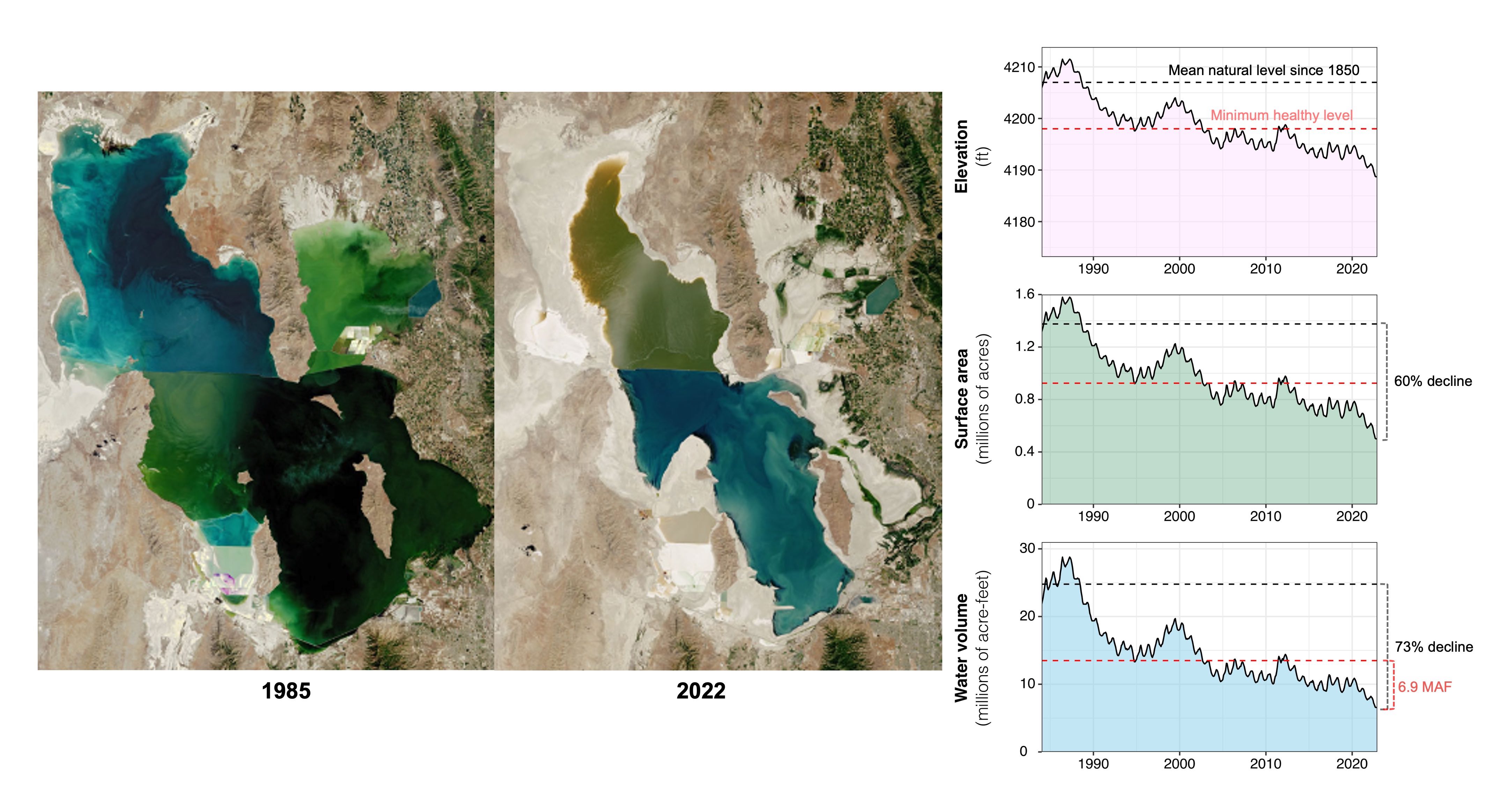
One of the main data figures from the report showing the accelerated loss of water since 2020.


There has been some pushback, including a major state agency calling our hypothetical "unlikely." I think it is really helpful to have open dialogue, and I appreciate all critiques and responses.

In defense of our general timeline, I point out that we're not just talking about the dramatic loss of water or surface area that would occur without dramatic changes. Those are important metrics, but the effects of unsustainable water use are hitting the lake long before its total disappearance. The main body of the lake is sitting at 19% salinity right now, almost 6-times saltier than the ocean. At these salinities, the lake's food webs are breaking down. We're not just talking about another foot of elevation loss. We are talking about whether or not there will be food for the millions of migratory birds who depend on Great Salt Lake this spring and summer.

Similarly, we discussed at length whether to make specific flow recommendations. We did not (
and do not) want lawmakers to feel that we are trying to do their job. Additionally, we recognize that the state has an ongoing process in place to estimate minimum flows and establish a long-term recovery plan. Here is an excerpt from one conversation on this topic:

"I think this document will be even more useful to lawmakers and the governor's office if it is unambiguous about ecological targets and the flows needed to achieve them in 2023. I think it's a great opportunity to "cut to the chase" and put those numbers on the table for consideration in the upcoming legislative session."

We ultimately decided to treat everyone like adults. We would share our frank and unfiltered conclusions based on our analysis of publicly available data and trust our readers to use it as intended.


We recommend establishing a minimum flow of at least 2.5 million acre-feet per year.


Is the state going to look like Blade Runner 2049?

Within days of the report going live, I got several messages from friends and strangers asking if it was time to pack up and leave Utah. This is one of the most serious threats we have faced as a state, and I understand the fear and instinct to give up. The risks are real, and we need to take them deadly serious. Nature doesn't negotiate or grade on a curve. We either get this right or suffer the consequences.

Last summer, Joel Ferry, a former state representative and current executive director of the Utah Department of Natural Resources expressed the risk bluntly. “We have this potential environmental nuclear bomb that’s going to go off if we don’t take some pretty dramatic action,” Ferry told the New York Times.

I do not think it is time to throw in the towel. In fact, I am quite optimistic that we will rise to this challenge and bring our water use to sustainable levels. As humans, we have an amazing ability to live in denial until the last minute, but we also have an enormous capacity for rapid change. Comparing this to the Utah Lake island debate of the past few years, we are in a much better position with Great Salt Lake. There is nonpartisan consensus around this issue, the state has already rejected proposals to take more water from the lake, and we are in action mode with legislation and executive movement. As Tim Hawkes says (one of the most effective legislative leaders on the lake), we are pulling emergency levers real quick.

The emergency language that we use throughout our report is based on our scientific assessment of the risk. We hope that it can spur solidarity and action in some small way.

Taking an analogy from state history, the wagons and handcarts are stranded on the plains. We need to drop everything and send help. As one member of the governor's office told me this week, faith and works is kind of our brand. Let's keep praying for precipitation and work out butts off to bring our water use into harmony with the beautiful Great Basin. 


Links to news coverage:

  1. Washington Post
  2. CNN
  3. USA Today
  4. Guardian
  5. Atlantic
  6. High Country News
  7. NBC
  8. Smithsonian Magazine
  9. Fox 13
  10. KSL
  11. Access Utah
  12. NPR Here & Now
  13. NPR Morning Edition
  14. Deseret News
  15. Salt Lake Tribune
  16. Live Science
  17. Science Alert
  18. Common Dreams
  19. Weather Channel
  20. Axios
  21. Esquire
  22. KSL at Night
  23. IFLScience
  24. Standard Examiner
  25. LA Times
  26. Beau of the Fifth Column
  27. KUNC
  28. Real News Network
  29. CNN TV
  30. Mormon Land
  31. High Country News
  32. Triple Pundit
  33. Snow Brains
  34. NPR Up First
  35. ABC4
  36. Digital Journal
  37. Guardian (in greater depth)
  38. Vice
  39. The Week
  40. Living on Earth
  41. Radiowest
  42. Guardian (third)
  43. Writers on the Range
  44. CBS
  45. CBS TV
  46. Deseret News
  47. Salt Lake Tribune (Morales/Belmont)
  48. Bloomberg Law
  49. American Society of Civil Engineers
  50. AZ animals
  51. Radiowest II
  52. Science Friday
  53. Salt Lake Tribune (Tom Huckin)
  54. NBC (dumb comments by me)
  55. Deseret News (history)
  56. KSL (Cox comments)
  57. New York Times
  58. CNN
  59. Deseret News
  60. Washington Post
  61. Washington Post
  62. Ben Shapiro (just over an hour in)
  63. Newsweek
  64. Watts Up With That
  65. ABC4
  66. Outside Magazine
  67. Newsweek (disappearing lakes)
  68. Science News
  69. Powder
  70. Axios
  71. KSL
  72. USA Today
  73. EarthDate
  74. USA News & World Report
  75. Washington Post
  76. ABC4
  77. Utah Insight (PBS)
  78. Provo Tribune
  79. KRCL
  80. KSL
  81. Yale Environment 360
  82. 7NEWS Australia
  83. Salt Lake Tribune (Terry Tempest Williams)
  84. Salt Lake Tribune (John Dreyfous)
  85. Deseret News (Brian Moench)
  86. Salt Lake Tribune (Leia Stokes)
  87. NPR
  88. America Outdoors
  89. Mother Jones
  90. Newsweek
  91. KSL
  92. Standard Examiner
  93. Salt Lake Tribune
  94. All Things Considered
  95. Front page of Hacker News (for one day, screenshot below as evidence, thanks Jason)