Letting some of it trickle out while trying to soak it all in

Sunday, March 16, 2014

Just our share of sun and more than our share of moon

As we approach the equinox, I am reminded about the only fair thing on earth. Whatever latitude you live at, you receive the same duration of illumination from the sun annually: 4,380 hours. Whether you live on the north pole where the sun rises and sets once a year or on the equator where the length of day is interesting as American Idol, half the time the sun is up, half it is down averaged over a year. This justice is afforded by the passionless geometry of a tilted sphere*.

Thanks Cornell for the diagram. I don't agree with all their 
scaling and color choices but it gets the point across.

Here in Fairbanks we take our sunshine lumpy. We are two degrees shy of the Arctic Circle which is defined as the lowest latitude that experiences at least one day a year without sunset. But we get reasonably close with almost 21 hours of sunlight on June 21st and just over three hours of low-slung sun on December 21st (that is literally a dark day here in Alaska).

Though our annual allotment of sunshine is completely fair (in a Solomon sort of way), it doesn't agree with everyone who lives here. That's why I'm here today to tell those who live at high latitude that there is an important, and as far as I can tell, completely overlooked luminous advantage to living in the far north (or south). Because the moon is more closely aligned with the earth-sun axis rather than with earth's equator, during the darkest months, the farther north you are, the more moon-time you get.

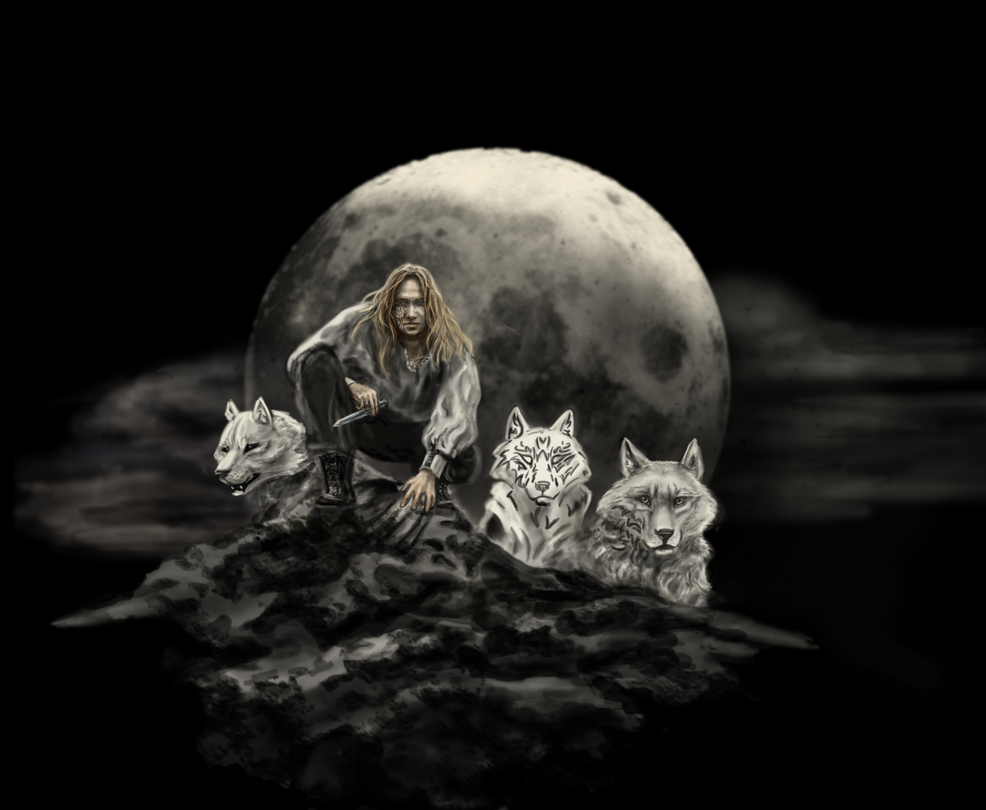
Long haired-man and the three wolves of justice bearing news 
that the moon spends more time looking at high latitudes.

Since the moon is illuminated when it is on the opposite side of the earth from the sun, and because during winter the earth is tilted in that same direction, at high latitudes the moonlight is out more. Over the course of a year this results in high latitudes facing a larger proportion of illuminated moon than lower latitudes.
All made possible by the quirky moon being more closely aligned with 
the sun than the tilt of the earth (awesomely termed latitudinal libration).

To make this clearer we need to specify what we mean by the moon being out. The moon is technically "out" or in sight 50% of the time at all latitudes. But at high latitudes a larger portion of that "out" time occurs when the moon is illuminated, giving us less "wasted" new moon time. Consequently, we have less daytime moonlight than lower latitudes when the moon is out (and illuminated) at the same time as the sun. The farther from the equator you travel, the more illuminated and out time you get.

For example, on the shortest day of the year in Fairbanks, the full moon rises at 2:40 pm as the sun goes down. The frosty moon then follows the same arc across the sky that the midnight sun followed exactly six months before on the summer solstice, providing the brightness of the full moon for 21 hours until it sets the next morning at 11 when the sun rises.

Sorry if this post reads more like a word problem than a stimulating diversion, but hey, it's near midterms and this is good practice.

As a warning, I have never heard anyone talk about this phenomenon so there is a chance I am missing something in my reasoning and am wrong. Let me know if you figure that out, but until then here's to mood swings, seasonal affective disorder, and moonlight!


*While this is true at a continental level, local topography strongly affects actual length of direct sunlight. For those of you behind a mountain or hill, you might have hundreds of hours less than your allotted 4,380 hours of sunshine. And this even though the earth is relatively smoother and more spherical than a pool ball.

Monday, February 17, 2014

Susitna 100 Race Report

The Susitna 100 this weekend was a race. "Big duh!" you might say, "it says, 'Race across frozen Alaska,' right on their logo." But many wilderness competitions are more endurance than race. This one was complete with wipeouts, wagers, performance-enhancing substances, and a large helping of strategery.

For me, the planning started long before the race when I could have been working on my dissertation, enjoying the beautiful outdoors, or even watching the olympics with my wife, but instead I decided to weigh my bike.
Stripped down and still not as light as the new carbon machines. It did survive that car crash though (thanks Martin).

Not just my bike though, I weighed my sleeping bag, pad, mittens, sunglasses, and even my socks (in case I determined having toes was worth less than shaving off 175 grams of wool) in a strange obsessive flurry. Then the trail report came in.

"The trail conditions are estimated at about 80% hard packed snow, 10% icy crust over snow and 10% glare ice (most of the glare ice is avoidable)."

What had started as an innocent post on Facebook soliciting a lightweight bivy sack, quickly degenerated into a "what wheels should I use" scramble and I ended up borrowing wheels from half of Fairbanks (thanks Kevin, Josh, Cody, and Jay).

At the pre-race meeting Heather quipped, "You could put studs on your cross bike with this trail and that would be the ticket."After further deliberation with the Francoms and Kriegers, our generous Mat-Su valley hosts, I settled on my studded commuter wheel up front and Kevin's Weirwolf/Snowcat rear tire/wheel combo.
Notice those skinny tires behind the huddling family. Thanks to Becker-Design for the poagies and frame bag.

At the raceline the only two skinny-tired rigs were mine and somebody on a department-store mountain bike. Andrew from Anchorage rolled up, "Snowcats huh? That looks like the ticket. Though I would have studded the back too, but maybe you didn't have the tire for it." Ben lent me his chapstick and we lined up at the start line.
They counted down from ten and 118 racers filed down the icy driveway at Happy Trails Kennel onto 100 miles of snowmachine trails. The pack quickly strung out as we clipped along at 10-15 mph. 


After twenty minutes of winding trail and swamp mounds it was Carey, Kevin, and I enjoying the 14 degree morning air (perfect for not overheating and not freezing anything off). We rode together through the first checkpoint but as we approached Flathorn Lake things got icier. Whenever we crossed a creek or bog, my companions would back off or speed ahead to avoid my studless rear end, which was wagging and jumping between ruts and cracks like a broken robotic dinosaur. The Ice-Spiker-Pro did an amazing job keeping the front from slipping out, but the slop out back was a little disconcerting. As Kevin and Carey cut across the glare ice at Flathorn, I picked my way around the edge of the lake and lost site of them. 

With lots of pretzels, gummies, and Rachel-made moose jerky I was feeling sugared and salted up and I made up some ground on the rolling trail before the Dismal Swamp. The wind was steady on the swamp and as soon as I hit the open ground I hit the ground hard. My front tire screwed its courage to the sticking place, acting as a pivot, and I spun around 180 degrees before slamming into to the polished ice. I drug my bike to the side of the ice patch and assessed the damage. Luckily, besides a bruised knee and some spilt pretzels, I was fine. I got back on the bike and soft-pedaled until Justin and Clint caught me (no sense in riding in the wind alone). Over the next fifty miles I would crash so many times that Hansel and Grettle could have found their way home blindfolded for all the piles of gummy bears and Honey-Stinger waffle crumbs I left whenever the trail got icy (though they might have caught diabetes from it). Once we got onto the wide Susitna River the wind completely died and we pedaled for thirty miles under beautiful blue skies surrounded by the the Alaska Range and Mount Susitna. 

Pulling up to Eagle Quest lodge, a biker on a carbon 907 with HED carbon rims blew past us. 
"Who was that?" I asked Justin.
"I don't know." We pedaled hard and caught Mark, a self-described old, fat guy from Wisconsin. His seat bag was huge and loose and swung from side to side with every pedal.
After 15 miles behind the hypnotic bag and when Mark was out of earshot I quipped to Justin, "We know each other well enough that you would let me know if something was swinging from my bike like that right?"
"It's kind of freaking me out actually. Not the bag, just how well he's doing." He was hammering, and seemed totally unfazed by the 75 miles we'd done so far. I started thinking I'd be fighting for fifth, not third, with this new addition to the up-front crowd.

But then Mark didn't stop at Cow Lake. It was the last major checkpoint, just over 20 miles from the finish, and the snow had started to fall. Justin and I refueled with some sodas and some Cup-A-Noodles. The warm salty soup must have been "heaven" flavored because they filled every corner of our bodies with a celestial light and sense of wellbeing. We knew then that we would catch Mark.

I felt as fresh as the beginning of the race the next 20 miles. The same sequence of events played out four times. I would catch Justin and then wipeout when we hit the ice (once ripping my front wheel from the dropouts). He'd regain a little lead and then I'd catch him again. We caught Mark at the trail shelter 10 miles from the finish. "What are you guys on?" he asked as we passed him.

With the ice at the finish I didn't have a chance to pass Justin, but I sure enjoyed the course, the company, and the fine family that accompanied me. Nice to finish a hundred miles in Alaska and not need to use your headlamp.

Note: I just found out that Mark wrote an account of the race too that you can read here.

Wednesday, February 5, 2014

Honest difference or intentional deception?

A couple months ago my friend Daniel asked me about how scientists were responding to the following Fox News article, Arctic sea ice up 60 percent in 2013. The article points out that the minimum extent of arctic sea ice increased dramatically by more than a million square miles from 2012, reversing the trend of ice loss, and now some scientists are worried about global cooling.

Before I responded, I looked up the data the article was based on from the National Snow and Ice Data Center (NSIDC). Here is the figure from that report.

Inline image 1
As you can see, the article is technically correct. Compared to 2012 (the all-time lowest year on record), 2013 was a bumper year for ice. On the other hand, if this is how Fox News reads long-term trends, let's be glad they're not in the financial sector.

So my question is, did the authors see this figure and really think it represented a recovery, or did they intentionally misrepresent the trend? I believe that people can look at the same data and honestly arrive at very different conclusions (Taylor Swift and Mackelmore both know what the Bieber has done but they don't agree on whether he should be deported). However, that is a very different phenomenon than intentionally pitching a twisted story.

My friend Martin, the famous walrus researcher (as famous as you can get studying walrus I suppose), got a flurry of inquiries about this article, including from several high-ups in local and state government. A report that clearly confirmed the trend of decreasing sea ice, identifying 2013 as the 6th lowest on record, and noted that ice was more than a 1.5 million square miles below average, became a propaganda tool denying the reality of human-caused climate change with a wave of the magic mass media wand.

So again, my question is, who or what is perpetuating (or perpetrating) this bad journalism? Is it simply news agencies headlining to increase sales, editors catering to the world-views of their audience or sponsors, or is it a symptom of too much or too little regulation of what can be called journalism? I don't have an answer but I'd love to hear what you think. Comment fast before the globe cools down and the internet turns off.

Tuesday, January 14, 2014

The Fairy Shrimp Trilogy

Filmed, produced, and narrated by Ben Abbott at the Toolik Field Station in 2007, this documentary was forgotten as quickly as it was filmed, produced, and narrated.
Part I 
The four chapters of the trilogy represent retakes rather than sequential scenes as Abbott developed the narration and learned how to focus a camera.
Part II
Like most of Abbott's ventures, the film is simultaneously boring and unfinished. However, like other bad movies, the documentary has attracted a cult following of at least two arctic limnologists and ecologists.
Part III
At the end of the field season, Ken Fortino and Cody Johnson, two of Abbott's supervisors, discovered the series on the lab computer and entered it into the Toolik Talent show unbeknownst to Ben. It didn't win, but the public display before eminent arctic scientists revealed the fact that the subject organisms in the film were in fact amphipods (Hyalella azteca), not fairy shrimp (Branchionecta paludosa).

Part IV
While this mixup is the crustacean equivalent of mistaking a milking cow for a dachshund, (for those two organisms are more closely related than fairy shrimp to amphipods).
Once he knew what his movie was about, Abbott began a PR campaign to rebrand a species that has been maligned in popular culture for over 100 years. From the Wikipedia article on amphipods we learn of this century-old bias:

Although they are very abundant, widespread and diverse, amphipods do not feature strongly in the public imagination. Thomas Roscoe Rede Stebbing wrote in 1899:
No panegyrist of the Amphipoda has yet been able to evoke anything like popular enthusiasm in their favour. To the generality of observers they are only not repelled because the glance which falls upon them is unarrested, ignores them, is unconscious of their presence.
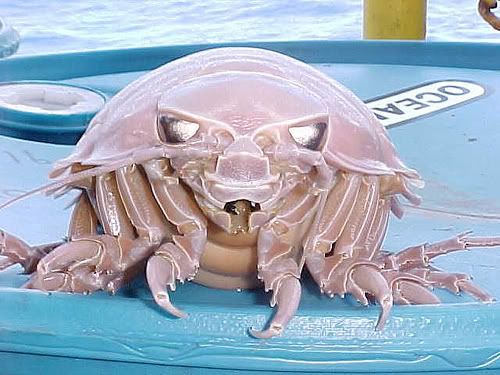
Last year a giant species of amphipod was discovered by the researcher wearing the grumpy shirt above. It was more than four miles below the surface at the bottom of the Pacific and would likely have made for a better poster child for the movement. Even the biggest amphipod, however, can't compare with the charismatic isopods. These relatives of the potato bug have been favored by humans for more than 300 million years, mostly because, as you can see in the picture below, they don't give a crap. 
As my brother Sam always says, "The less you pretend you are into them, the more they will be into you."

Monday, December 2, 2013

Xgiving

Contagion was a good movie for
Matt Damon 

This was a good week for 
me

Twenty five hours past forty
but they say that long workers exaggerate
on accident, counting time backwards from the end of the week
trying to prove their worthiness. 

And a holiday! One we all get behind
cause Christians and pagans were there from the beginning
Need and bounty twirl on the American beach
sand in the stuffing
and we eat for days what should have been our national bird. 


Monday, November 18, 2013

Gun control and alcohol

A well regulated Militia, being necessary to the security of a free State, the right of the people to keep and bear Arms, shall not be infringed.
The Second Amendment

After one year from the ratification of this article the manufacture, sale, or transportation of intoxicating liquors within, the importation thereof into, or the exportation thereof from the United States and all the territory subject to the jurisdiction thereof for beverage purposes is hereby prohibited.

The Eighteenth Amendment

The eighteenth article of amendment to the Constitution of the United States is hereby repealed.

The Twenty-first Amendment

It's been a long time since I posted and November is a good month for controversy, so I thought I'd write about the regulation of guns and alcohol. 

Maybe three years ago, driving home from my dad's house on Christmas Eve, I had a discussion with my brother Tom and his wife Kelsey comparing gun ownership and alcohol use. We never reached a conclusion but it has been on my mind ever since. 

Certain issues seem to preclude rational discussion. I'm not sure what makes an issue untouchable. It doesn't seem to be how personal it is or if the outcome of the discussion has any bearing on your life. I can talk about God, gay marriage, evolution, and President Obama without hesitation across idealogical lines, but something warns me to wait until I know my audience before bringing up climate change, Hillary Clinton, or defunding the military.

Nevertheless, as we drove through slushy Spanish Fork that night, we started talking about the second most inflammatory subject of them all (the first being abortion). As happens in such discussions, we quickly stopped listening to each other and instead focused on feeling outraged and flummoxed by how another thinking being could hold a different opinion on such an obvious issue.

After my turn to talk was over and while pretending to listen, the following thought occurred to me: Why is gun ownership and regulation in its own category in my head? Is it any different from other risky behaviors like alcohol consumption, automobile use, or back-country skiing? The agitated fog that usually surrounds talk of guns started to lift and I saw the issue in a new light. There are risks inherent in gun ownership, as there are with many other behaviors, and regulation should be proportional to that risk.

Seeing a potential path towards mutual understanding, I asked Kelsey what she thought about alcohol consumption (a pastime she enjoys responsibly). She pointed out several benefits associated with alcohol, including social interactions, artisan craftsmanship, and cultural tradition, and implied that the negative impacts are due to irresponsible use, not the substance itself. She insisted that drinking was inherently different than gun ownership, which was intrinsically violent and dangerous. They dropped me off at my mom's house and I slept in the room I grew up in with my wife and two children waiting for Christmas morning.

All of us engage in risky behaviors. However, we tend to overestimate cost and underestimate value when judging other people's risky choices. Smokers and skateboarders are engaging in reckless behavior with high risk and very little benefit (says I the non-smoker and reformed long boarder). Conversely, we see the benefits of our choices more readily than the costs. For example, the dangers inherent to mountain biking and mountaineering are far outweighed by those activities' health, spiritual, and environmental benefits. This gets complicated when you get a big group of people together with different risk tolerances and double standards in perception.

The Abbott family engaging in what is certainly considered by many to be unacceptably risky behavior.

The kids love the wind in their hair though, and you just can't get that with a helmet (unless you are talking about this helmet).

I am not suggesting that there is no collective way to evaluate and mitigate risk. This is one of the major roles of government in any society. The point of most laws is to define the appropriate balance between personal liberty and communal safety when the two are at odds. Statistics, stories, and ideological affiliation all inform our individual and communal assessments, though these factors don't all carry equal weight. What we believe we should believe (based on family and friends) shapes what statistics and stories we seek out and what we accept or reject.

So what about booze and what about guns? How risky are they? I've assembled a variety of gun and alcohol statistics (with a few bike an car stats thrown in for context) based on ostensibly neutral, conservative, and liberal sources. Here is the executive summary (see the spreadsheet in the link above for citations):

Alcohol

  • 221 million Americans (67%) drink alcohol an average of four drinks per week 
  • The American alcohol industry is worth $400 billion 
  • $59.4 billion in annual revenue
  • Money spent by industry lobbying federal politicians in 2013: $15.8 million
  • Alcohol causes 80 - 85 thousand deaths annually in the U.S. 
    • 10,000 from impaired driving
    • 16,000 from liver damage
    • 20,000 from alcohol-related cancers
    • 34,000 from alcohol poisoning, alcohol-related violence, accidents, and other causes
  • Estimated societal cost of death and injury: $223.5 billion ($677 for each U.S. citizen)
  • Death and injury cost percentage of annual revenue: 376% ($223.5/$59.4)
  • 3.6 deaths annually per 100,000 users
  • 3.2% of all deaths in U.S.
Guns
  • 155 million Americans (47%) live in a home with a gun and 108 (33%) own a gun personally
  • The American gun industry is worth $32 billion
  • $6 billion in annual revenue
  • Money spent by industry lobbying federal politicians in 2013: $12.1 million
  • Guns cause 29 - 31 thousand deaths annually in the U.S.
    • 10,000 from homicide (75% of homicides involved handguns)
    • 19,000 from suicide
  • Estimated societal cost of death and injury: $153.3 billion ($465 for each U.S. citizen)
  • Death and injury cost percentage of annual revenue: 2,555% ($153.3/$6)
  • 2.3 deaths annually per 100,000 users
  • 1.2% of all deaths in U.S.

Bikes

  • 99 million Americans (30%) own a bicycle
  • $7.3 billion in annual sales
  • Bikes result in 600-700 deaths annually in the U.S.
  • Estimated societal cost of death and injury: $4 billion ($12 for each U.S. citizen)
  • Death and injury cost percentage of annual revenue: 56% ($4/$7.3)
  • 0.66 deaths annually per 100,000 users
  • 0.03% of all deaths in U.S.

So, alcohol kills more people (in absolute terms and as percent of all users) and costs the U.S. almost four times its annual revenue in deaths and injuries (if you care about that). Guns kill slightly fewer people (as a percent of all users) but the monetary cost of deaths and injury is over twenty-five times what the industry generates (again, if you care about that). All in all, I was surprised at how similarly dangerous these two Constitutionally-protected activities are.

Two things stood out while compiling these numbers. First there are lots of conflicting and contradictory  estimates on some subjects. For example, estimates of the number of instances guns are used in self defense annually vary from 60,000 to 3.5 million (two orders of magnitude!). The actual number (which still is uncertain) is likely close to 100,000. Second, lobbying by the gun industry more than doubled this year. It has been relatively stable, staying between $4 and $6 million over the past 15 years. This year when it reached more than $12 million. What is going on?

So, what is the point of this post? Am I defending guns, attacking alcohol, or just saying that you are way safer on a bike than you are drinking or owning a gun (way way safer than if you are drinking and owning a gun)? My goals are three-fold. First, point out that gun ownership is a risky behavior, just like many others, and we don't have to not be friends if we don't agree where the line should be drawn between safety and liberty. Second, we should acknowledge the risks that accompany our choices. We tend to downplay the costs of what we want to do and focus on perceived benefits. Third, a lot of our arguments for or against guns and alcohol are kinda non-sensical (dumb). If you are in favor of guns or alcohol, acknowledge that you consider the benefits to outweigh the costs, but don't imply that your behavior doesn't have any costs. I will leave you with a list of good and bad arguments for and against guns and booze (I'm categorizing arguments by logical merit, not by if I agree with them), and a brief statement of my position.

Good argument: There are legitimate uses of guns that can be a positive part of an individual's family's recreation and culture.

Good argument: Responsible consumption of alcohol can be a positive component of an individual or family's recreation and culture.

Bad argument: Chicago and New York have some of the nation's strictest gun laws and they have some of the highest rates of gun violence. Reason: Without a timeline you can't establish causation here. The gun laws are likely a response to a gun violence problem, not the other way around.

Bad argument: More gun control will automatically result in lower gun violence. Reason: Violence in general is complex and there are a lot of guns in the system. Effects of any legislation will have large lags (potentially decades).

Bad argument: Periods with high gun control aren't safer than periods with low gun control. Reason: See answer to previous bad argument.

Bad argument: Guns don't kill people, people kill people. Reason: There is strong evidence linking access to guns with suicide risk and over 230,000 guns are reported stolen each year. As Eddie Izzard says, "The National Rifle Association says, 'Guns don't kill people, people do.' But I think the gun helps, you know?"

Bad argument: We tried banning alcohol once and it didn't work. Reason: During prohibition, deaths due to liver disease decreased by 2/3 (since we don't know the rate of clandestine alcohol consumption during this period, this is the most direct measure of alcohol use available).

Bad argument: An armed society is a polite society. Reason: First off, even if this cliche was coined by one of my favorite authors, Robert Heinlein (in a novel), I'd certainly rather live in an impolite society where I'm less likely to get gunned down by someone who finds my behavior impolite. The idea of increasing politeness by implied threat of killing is as anti-liberty as any tenet I've encountered.

Bad argument: Crime is sky-rocketing and it's so dangerous on the streets that we need guns for self defense. Reason: Crime rates have fallen 30-40% in most areas in the U.S. over the past two decades. It is safer now than ever before.

Bad argument: Gun ownership and number of guns in the U.S. are causing a rise in crime and violence. Reason: See answer for previous bad argument.

OK argument: Medical research suggests some health benefits from moderate alcohol consumption. Reason: There is no way alcohol saves more lives than it takes, but for individuals who are capable of responsible use there are some potential benefits.

OK argument: Guns are used approximately 100,000 times a year in self defense and certainly protect some number of lives and property each year (most of these uses are brandishing not firing of the weapon). Reason: We don't have the data to draw conclusions about whether guns save more lives than they take. Thousands of people die from gun violence yearly and some number are saved by guns.

Bad argument: People can get addicted to anything like exercise or eating. Alcohol is no different than other things. Reason: I personally know dozens of people whose lives or livelihoods have been destroyed by alcohol. I have one friend who exercises too much and a couple who are addicted to World of Warcraft.

So, what would I do with booze and guns if I were king? I would outlaw advertising for alcohol and guns. People can use them if they want, but companies shouldn't be able to push dangerous products (especially not to poor people and children). I would also forbid donations to politicians and political groups. In my opinion it's a strange system of sanctioned bribery dressed up as free speech. Training and licensing should be required for both activities. I would also require all people considering purchasing a semi-truck to watch this advertisement:

What do you think?

Monday, July 15, 2013

Biking the Denali Park Road as a family

On the 5th and 6th of July, Rachel, Ingrid, Henry, our friend Will, and I biked the Denali Park Road from Wonder Lake to the park entrance. It was 86.1 miles and a fair bit of climbing.

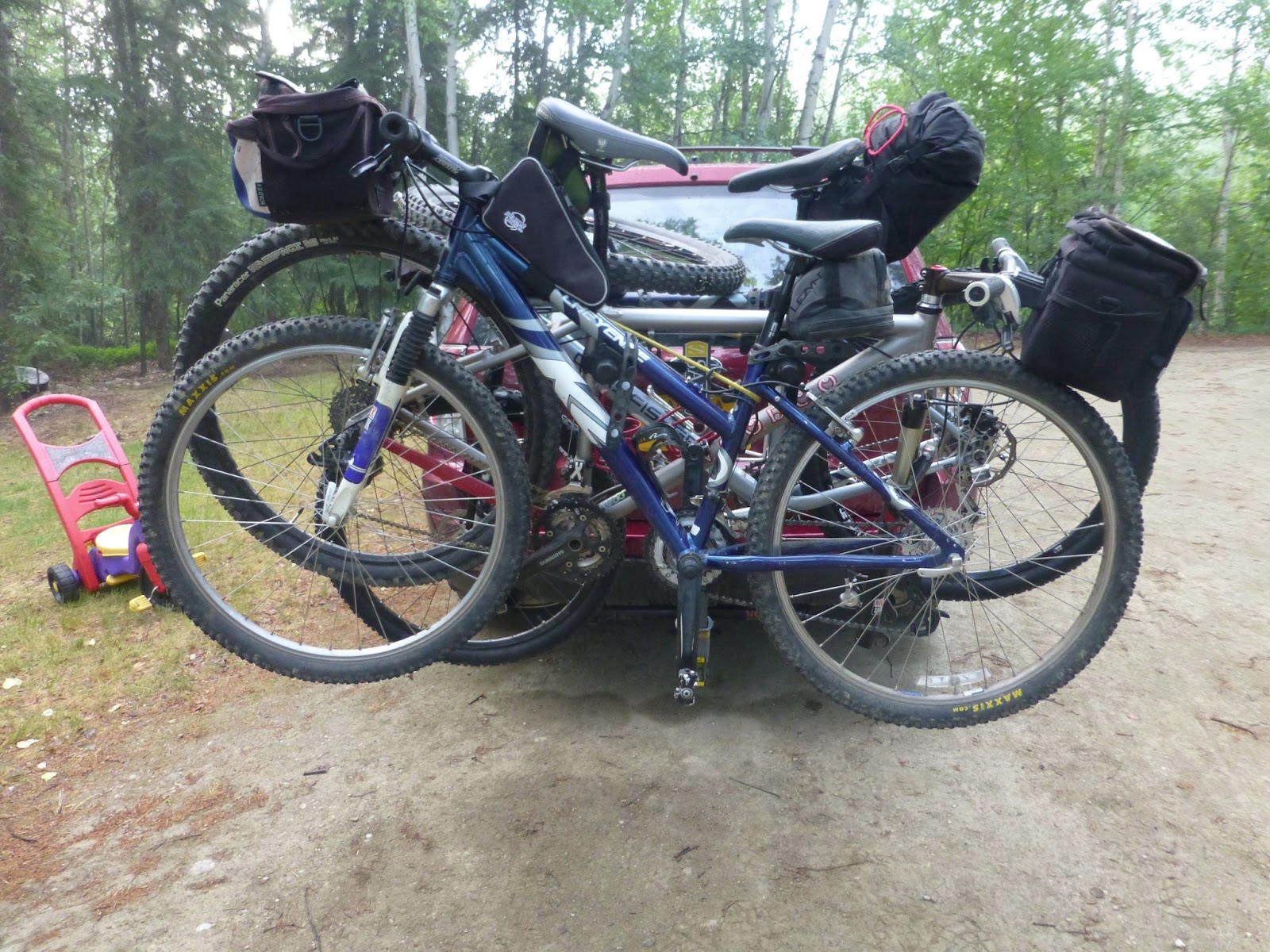
With a little wheel removal we were able to get all the bikes on the back and the trailers in the trunk.

You can't drive into the park and the buses only take two bikes each so we reserved two spots on the 11 am camper bus for the Abbotts and one spot on the 2 pm for lonely Will. Luckily kids don't count as real people so park entrance and bus tickets are free! We left the house just after 6 so we would have time to make it through the fire at Skinny's, the construction at Healy, and the backcountry orientation course at Denali.

The buses stop every 45 minutes or so to look at animals or take a rest stop, which is perfect for kid (and dad) attention spans. Here we are at Polychrome Pass.

After we took the previous photo, Ingrid said, 
"OK, now everybody get out of the picture except for me."

Pretty soon we were at Eielson, almost to Wonder Lake. The kids were so good we bought them a puppet Raven and Otter at the gift shop. Ingrid chewed off the Raven's eye in about ten minutes but Folkmanis sent us a replacement and a bonus robin.

Car seats are officially required on the bus and we weren't sure how we were going to get them back to the park entrance. Once on the road we talked with our bus driver Chuck and he offered to take them back for us! He dropped them off right at our car so they were waiting for us when we pedaled up. Serious props for Chuck!

At Wonder Lake, waiting for Will and wondering how the kids were going to do.

The mosquitoes were pretty thick in the woods but there was a breeze by the lake. Rachel and I had a "you brought the bug spray right?" discussion while we were packing up but luckily we found a bottle of hippie eucalyptus stuff that got us through. Wonder Lake was the only place with thick bugs! 

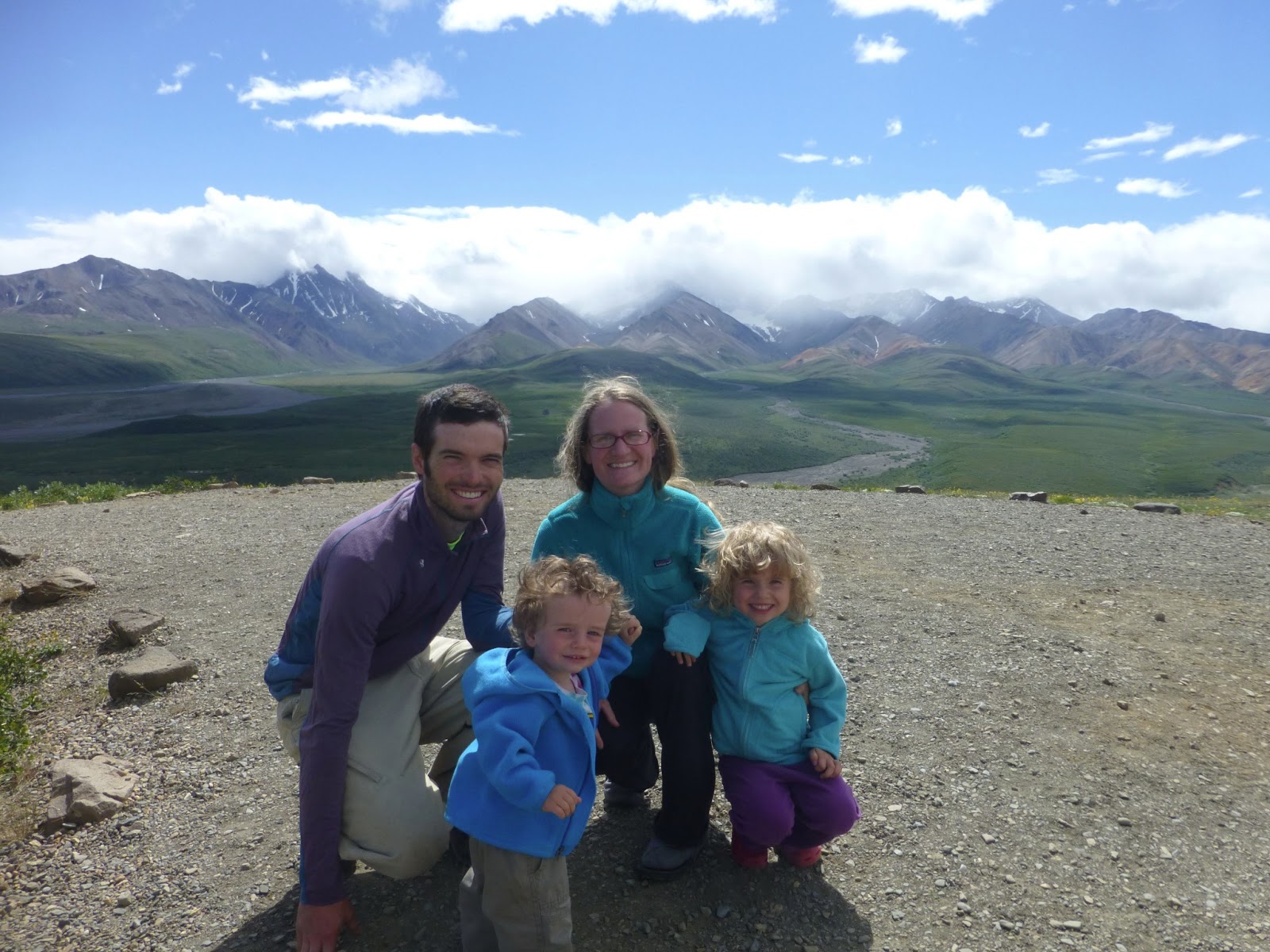
Once Will arrived around 7 we loaded the gear into the cargo trailer, the kids into the Chariot, and got on the road. Denali came out and said hi. Here is the family and Will in front of The Great One.

Henry didn't like it when Ingrid would lean on him but Ingrid let him rest his weary head on her shoulder.

Some bikers at Wonder Lake warned us about a juvenile grizzly that had charged them about ten miles out. Will spotted him around mile 7 loping towards the road. After taking this picture Rachel wisely suggested, 
"Isn't it about time to put away the camera and get out the bear spray"? We didn't think he'd seen us and were downwind, so we slowly backed up 100 yards or so and lined up on a little ridge with better visibility. We lost sight of the bear for five tense minutes but knew he was to the north of the road (to our left). As we talked through our bear protocol Will asked,
"So if he does attack, at what point do we abandon the bikes,"? Looking behind me at our trailer full of children I responded with a grim smile,
"For me, I think that's going to be pretty far along." Just then we heard a deep rhythmic "hrumpff hrumpff hrumpff"! off in the bushes to our left. We could see brown fur through the green brush on the roadside but weren't sure how far away he was. A little breeze parted the willows and we saw that he was thirty yards back by a small pond. He'd circled around to get downwind of us and was now sniffing the air and barking in disapproval. He eventually turned away and galloped to  the northwest. We hopped on our bikes and calmly rolled to the east watching over our shoulders for the next few miles.

Most of the backcountry units were already reserved so we camped in unit 35, just 15 miles from Wonder Lake.

To preserve the wilderness experience for bus riders you can't camp within a half mile of the road. We felt like the Von Trapp family Hauling our children across the tundra in the shadow of the mountain, but fleeing bears instead of Nazis.

Like the Von Trapp singers, Ingrid and Henry performed an impressive duet when we woke them up Saturday morning. The Alaska Range was pretty spectacular though:


The hills are alive.

We were on the road by 10 am.

Angry because of the weather by 11.

At Eielson by 12.

And bored of the Denali views by 1.

We'd planned on rain and bugs, but instead got sunburns and breezes.


At Stony Pass Henry needed to fuel up. While he nursed, a bus pulled up and a bunch of Indian tourists and old Canadians took pictures of the hardcore biker-mamma in front of Denali.

From Toklat to Polychrome the wind was mighty. It blew the cover off the Chariot, but Ingrid and Henry just laughed as the dust whipped through their little compartment.


Rachel was out front most of the time, but this old bull startled her and she shouted, "Caribou! What do I do"? Ingrid thought that sounded like a song which she sang for the next forty miles.

It was nice to have Will to haul the gear up the big hills :).

Grinding up the last bump of Polychrome.

The buses started getting thick around 2 pm (all morning was bus free) but they were all respectful and passed slowly.

Will blew by this trucker despite the perilous flames.

Rachel and Will feeling satisfied at the top of Sable Pass. The 17 miles of downhill after Sable were a nice treat after the slow mountain passes we'd gone through.

The pitstops became more frequent after Sanctuary river. 

Henry was starting to look a little bedraggled and ready to head home.

Ingrid still looked fresh and fabulous though in her travel pearls.

They sang us up the surprisingly long pass between Sanctuary and Savage. Henry is singing his "Uh-Oh" song and Ingrid is freestyling on top of that.

Henry cried for the last couple of miles before Savage River.

But was happy after a quick nurse.
The last 13 miles from Savage to the park entrance ended up being the most difficult, despite their being paved. Rachel had bruised her knee on some of the washboard and there turned out to be a considerable amount of up on what I had described as being "totally downhill."

Even though it was only 50 F, between the not pedaling and the exhaustion, Rachel was hypothermic by the time we got to the car at 11 pm. We cranked the heater though and she recovered pretty quickly.

Will magically packed the car, we loaded the kids without waking them up, and we got back to town in time for a shower before his Sunday morning departure.

Thanks to Cody for the bike, Chuck, Martin, and Britta for help with logistics, Henry and Ingrid for being super children, and Rachel and Will for being awesome biker buddies.