I don’t know about you, but I need a break. The last 18 months have felt like a nonconsensual ride on a rollercoaster designed by Guillermo del Toro. Each morning brings another set of surprises—usually something like a final exam for a class I forgot I was taking (or teaching).
One of the few respites has been more frequent outdoor adventures. This last winter was amazing, and I’ve tried to get out weekly into the hills, mountains, and lakes ever since.
Smelling the flowers with Tom and Bix.
As a slight person with a high metabolism, I burn through a lot of calories on the saddle, in the canoe, or on the trail. As a total cheapskate, it gives me heartburn to think about paying for fancy energy bars for each expedition.
Over the past few years, I’ve developed the following recipe for an energy bar that I find delicious, nutritious, and extremely cost effective. I call them 4Bs (Ben’s Banana & Bean Bars). Feel free to share, modify, and use however you please.
Prep time: 30 minutes
Cook time: 2 hours
Base ingredients (you can change the proportions around):
5 bananas
4 cups cooked beans
3 cups dry oatmeal
1/2 cup peanut butter
Seasonings (experiment with what you like):
Nutmeg
Cinnamon
Cocoa powder
Chilis/peppers
Honey
Maple syrup
Add ins (the sky is the limit! Add however many things you like):
Chocolate
Berries (dried, frozen, or fresh)
Coconut chips
Coconut oil
Nuts
Craisins
Raisins
Dates (pitted and sliced)
Chia seeds
Cooked quinoa
Instructions:
Blend the bananas, beans, and oatmeal together (immersion or normal blender). Fold in the add ins with a spoon and mix until evenly distributed.
Spread on a greased pan (olive oil or coconut oil) and cook at 325 F for 1 hour. Pull out the pan, cut the bars to the desired size with a pizza roller or knife. Then flip and cook for 1 more hour.
The base ingredients (I used precooked steel cut oats in this version, though I usually use dry rolled oats)
The add ins I used with the last batch
Everything altogether and ready to be combined
My favorite secret ingredient: chili tapines, hand picked by my grandpa
We got the following email from Lake Restoration Solutions yesterday.
Honorable Judge Scott,
Please see attached Notice of Dissolution regarding Lake Restoration Solutions, LLC - Case No. 220900164.
Lake Restoration Solutions no longer has legal representation for this case. If you have any questions, I’m happy to help as best I can.
All the best,
What started with a poorly stapled lawsuit ended with a poorly named Word document: “Notice of Dissolution .docx”. The informal letter informed the court that LRS dissolved their LLC on June 12th. The dissolution was conveniently timed to get out of the attorney fees they were ordered to pay months ago and avoid sitting for depositions, which were scheduled for the next few weeks.
Jared Tamez took this photo of the lake from Khyv Peak just as the news broke about LRS' dissolution
From the beginning of the saga in 2017, we knew that LRS was headed for meltdown. Their out-of-state LLC status was an obvious tell. Indeed, one of the reasons they sued me was that we pointed out the many unacceptable economic and environmental risks they were trying to impose on the public. We are lucky they fell apart before breaking ground on their lake terraforming experiment.
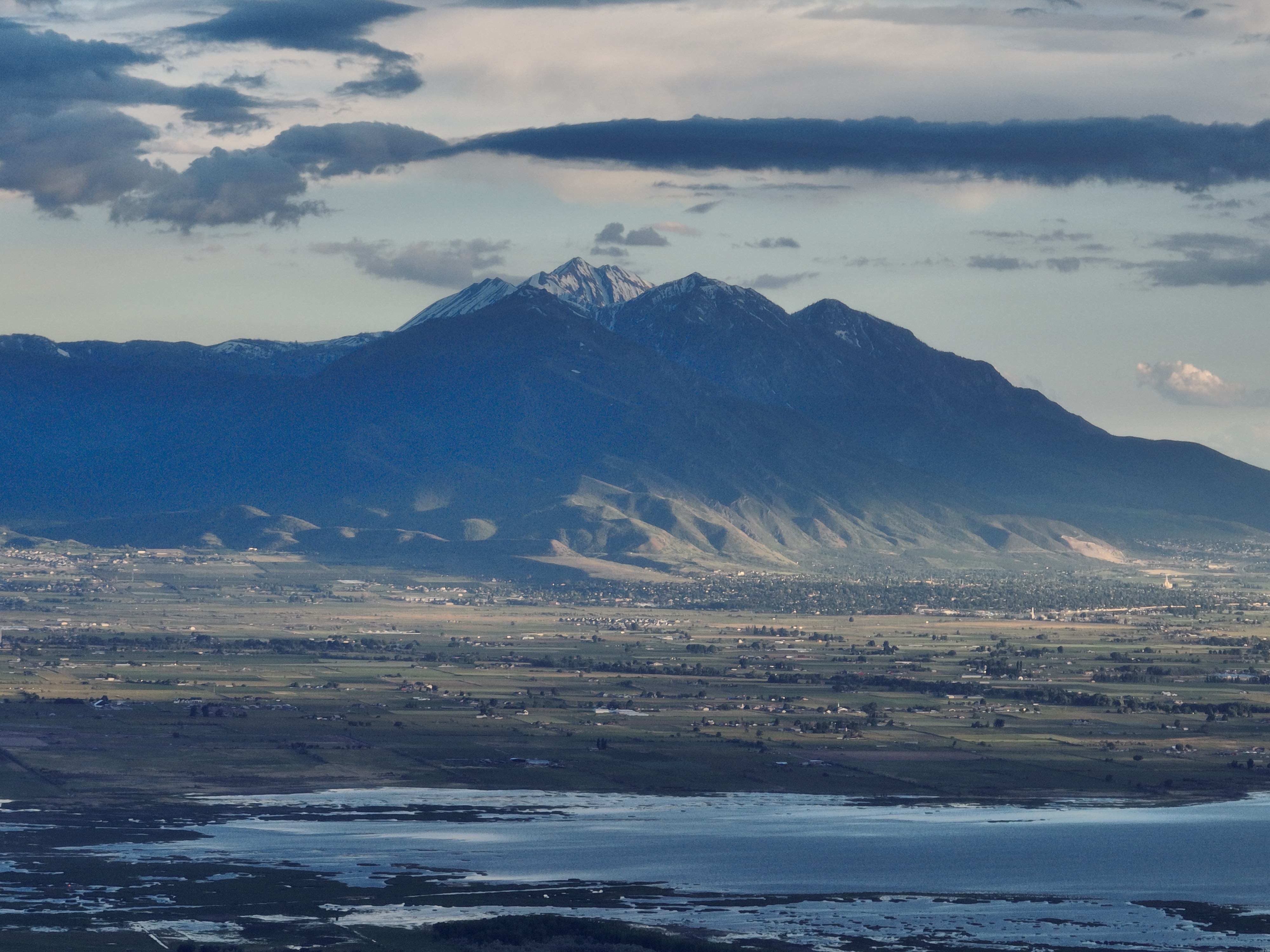
You can't see the lake from my house directly, but a quick drone flight reveals this view of Provo Bay and Mount Nebo.
While LRS’ failure doesn’t leave us with half-built islands, it sure does raise a lot of questions. Here are a few that I am wrestling with as the news sinks in:
How did such an unserious proposal get so far and garner so much support?
Why didn’t state leaders seek independent opinions from qualified agencies and external experts?
How were our budgeting and permitting processes so vulnerable to improper influence and pressure within and outside of government?
What other important natural resource decisions are similarly compromised (e.g., permits for mining, development, and oil and gas extraction)?
Why didn’t independent scientists (me included) get involved earlier?
Once the science and management communities had spoken, why did it take so long before any political leaders were willing to criticize the project?
How can we strengthen internal checks and balances in the legislature and governor's office?
What kinds of retaliation were carried out against those with questions or criticisms? Who carried out that punishment, and how can we prevent it in the future?
Will there be any accountability for LRS and its agents for their illegal lawsuit, damage to public trust, and abuse of government?
Why do public funds continue to be allocated to this kind of project generally and this team specifically?
Will the failure decrease their influence or enhance their reputation as they present themselves as victims?
How can we decrease conflicts of interest and establish a more rigorous and independent process for vetting proposals?
What firewalls do we need to strengthen to ensure protections for state regulators and managers?
Will we see any admission or reflection from those who supported the project or punished critics?
How can we empower state employees and all community members to express their opinions about proposals in their areas of expertise?
How can we strengthen our decision-making process to decrease risk of similar boondoggles?
What do citizens need to do and what laws need to be changed to rebalance influence of the public and lobbyists?
How can we repair the damage to free speech and trust?
How can we learn the most from this?
I grew up in Orem, but it wasn't until we moved back for my job at BYU that I got involved in policy. As a state, we are facing multiple major decisions simultaneously. From the Great Salt Lake rescue to the renewable energy transition, we need to have the political and administrative maturity to ask hard questions, clearly evaluate performance, and change direction when needed.
I love the idea of the Utah Way, and I think our state is capable of setting an example of collaborative and civil problem solving. However, if we're not vigilant, the Utah Way can devolve into the "don't rock the boat way" and eventually the "don't ask any questions way". We can't let the cohesiveness of our community compromise our commitment to process and separation of powers.
We currently are stuck in a pattern of overconfidence, conflicted interests, and blaming. From the Inland Port Authority to the prison relocation, we seem to be plagued by insular thinking, insider deals, and inadequate accountability.
Let’s change that.
How the lake might feel today.
News coverage of the development:
Deseret News: Utah Lake island project sinks after company behind proposal dissolves
Daily Herald: Proposal to build islands in Utah Lake seemingly over as company dissolves
Fox 13: Utah Lake islands project likely dead after company dissolves
Tribune: Plan to dredge Utah Lake islands appears dead as developer dissolves business
The Utah Lake Restoration Act kicked off the islands project, and the Utah Inland Port Authority Act created a quasi-governmental agency to carve off city land and funnel taxpayer dollars for warehouse development.
Thankfully, the islands project is mostly dead, and local opposition has slowed the Inland Port in Salt Lake. The new director of the Inland Port Authority himself said, "There was some super sketchy crap going on at the inland port", earlier this year.
However, the Inland Port Authority is now trying another tactic. They are developing a constellation of nine satellite ports across the state. The most recent addition is right here in Utah County, and it cuts into the wetlands of the state's most beautiful water body, Utah Lake.
As someone who lives in a house and depends on local business, I am not anti development. However, with our county growing so rapidly, we need to be really deliberate about how we grow. I love the idea of streamlining shipping and planning non-road transportation options. However, I am not convinced that this approach moves us in that direction. Indeed, I have yet to hear a cogent business or environmental case for this concept.
One business leader explained that all the inland port does is increase their profit margins by creating a tax haven. It creates an incentive to abandon their already existing warehouses and relocate to avoid taxes. While this lets the Port Authority claim "new" jobs and development, it is really just cannibalizing economic activity in the most inefficient, subsidized way. Looking at the conflicts and compromises the Inland Port Authority has created in Salt Lake and Tooele, I am highly skeptical we want a repeat in Utah County.
Here is an info sheet on the project, and here are two important events today where you can learn about what is going on and voice your opinion:
We learned from the islands battle how important it is for everyday citizens to be informed and involved in these development decisions. Thank you for taking the time to read up and speak up. If you are willing to strike up a conversation, you can find your legislators' contact information here.
Over the past few weeks, I have drawn the ire of two national figures over my Great Salt Lake research and outreach.
First, Wesley Smith of the Center on Human Exceptionalism wrote a piece in National Review criticizing Terry Tempest Williams' essay in the New York Times. Smith called the idea of granting rights to Great Salt Lake radical and subversive. According to him, acknowledging the rights of any ecosystem would cause the end of human flourishing, though it would also be unenforceable.
In a less thoughtful but higher profile kerfuffle, Ben Shapiro mocked me in his podcast for our January report on the decline of Great Salt Lake. Responding to a headline in the Washington Post, Shapiro claimed that I and other environmentalists are alarmist and never admit we're wrong. In a rhetorical two-step, Shapiro seems to simultaneously take me to task for being a godless liberal while also criticizing my recognition of God's hand in the short-term rebound of Great Salt Lake.
Before discussing either critique, we should all take a deep breath and laugh that I'm the national discussion at all. As a baby professor who is not good at much besides bicycling long distances, I hope that this unexpected attention is as short lived as it is unlikely.
However, it does provide an opportunity to discuss a question I take very seriously: how are we supposed to relate to nature? This question has been important from the beginning oft Homo sapiens some 300,000 years ago, but it has become absolutely crucial over the last 70 years as humans have become the predominant force controlling many of the Earth's great cycles.
Shapiro's criticism is shallower than Great Salt Lake right now, so I won't take too much time on that, but Smith's ideas are interesting. His center puts humans at the center of the Earth system. I agree with him on that point, but there are several reasons why I think acknowledging the rights of ecosystems are profoundly pro-human and fundamentally conservative.
In my ecology classes, I teach two basic and important terms:
Population: the number and fitness of individuals of a single species in a given area.
Community: the number and interactions of all living things in a given area
I then show my students a picture like the following and ask them, "Does this picture show a population or a community?"
Most say that this shows a population. After all, they are all African elephants, right? Look a little closer.
Is this a group of elephants floating on its own, in the void? Look at the vegetation, the soil, the egret, the atmosphere. Imagine the microbiome on and in the elephants. When we overcome our bias towards moving organisms that could harm us or be a food source, we start to realize that there are trillions of organisms of thousands of distinct species that are interacting in this photo alone.
Even if my value system prioritized the wellbeing of elephants above all else, I need to take an ecosystem approach to protect those elephants.
Like Smith, I believe that humans have a special role and responsibility in the Earth system. Unlike Smith, I view it as fundamentally anti-human to deny the rights of our home. We will be tempted over and over to exchange long-term ecological integrity with short-term economic or political gain. It is one of the main narratives of the past century. Our continued flourishing depends on changing that narrative.
Dr. Robin Wall Kimmerer describes the Law of the Honorable Harvest in the lecture below. This Indigenous code could inform the practical and profound dimensions of our relationship with our home.
One of the central tenets of the Law of the Honorable Harvest is to ask permission of the ones whose lives you seek and to abide by the answer. Think how respectful and serious this acknowledgement of rights is.
In my faith tradition in the Church of Jesus Christ of Latter-day Saints, we have a similar commandment in Doctrine and Covenants 59:
Yea, all things which come of the earth, in the season thereof, are made for the benefit and the use of man, both to please the eye and to gladden the heart…to be used, with judgment, not to excess, neither by extortion.
Whenever we forget to acknowledge the spiritual existence and agency of all parts of the Earth system, we are likely to slip into casual consumption and self-destructive exploitation. From my scientific training and religious beliefs, we must take a community approach that does not exclusively consider individual humans. To stand a chance at making it through the next hundred or even fifty years, we need to radically change our approach. We must expand our legal and moral frameworks to expressly include the Earth and all our community.
If we view economic growth or political success as competing with the environment, then we reveal our lack of understanding and foresight. A house that is eating itself cannot stand for long. You can call it radical and subversive, but I think it is profoundly conservative and sane.
It was a few weeks ago, but things have been so frantic that it feels like yesterday. I went to get donuts for my lab. I love the Provo Bakery, and their day olds are about the best deal in the county. The weather and the traffic signs conspired to teach me a lesson. I've forgotten how to stop.
From covid to Utah Lake to Great Salt Lake and back again. Things have been too much and too fast. I feel that it is so important to say yes when opportunities come up to advocate for our community and ecosystems. But it has been hotter and heavier than I can sustain.
My friend Greg has been a real savior for me this winter. We have been trying to get out and ski at least once a week. Earlier this month, we tried Greg's crazy idea to ski all four faces of Baldy in a day. Fueled by my mom's nut mix and mandarin oranges, we created a giant infinity sign as we looped down and up each face.
The descents were thrilling and extremely varied, but the long slogs back to the top felt the most important to me. They forced me to slow down. I wasn't feeling well, and I was climbing slow. I had to take the time to breathe, listen, and see.
Every climb was different. The same precarious and permanent mountain. Such diversity in the light, forest, and snow.
Unlike the snow-blasted stop sign, the mountain's lessons were more subtle. Like most important lessons, it wasn't clear what the mountain was trying to teach me. What parts of the parable applied to me, and what parts to my mountain of unfinished tasks?
I resolve to do less and to do it slower. There are so many people here to help. With better planning and coordination, we can protect what needs protecting without a wake of avalanches and debris flows.
I'm grateful for your patience and friendship. Thank you for your forgiveness and vision.
This morning, I joined with religious leaders from across Utah to demonstrate solidarity and support our political leaders in taking dramatic action to save Great Salt Lake.
The interfaith crew gathers before the press conference. Photo by Marc Coles-Ritchie of the Mormon Environmental Stewardship Alliance (MESA).
I've participated in a fair number of rallies and press conferences, but this felt different. Like usual for February, The Capitol was abuzz with legislative activities and booths in the rotunda. It was boomy and hard to hear, but the messages moved my body and soul. We weren't complaining about the failure of the legislature to take next steps. We weren't railing against the shortsightedness that afflicts us all. We were coming together in communion and love. Here are the notes I used when addressing the crowd.
Rios Pachecho of the Northwestern Band of the Shoshone Nation kicks off the interfaith press conference. Photo by Alexis Perno, Great Salt Lake Collaborative.
The group called Sportsmen for Fish & Wildlife is seeking $500,000 from the Utah legislature. Along with its sister organizations Big Game Forever and Stag Consulting, this group has received more than $12 million from the state to politicize wildlife management while fighting in court to keep Utahns from knowing how they spent the funds. The group was the subject of a legislative audit for inappropriately commingling money from public and private sources, and there is a direct connection with the Utah Lake islands project (details below). They have been called out by multiple groups ranging from the National Rifle Association to Utah's Legislative Auditor General.
Starting tomorrow with the appropriations process, our legislators will decide whether to use more of our money to support this group. There are 20 legislators on the Executive Appropriations Committee. You can find their emails listed on pages 15 and 16 of the Great Salt Lake Audubon Society's legislative update. Please take a few minutes to email or text these legislators to refuse the "Hunter Nation" funding request. Many budget items only get a brief mention, and your message could make sure that our taxes are used for their best and highest purpose. The legislative update also recommends several good uses of funds, including water conservation for Great Salt Lake.
It doesn't come natural to many of us, but having the courage to send a short and polite message can make a big difference. Thank you for your concern and action at this important time.
Here is some background on these guys that I put together for my blog post last year: