Letting some of it trickle out while trying to soak it all in

Tuesday, February 8, 2022

Contrasts in the great Utah Lake debate

 This Utah Lake saga has been a dizzying lesson in contrasts.


Restoration vs. reengineering

Data vs. marketing

Volunteers vs. lobbyists

Reality vs. renders

Conservation vs. consumption

Independent coverage vs. paid advertising

Conversation vs. lawsuits

Legacy vs. land grab

Gratitude vs. greed


It was especially clear last night in Salt Lake. 


Pictures by Decker Westenberg of the Daily Universe

Nearly 600 citizens from every walk of life gathered at the capitol to celebrate the lake that sustains us and demand accountability and protection. Mary explained the Indigenous worldview, reminding us to look seven generations back and seven generations forward. Gabe powered the event with bicycles, and Byron led us in song. Children shared their hope for a natural and intact lake ecosystem. Leaders linked arms with the crowd, seeming to understand that we must work together with respect and commitment. Creation is sacred and so much more than what we could sell it for.


At almost the same time, in the Grand America Hotel, the developers wined and dined influential invitees at their closed-door event. Their paid experts explained how no one cared about the lake or knew how to care for it before they arrived. They graciously offered to do the great service of filling in our largest freshwater lake at no cost to taxpayers. The lake is broken they said: too wild, too windy, too wet. Our creator must have made a mistake when making the lake.


The contrast was clear again today in the committee hearing for H.B. 240. 

Representative Keven Stratton proposed modest amendments to the Utah Lake Restoration Act—a law custom built for the island project. Stratton asked for clarifications about how to make the process more transparent, fair, and constitutional. Representative Casey Snider spoke clearly: a company that can’t stand up to scrutiny—that chooses to silence critics with lawsuits rather than answer their questions—isn’t a company we should do business with. During the public comment period, dozens of independent citizens spoke in favor of increasing oversight and exercising prudence and science-based management during these crucial early stages of the lake’s convalescence. The lake is a living thing worthy of our respect and reciprocity. Tara called for all our leaders to learn about the lake’s ecology. Kaye described how she used to waterski across the entire lake—changing course when needed to avoid obstacles. Peggy asked who would be responsible for maintenance and pointed out that the “land” couldn’t be sold without clear title.

One person spoke against the amendments: Jeff Hartley, one of the developers’ many professional lobbyists. He said that one minute wasn’t long enough to describe how misguided and unfair these amendments were. Despite the common-sense nature of the bill, 6 of the 13 representatives sided with Hartley. They said it would be unfair to move the goalposts during the game. The developers have held more than 100 closed-doors meetings, and it wouldn’t be right to clarify the conditions they agreed to at this point. Who else would want to “invest” in the lake if they weren’t sure they could get their money out of it?

I know a few. 4 Abbott kids, more than 50 cousins, 117 experts, 563 citizens at the capitol, 6,000 petition signers, and soon all 14 generations of Natives and newcomers in this valley.

The vote count was 6 for and 6 against when it came to Keven.

“Does the bill sponsor vote for these amendments?”

“Damn right I do.”

Tuesday, February 1, 2022

Utah Lake: our sacred trust

This morning, we held a press conference at Utah Lake on the LRS lawsuit. The live stream recording is accessible on Conserve Utah Valley’s Facebook page here. Several of my students, both my parents, and friends and acquaintances gathered in support. James Flaming Eagle Mooney and his entourage pronounced a blessing on all in attendance. My fabulous lawyers, Whit Krogue from RQN and Adam Alba from MCG then gave a primer on free speech and the contents of our answer to the lawsuit.

Adam and Whit set the stage.

Isabella Errigo read a message from Chief Executive Mary Meyer from the Timpanogos Nation, who was unfortunately quarantined with sick family. Andrew South then spoke about the engineering and economics of mega projects like this, followed by Elisabeth Currit reading a message from George Handley on our responsibility and expectations. Carol-Lyn Jardine then spoke about the efforts of Conserve Utah Valley and the broader Utah Lake Conservation Coalition, including the rally this upcoming Monday (don’t miss it!). I usually don’t like to read from a script, but this time, I felt I should write down exactly what I wanted to say. Here is what I read (photos courtesy of Jared Tamez and Jeff Beck):

I am so grateful for these community leaders who have given their time today to share their wisdom, experiences, and opinions about Utah Lake. I am also grateful to all those reporting on these issues and all those following along at home or at work. The biggest thing I’ve learned from this experience is that the vast majority of our community and leaders are well intentioned and want a bright future for Utah Valley and the lake at its center.


Whit on the fundamental importance of free speech.

A vibrant, free society depends on the open exchange of ideas, transparency in government, reliable information, and freedom of speech. Public disagreements and hard questions are needed at every step of big decisions about our community. I’m hard pressed to think of a bigger decision than the future of Utah Lake. Depending on how you think of it, this is a 150 square mile decision or a 30,000-year decision looking back to the Pleistocene origins of this unique water body.

Isabella reading Mary’s words about the sacredness of the lake.

The importance of free and open debate in making decisions makes this lawsuit really troubling. I have family, friends, and a professional network that have supported me and my family through this trauma, but I can’t shake this one question. What if this lawsuit had targeted someone else? What if the developers picked a college student, a single parent, or a working-class family speaking out about issues in their neighborhood? Do we want to live in a society where only those who can afford to retain permanent legal counsel can fully participate in public debate? Will we tolerate legal actions that dodge the hard questions and instead seek to silence citizens who are trying to understand and speak out about what is going on?

Elisabeth reading George’s words about leadership and stewardship.

The way we respond to this crisis will influence how our valley grows and what our society grows into. You may not agree with my conclusions about Utah Lake and this project, but I hope and sincerely believe that we are unified in our commitment to free speech and accountability. Our society is stronger when everyone can confidently share their views and raise concerns. Along those lines, I invite our political leaders to strengthen our state’s anti-SLAPP statute so that all Utahns can confidently participate in discussions about our state’s values and future.


Andrew talking about the societal and economic risk of mega projects. 

Now let’s get back to the lake. Utah Lake is big geographically, but it’s ecological and cultural importance aren’t just a matter of size. This desert lake is an island of water in the vast sea of land that is the Great Basin. Consequently, it is a keystone ecosystem in western North America—supporting tens of millions of birds, fish, and other species. The lake is generous and resilient. As Chief Executive Meyer of the Timpanogos Nation has taught us, this lake has sustained multiple civilizations around its dynamic shoreline for more than 20,000 years. When my ancestors arrived less than 200 years ago, the bounty of the lake’s fishery saved them when their crops failed. Many of us literally would not be here if it weren’t for Utah Lake.

Carol-Lyn showing the packet that was delivered to every representative and senator today.

Since the arrival of the Pioneers, we have a mixed record with our stewardship of the lake. We introduced exotic fish to replace the native ones we overharvested. We changed the lake’s hydrology to meet our immediate needs, not anticipating the feedbacks and impacts that would have on the whole valley. Our excessive water diversions resulted in the lake drying up during the Dustbowl, extincting one of the lake’s endemic fish, the Utah Lake sculpin. These errors have one thing in common: instead of carefully observing and learning from the lake, we assumed we could remake it in our own image. This is a story that has repeated itself thousands of times around the world. Wendell Berry calls this “arrogant ignorance.”

Me describing what a sailboat looks like and how it works.

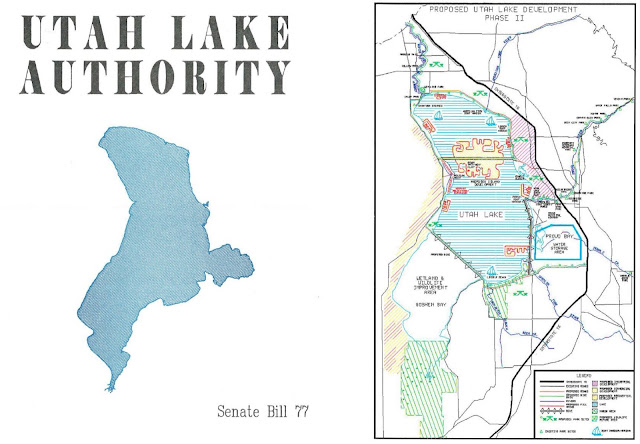
Lessons learned from that failure in the 1930s helped us establish careful water management that led to the lake refilling. We rejected proposals to fundamentally change the lake in the 1970s and 80s. When the federal government tried to drill for oil under Utah Lake during the oil crisis, our community and state said no. The lake was too important to risk when other resources were available throughout the state and country. Then in 1989, when a senator proposed to create a Utah Lake Authority that would dike off Goshen Bay, crisscross the lake with highways, and build artificial islands—all in the name of comprehensive restoration and improvement of the lake—our leaders said no.


This isn’t the first time islands and dikes have been pointed at Utah Lake. This bill from 1989 wanted to “fix” the lake by destroying it similar to the current proposals under consideration.

For the past 40 years, we have taken a different path. We chose to invest in healing and ecological restoration. Rather than trying to transform the lake into something new, we decided to study and learn from the lake and begin undoing some of the mistakes we had made. Utah Lake had a huge advantage over other waterbodies such as the Great Salt Lake, which had suffered permanent modifications. Though not healthy at that time, Utah Lake was at least whole and intact. Starting with investments in wastewater treatment, we began to reduce the flows of excess nutrients and other pollutants to the lake. The listing of the June sucker as endangered accelerated these efforts, bringing diverse community partners to the table to discuss how we could restore the lake while still meeting our needs. We began removing the introduced species and testing methods for reestablishing native plants and fish. Collaborative agreements between farmers, cities, and other water users began restoring river flow to the lake—its lifeblood.

Hashtag for real don’t pave the lake.

These efforts are now bearing fruit as algal blooms decline, native species recover, and people across our valley rediscover the beauty, power, and wonder of this unique ecosystem. Right at this delicate and crucial moment of healing and recovery, we need to have an extra measure of caution and commitment. Utah Lake’s recovery depends on sustained support, rigorous research, and robust public participation.

An osprey returns to its nest on the lake.

The island developers seem to think we don’t have the right to say no. They tell us they want input, but apparently only about the size, number, and shape of the islands. They tell us that the law has already been passed, or that we should wait until some point in the future to speak out, potentially when their project is so far along that it can’t be stopped. I don’t accept that argument. I reserve the right to say no. Our community has the right to debate and decide whether or not this is the right direction for us and the lake that sustains us.

James Flaming Eagle Mooney and entourage performed a smudge ceremony.

So, I want us all to take a deep breath and ask ourselves, how did we get here? What are we considering and why? What are the policies and programs that have brought us to the brink of such a bad decision? Take a look at the signs around us. They say, “Don’t pave Utah Lake.” Are we seriously considering throwing away decades of restoration? Are we seriously considering destroying one of our state’s natural wonders for short-term profit? If we allow this project to move forward, are we going to need signs next that say, “Don’t bulldoze Mount Timpanogos”? “Don’t sell Bridal Veil Falls?” How many times do we need to learn this lesson? I believe we are better than this.


Bremen and Logan hold back the wind (and hopefully the islands).

Like medicine, the first rule of ecological restoration is to “do no harm.” What we need right now isn’t islands, or a bigger shovel as proposed by the new Utah Lake Authority. We need cool heads and leaders with vision and moral courage who can help our valley fulfill our sacred stewardship of this lake.

The lake.

Thursday, January 20, 2022

Lawsuits for Utah Lake

Last Tuesday, Lake Restoration Solutions sued me for $3 million dollars (news coverage here and here). Life’s been a little crazy since then, but the outpouring of support, love, and service from all of you has far outweighed the LRS developers’ fear and anger.

Every day since this went public, I have gotten emails, text messages, and phone calls from friends, family, and strangers. This morning Josh Johnson called me and said, “maybe these guys didn’t know that you have 50+ cousins just on the Hansen side.” 

Part of my legal team testing the waters on Utah Lake earlier this month.

From my perspective, we’re all cousins, and we are many more than 50. With so many dedicated, creative, and persistent people working together, I have absolute faith that this will turn for the benefit of Utah Lake and our community. I have felt your love and the calm assurance of the Spirit every day since they dropped off their lawsuit.

It is our God-given responsibility to care for and defend the glorious Earth that sustains us all. No part of this sacred creation is expendable—we can’t tolerate lakes being destroyed just like we can’t tolerate people being silenced for participating in civic life. As Naomi Klein wrote, “if each of us loved our homeplace enough to defend it, there would be no ecological crisis, no place could ever be written off as a sacrifice zone.”

I am so grateful to be surrounded by people of character who are committed to integrity and truth. “Do what is right; let the consequence follow.” 

If you want to help us win this lawsuit, feel free to contribute through the legal defense fund put together by Conserve Utah Valley on Facebook here or through PayPal here. If you already gave through the GoFundMe page that Melanie started, thank you (that will all be consolidated). Our goal is to not only win this case, but to use this opportunity to restore protection to Utah Lake, strengthen freedom of speech, establish strong precedent for public participation in government, and nurture a healthier and more open process for decision making in our state.

If you’re reading this, LRS, I’m not scared. I’ve got 50+ cousins just on the Hansen side.

Part of my expert legal team holding a confidential meeting at an undisclosed location on the north side of Utah Lake.

Friday, December 31, 2021

The Ecology of Jesus

Last month Jay Griffith and Andi Pitcher invited me to participate in an online conversation about how the coming of Christ changes our relationship with Earth and all living things. It was part of the Think Again Faith Again series, so I jumped at the opportunity. They asked me to write some thoughts as a primer, which I ended getting to them less than 24 hours before the actual event because…of course I did (sorry Jay and Andi).


Here is the recording:


And here are the preparatory paragraphs and some thoughts about what Jesus teaches us about ecology:


Ecology is the study of how living and nonliving parts of the Earth system interact. Rooted in the Greek word for home (oikos), ecology tries to understand how the household of God is run. We usually think about what Jesus taught us about our relationship with self, society, and God. But Christ’s example is rich with teachings about proper attitudes and behavior in ecological communities (populations of different species) and ecosystems (all life and environment).

Pope Francis wrote, “how inseparable the bond is between concern for nature, justice for the poor, commitment to society, and interior peace.” This congruence between love of God, creation, and neighbor is taught in every book of scripture and most perfectly typified in the pattern of Christ’s life. His birth among peasants, beasts, and Earth. His disdain for hierarchy and insistence on reconciliation. His interpretation of dominion as service and love. Most importantly, his demonstration that all life depends on death. In a world of nearly 8 billion neighbors, how can we apply Christ’s ecology today? In this conversation, we hope to ask, what can we do as a faith community to return to a place of obedience to Earthly laws? We will explore how the life and teachings of Jesus could heal our personal relationships, patterns of consumption and reciprocity, and the structure of our societies.

Perhaps more than any other choice we make, the relationship we cultivate with our earthly home affects our ability to keep the two great commandments: love of God and love of neighbor. We live in a time of unparalleled human dominion of the Earth’s great cycles and life—an epoch called the Anthropocene or time of humans. Though our relationship with the Earth is obscured by industrial supply chains and carefully controlled indoor lifestyles, our dependence on ecological community—relationship with creation—is more immediate and absolute than ever before. Indeed, our abuse of the environment is now the leading cause of human sickness and death—pollution accounts for 1 in 4 deaths every year, more than all communicable diseases, dietary disorders, and human violence combined.

A figure from Isabella Errigo and others 2020, showing causes of death (Human Health and Economic Costs of Air Pollution in Utah).

Economic and ecological sciences typically assume that human nature is immutable. Christ’s Gospel of radical transformation—his invitation to abandon all our wealth and be released from the burdens of our careers—challenges this assumption. Jesus showed us that each individual, community, and ecosystem has unique and sacred attributes. No one and no place is dispensable. We must meet our temporal needs in ways that do not poison or exploit the Earth. What can we learn from Christ’s example and teachings about how to live in community with creation? How can we share this gospel in time to save our sisters and brothers across all the branches of the tree of life?


Here are ten lessons from Christ’s life and teaching that are relevant to how we treat other humans, other life, and all creation.

  1. Redefinition of power to mean humility, meekness, and focus on others. Power is not the capacity to take life but to give it. This turns our modern concept of dominion on its head. According to Christ’s teachings, stewardship or dominion over the Earth are simply a responsibility to serve and protect it.
  2. Utter rejection of inequality and injustice. In all his interactions, Jesus taught us that hierarchy doesn’t (or shouldn’t) determine relationship. His time, attention, and service was guided by need. Rather than a chain of command, Christ taught us connect with all creation in a web of learning and sharing.
  3. Nothing is wasted, nothing is disposable. Christ put an end to destructive sacrifice.
  4. Glorification of all creation: Zion will come forth from all creation. Jesus paid special attention to small things that sustain other things. There is beauty and glory in meekness and humility.
  5. Common purpose for all creation. All life and even the nonliving elements share the purpose of fulfilling the measure of our creation and having joy.
  6. Agency and opposition. The universal separation isn’t between humans and nonhumans, it’s between things that act and things that are acted upon. All life has agency—the ability to choose and act for itself. Opposition allows us to exercise that agency. Darkness and life, death and birth, right and wrong.
  7. Consent—that we should interact with the Earth through persuasion, forbearance, and love unfeigned, without compulsory means. We should receive gifts rather than extract resources.
  8. Collaboration and disinterest in credit. During creation, Christ worked with the Earth to create life: “let the Earth and water bring forth life.”
  9. True power and persistence come from resilience not rigidity. Christ had no patience for those who compromised the spirit of the law for its letter. He focused on the specific circumstances. Gift of time.
  10. Uncompromising and expecting radical change. There is an objective reality that is uncompromising and absolute in its consequences. Choices bring greater life or greater death. Wickedness never was happiness. Christ asked us to leave our wealth and comfort to follow him and serve those in need.

Additional readings:

Robin Wall Kimmerer 2014, “Mishkos Kenomagwen: The Teachings of Grass”.

Pope Francis 2015, “Laudato Si’—our care for our common home”.

Wendell Berry 2012, It all turns on affection.

Ben Abbott 2020, How close are we to the edge?

Joseph Smith 1834, Doctrine and Covenants 104


Beauty and function in every detail and corner of creation.

Sunday, November 28, 2021

Seven problems with the Utah Lake islands proposal

As you may have heard, there is a truly epic project brewing in Utah Valley. In 2017, a limited liability company proposed to build 20,000 acres of artificial islands in Utah Lake, claiming this would somehow help the ecosystem. In 2018, the Utah legislature passed House Bill 272, which opened the door to transferring the lakebed from the people of Utah to a private corporation. Since that time, the lake developers have been solidifying political support and lining up financing, including a $10 million loan guarantee approved by the legislature last year without any public vetting. They are having a major lobbying dinner at the state capitol next week. The company says they are motivated by a desire to restore the lake, describing their project as a “comprehensive restoration.” Here is the full text of their proposal

After interacting with them for years, I have major doubts about their intentions and methods. While there are literally hundreds of ecological, financial, and legal problems with their proposal, I’ve summarized seven of my main concerns below. If you want to dig deeper, check out this new article called “Getting to know Utah Lake.” There are also several op-eds that have been written on this topic, including The present, future and past of Utah Lake in the Deseret News and Keep Utah Lake shallow and wet in the Salt Lake Tribune. If you prefer video format, here is a presentation I gave at the Salt Lake Watershed Symposium earlier this month: Is Utah Lake a Steaming Failure or a Gleaming Success?

Buckled ice on Utah Lake (Justin Lehman)

Problem #1. The project is built on false premises. The developers claim that 1. Utah Lake’s condition is bad and getting worse, 2. The lake needs to be dredged, and 3. The lake used to be deep and clear. These claims couldn’t be farther from the truth. Utah Lake has always been shallow and cloudy. In fact, these are some of the attributes that make the lake so remarkably resilient. Multiple studies have found that Utah Lake’s status is better than most water bodies in the U.S., and its sediment is not contaminated—it is clean and crucial to the health of the lake. Dredging would cause immense damage to the lake ecosystem while not providing any ecological benefit.

Hundreds of science-based restoration projects have put the lake on the road to recovery. Cooperative agreements with farmers and other water users have restored river flow to the lake, and upgraded wastewater treatment plants are decreasing nutrient flows to the lake. Invasive species removal has been effective, reducing carp biomass by 80% and restoring native plants along the lakeshore. The Hobble Creek and Provo River Delta restoration projects have been immensely successful, increasing public access to the lake and improving habitat. In response to these efforts, algal blooms are decreasing, native species are returning, and public use of the lake is on the rise. Thanks to this progress, the native June Sucker was downlisted from endangered to threatened just this year. Why would we make such a drastic change when things are finally going the right direction?

A juvenile June Sucker. This endemic fish went from no reproducing adults in the late 1990s to more than 4,000 spawning in 2021 (Riley Nelson)

Problem #2. Building islands would destroy the attributes that make Utah Lake resilient and reduce ecosystem services it freely provides. The unique characteristics of Utah Lake have helped it maintain much of its function despite decades of abuse. First, about a third of the water that enters the lake evaporates to the atmosphere. This causes the constant formation of calcite (the source of the lake’s beautiful cloudy color), which makes nutrients in the lake unavailable to algae. Second, the water’s cloudiness slows the cyanobacterial blooms that affect most water bodies more often and intensely than Utah Lake. Third, the lake’s shallowness prevents the worst effects of algal blooms when they do occur. In deep lakes, blooms consume all the oxygen in the deep water, which causes fish kills and massive release of pollutants from the sediment.

The islands proposal would destroy all three of these attributes: reducing the lake’s surface area, allowing more light to stimulate algal growth, and creating multiple deep channels in the lakebed. This would damage the invaluable ecosystem services the lake freely provides us, including increasing local precipitation, cooling the valley during summer extremes, removing nutrients, providing world-class opportunities for recreation and photography, and creating habitat. Indeed, the lake is currently a hot spot of biodiversity, providing habitat for nearly 1,500 species, including 10 million fish, 35 million water birds, and 69 kinds of mammals, amphibians, and reptiles. How would a project that directly destroys the resilient qualities of the lake make things better?

Lights reflect off the water while Mount Cascade looms in the background (Chuck Castleton)

Problem #3. This proposal would permanently deface our valley and dishonor the legacy left by our ancestors. Anyone who has hiked Timpanogos or any of the surrounding mountains knows that Utah Lake is the centerpiece of our community. The developers propose to build massive islands housing half a million people in the shape of arches, beehives, railroad spikes, and seagulls. This would destroy views of the lake and make our valley unrecognizable to our ancestors. Before European contact, Utah Lake supported the Timpanogos Nation for generations—we now know that people have been living in this area for more than 20,000 years. When the Mormon Pioneers arrived, fish from the lake saved the settlers along the Wasatch Front during crop failures in 1855 and 1856. After disasters during the Dust Bowl, our ancestors carefully regulated water diversions to make sure Utah Lake would be preserved. Will we honor that legacy or desecrate a lake that so many have worked to protect?

Harvest of June Sucker and other native fish from the shore of Utah Lake in 1855. Courtesy of the June Sucker Recovery history.

Problem #4. The project is very likely impossible. It is very common for developers to underestimate the technical challenges and economic costs of projects they are pitching. The larger the project, the greater the potential for overconfidence. Let’s compare this proposal to similar large projects. The world’s largest dredged island is the Kansai International Airport, which was built in Osaka Bay in Japan. The island is around 2,500 acres. It took 23 years to plan, permit, and build, costing around $20 billion. Despite careful engineering and environmental surveys, when they began building on the island, it sunk 27 feet into the sediment. The Utah Lake islands would be 20,000 acres: 8-times larger than Kansai island. Additionally, the bed of Utah Lake is unconsolidated marl—which has much less structural integrity than the Holocene clay in Osaka Bay.

On the dredging side, the Hudson River Cleanup currently holds the record for the largest freshwater dredging project: 2.7 million cubic yards of sediment removed over 10 years for a cost of $1.6 billion.  According to the island developers, dredging Utah Lake would involve removing 1 billion cubic yards of sediment, making the project 370-times larger than the already enormous Hudson River project.

Despite the truly unprecedented size of this project, the developers are claiming they can do it for $2.6 billion in just 8 years. This seems like either a textbook case of engineering hubris or intentional false advertising. Independent estimates suggest the project could cost $10 to $90 billion while providing no ecological benefit to the lake system.

The Executive Summary from the islands project, showing the size and shape of the proposed work.

Problem #5. The project is very likely illegal and will probably never get permitted. By law and precedent, Utah Lake must be managed according to the public trust doctrine. This legal framework requires the state of Utah to act as a trustee to hold the lake (and other waterbodies) for the benefit of all Utahns—present and future. This doctrine has been challenged multiple times in other water bodies around the state, but the Utah Supreme Court and U.S. Supreme Court have defended it quite fiercely. This is why the island developers’ first step was to lobby the legislature to change the law. In January of 2018, Representative Mike McKell of Spanish Fork introduced the Utah Lake Restoration Act (H.B. 272), which would allow the state to dispose of sovereign lands in exchange for “comprehensive restoration” of the lake system. Despite the law’s clear constitutional problems and the infeasibility of the island proposal, H.B. 272 passed with overwhelming support in both the house and senate. This law hasn’t yet been tested in court, but if the legislature attempts to transfer large portions of the lakebed to private parties, they would almost certainly be sued.

Previous disputes over Utah Lake and other nearby waterbodies provide a hint of how that might go. In 1990 the Utah Supreme Court ruled that the “essence of [the public trust] doctrine is that navigable waters should not be given without restriction to private parties and should be preserved for the general public for uses such as commerce, navigation, and fishing.”  The court specified that even leasing of these lands can be challenged. A 2019 ruling by the Utah Supreme Court specified that “the abdication of the general control of the state over lands under the navigable waters of an entire harbor or bay, or of a sea or lake. . . is viewed as a gross infringement of the public trust doctrine.”

Even if the project didn’t get tangled in state and federal court, there is still the question of permitting. All such projects are required to do an environmental impact study, which typically takes 10 years or more (this legal panel at the Utah Lake Symposium discussed the law and permitting challenges this project will face).

A juvenile northern harrier learns to hunt near Utah Lake (Travis McCabe).

Problem #6. The project has no scientists on its team. This is one of the strangest and most troubling aspects of this proposal. For any legitimate restoration project, you assemble a team of researchers, engineers, and legal experts to ensure an efficient, effective, and safe process. While there are several engineers and lawyers involved, the team appears to be primarily real estate entrepreneurs. There are no PhD-level environmental or ecological scientists on the team, though their “senior scientist” did earn a master’s degree in biology in 1996. The developers know this is extremely unusual for a project this size because they have been trying to recruit researchers from all over Utah. They have made job offers to several faculty at BYU and even tried to snatch a graduating Ph.D. student from my department to lend some credibility to their proposal.

The fact that no researchers are willing to take their generous salary highlights another particularity about this project: no one in the research or management communities thinks it is a good idea. With most environmental proposals, there is heated debate and disagreement about pros and cons. I have spoken with more than 100 researchers from across the state and beyond, and all of them think this project is a horrible idea. It has dozens of poison pills and no upside for Utah Lake or the people of Utah.

Utah Lake as seen from Mount Timpanogos (Jeff Beck).

Problem #7. The project has shady foreign funding. The developers claim to have $6.4 billion lined up in investments. This money ostensibly comes from Dubai, where the famous Palm Islands were constructed in the early 2000s. Those islands have been both a, ecological and economic failure. They have caused massive erosion of Dubai’s coastline, extensive algal blooms, and widespread asphyxiation of corals and other marine life. Though $6.4 billion is woefully inadequate to complete the described work (see problem 5), it would still make the Utah Lake islands the largest private restoration project in history. More to the point, if they have so much money lined up, why are they still fundraising? Last year, they tried to raise $15 million on the SEC but ended up with only $200,000—potentially from a single investor. They told the state legislature that they had applied for $200 million from the EPA (rejected this fall), which helped them get a $10 million loan guarantee slipped into the Utah state budget last year. Now they are working with a PR firm Halcyon host a series of fundraising events with celebrity concerts costing $1 million.

These kinds of “moonshot” projects with outside investors have been proposed before. Right here in Utah Valley, we flirted with the idea of a ski resort behind Y Mountain for more than 30 years. The investors never showed up and the proposal ended with nothing but bankruptcy and a heap of wasted taxpayer dollars to show for it. These large miracle solutions are always just what they seem: too good to be true. True ecological restoration takes scientific evidence, community engagement, and persistent collaboration. If we allow the island developers to start this project, we may end up with an injured lake and an enormous mess of half-built islands to clean up.

Light from Saratoga Springs reflects off a partly frozen Utah Lake (Mandy Jensen).

So what can we do? The best way to permanently stop this dangerous proposal is to repeal H.B. 272. This is the law that allows the legislature to dispose of our public trust lands in exchange for the islands project. It was passed in 2018 without much opposition or fanfare (coverage here), but it has left the door open for foreign investors to .

A more complicated issue is the Utah Lake Authority bill, which failed earlier this year. A revised version will be considered in the 2022 session starting in January. The bill would create an independent body, similar to the Inland Port Authority, to oversee projects within and around Utah Lake. It is not associated with the islands project, but my concern is that it completely reworks the governance of Utah Lake right when we are making measurable progress. While the revised bill has not yet been made public, I worry that it could threaten the important gains that have been made over the past decade. While increased coordination among stakeholders around the lake could be a plus, the authority could also make modification of the lakebed and surrounding area more likely. Utah Lake has been saved from the costly and damaging alterations that have been made to the Great Salt Lake (diversions, causeways, and artificial bays have resulted in major hydrological and toxicological problems).

Perhaps most importantly, we need to share the positive message of a lake in recovery. Utah Lake is a beautiful and sacred place, and it needs our support and love. We will only convince the legislature and the people of Utah Valley to turn their hearts back to the lake if we can show them its value and central role in our history and future. Please share the Getting to know Utah Lake article with your family, friends, and representatives at the city and state level. Please visit Utah Lake and share its unique beauty with all you know.

Utah, I ask that you please take heed to what the experts opposing this project have to say. Our people and the reeds around this lake give you your name. We stand in favor of restoring the lake to its natural beauty but have to oppose privatizing and desecrating this historic sacred site. 

-Mary Murdock Meyer, Chief Executive of the Timpanogos Nation, August 2021

 Utah Lake Sunset (Preston Holman).

Sign this petition by Conserve Utah Valley and a coalition of community and conservation groups to stop the island developments.

Ben Abbott is a professor of aquatic ecology at Brigham Young University. He has been studying reservoirs, lakes, and river networks throughout Utah and Idaho since 2009. The scientific and legal claims made in this blogpost are based on a synthesis of over 70 studies and reports on Utah Lake, which was published this August: Getting to know Utah Lake.”

Sunday, October 31, 2021

Behind (for) a good cause

This year has been the most spectacular sequence of missed deadlines and unanswered emails. Life turned what I intended to be a deliberate deceleration into a focused flurry of new projects and ventures. The current state of my life (and my inbox) brings me consternation, and I do hope to soon pare down my commitments. However, I take great consolation that my behindness is because of what I believe to be needed and meaningful projects.

January 2021 

After a year of COVID-19, I was pretty caught up. I’d finished a couple of long-simmering research projects and was starting to feel on top of this whole professor thing. Then the environmental science capstone class that I was teaching decided to do their group project on rapid decarbonization pathways. Because fossil fuel combustion is fueling both air pollution and climate change, this is a really important topic. It’s also totally different than my typical ecological research. The students really dug in, and it grew into a major project with collaborators in Germany, Finland, and across the U.S. It also took much longer than a semester, and we are just now getting ready to submit the findings for peer review. One of the students even made this awesome poster with our slogan.


July 2021 

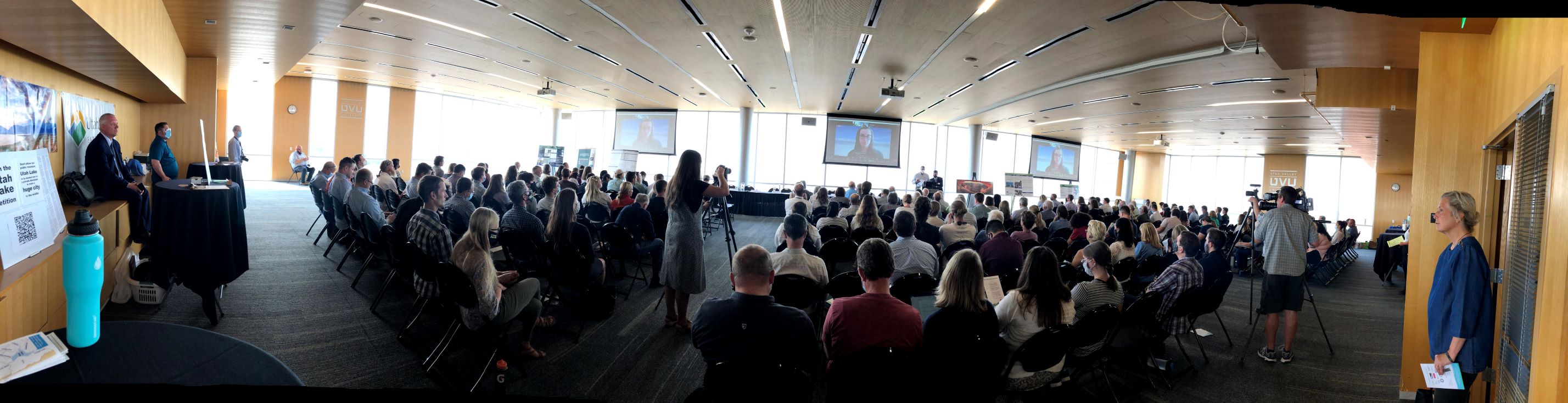
During a meeting of our Utah Lake monitoring project, one of our collaborators mentioned that the proposal to build artificial islands on Utah Lake had reared its head again. We learned that the island developers had taken the legislature out to lunch in April and presented their two-hour dog and pony show about how the real way to restore Utah Lake was to destroy it. I was still working on the renewable energy project and supervising a team in Alaska, but this islands proposal is level-11 crazy. In 2018, they convinced the legislature to pass a law that would allow the state to give the lakebed of Utah Lake to a private corporation. In 2020, they weaseled a $10 million loan guarantee slipped into the state budget. We went into full emergency mode and organized a symposium to bring researchers, managers, lawmakers, and concerned citizens together to discuss the lake. In just a few weeks the plans and funding came together, and 500 people gathered at UVU and virtually to participate in the Utah Lake Symposium. It led to ongoing talks with the legislature and will hopefully conclude with the permanent protection of this unique and important water body.


Since then, a half-dozen other “side projects” and opportunities have kept me from feeling on top of things. However, I am honestly deeply grateful for the chance to contribute, even in a small way, to issues that go beyond my personal professional development. We are living in a period of extreme change, and there isn’t time for career building and navel gazing. Or at least that’s what I tell myself when I’m feeling really ragged and resentful about not having the time to watch the newest True Facts video.

Thursday, September 30, 2021

Myths and misinformation about meat

 I was cruising my favorite news app yesterday when an add came up claiming that beef was actually super sustainable and good for the environment. I couldn’t help but click. It was funded by the Beef Farmers and Ranchers association—the group responsible for the “Beef, it’s what’s for dinner” campaign. The website was a tossed salad of half-truths and incomplete reasoning. Beef has a big carbon footprint, but smaller than a flight to London. Cattle are “up-cyclers” taking useless plants and turning them into calories and leather. Meat is a nutrient dense food that supplies 9% of U.S. calories but (wait for it) a whopping 10% of our protein and some vitamins.

My favorite part was that they showcase their “Environmental Stewardship Award,” which, it turns out is an annual award given exclusively to cattle producers and funded by McDonalds among other conflicted sponsors. The meat industry is so committed to greenwashing that they bought the URL www.environmentalstewardship.org and use it to shower an award on themselves every year.

While this vein of greasy propaganda was particularly rich, it isn’t unique. I am frequently forwarded Alan Savory’s TED talk on how grazing could halt desertification and solve climate change too. As an aside, TED talks, like Wikipedia articles, are a great place to start your research, and a very bad place to draw your conclusions1. Just this week, I was called a “shame and a sham” (kind of a nice ring to that actually) for suggesting that eating a plant based diet would be good for the environment.