Letting some of it trickle out while trying to soak it all in

Sunday, January 5, 2020

Is nuance doomed? Building common ground in the new year.

My New Years resolution for 2019 was to watch more TV. 

Since starting my postdoc in 2014, I've been pretty focused on productivity. Even the things I chose to do for fun--like lobbying the legislature and writing op-eds--resembled work. My focus on productivity didn't seem to be too much of a problem until one morning, I saw a man on the train to Farmington. I was feverishly putting the final polish on my presentation to the Utah DNR on "The effects of wildfire on water quality." This full-grown man was leaned way back over the next seat, belly hanging out and playing a Nintendo Gameboy. It looked like he was on his way to work, but he was only concerned about getting the the next level in Kirby's Adventure. He seemed alive. He seemed to be enjoying himself. He seemed comfortable with his place in the universe.

Channeling the example of my gameplaying friend, I actually fulfilled my resolution. You might even say I magnified it. In 2019 I watched the entirety of Stranger Things, The Good Place, Dark, Orphan Black, and I even started Battlestar Galactica and The Americans (those ones took more discipline). November and December were particularly productive. I finished The Expanse, Man in the High Castle, and See.

The shows I watched in 2019 were about everything from a kidnapping in a small German town to American Nazis in a multiverse. They lacked thematic or topical similarity, but they shared an important commonality: compelling and conflicted characters. The shrewd peacemaker Chrisjen Avasarala exploited the death of her soldier son to advance her political career. The blind Baba Voss learned to fight like Keanu Reeves from his years as a slave trader. The severely abused Helge Doppler helps kidnap children for experiments. Sarah Manning is a con artist and absent mother, Michael is a repentant demon, and Juliana Crane falls in love with a Nazi. The specific scenarios are outlandish, but the complexity and contradiction are straight out of real life. 

How come we like our TV shows to be morally ambiguous and complex but we expect public figures and political disputes to fall into neat categories? Liam Neeson is a racist, we can't read Harry Potter anymore, and Peter Handke is nothing but a genocide denier. With the decline of in-depth reporting and shortening of attention spans, is nuance doomed in the 2020s? 

Literature not news. Story not opinion. Parables not commandments. There must be a market for complexity and nuance. Humanity is crashing the whole Earth through what has been described as the Great Acceleration. We have the proverbial pedal to the floor, consuming more and more each year. There must an appetite for long-format discussions and reflections, or I fear we are doomed to trip over our good intentions. Reality is full of unexpected dynamics such as scale dependence, induced demand, perverse incentives, and nested feedbacks. When we are fed a simple story about what is wrong with the world or what might fix it, we should ask what are the tradeoffs.

I thought that TV could be a tool to remind us of our humanity, but things didn't seem to get better in the 2010s, even as TV experienced a renaissance. Haven't we learned from Netflix and Amazon Prime that a single act or belief doesn't define a person or body politic? Most are neither Nazis nor angels. It's a for better and for worse world. Why then do we seem increasingly allergic to nuance?

An unnamed mountain on the North Slope of Alaska. I study the effects of climate change in this area thanks to a field station that exists because of oil exploration.

The flat of the valley filled up with single-family housing. The fatbike Martin gave me after I smashed it up in a car crash I caused.

 I hate cars, but I love this view. I hate roads, but I love to watch my kids play in our cul-de-sac.

Henry and I lifted it to some dirt, but this ant probably still died.

This is my friend Dan.

In 2019, I had two experiences that demonstrated how absolutist our thinking has become (or has always been). 

In January, a reporter named Peter Sinclair put together a short format documentary on the permafrost climate feedback for Yale Climate Connections. Peter interviewed several of the top researchers on the subject plus myself and weaved our accounts into a complicated and uncertain story. Like most real science, the conclusion was more than could fit in a headline. The huge stock of organic matter in the permafrost zone is beginning to release carbon dioxide and methane to the atmosphere in response to anthropogenic climate change. However, none of the experiments or simulations the scientific community has evaluated indicate that the permafrost climate feedback will exceed direct human emissions. Also, the studies that have investigated different warming scenarios have found that most of the permafrost greenhouse gas release could still be avoided if human emissions are rapidly reduced.

The video got more than 15 thousand views in the first week (viral by scientific standards) and the comments hammered us from both sides. One side called pawns of big oil, climate change deniers, and accused us of taking "hopium". The other side called us alarmists, opportunists, and fear mongers. Though I haven't read through the 400+ comments on YouTube, here is a sampling from the first dozen or so:
Peter Sinclair’s video on YouTube was a cleverly crafted propaganda video, in which scientific authority and language was abused in order to give human beings connected to the Internet the impression that ice couldn’t melt because it requires heat. 
Yale shouldn’t take it upon themselves to spread Darkness and Lies, so should praise any and all information campaigns about these very important issues instead of trying to quell them. 
THIS IS PURE PROPAGANDA MIND GAMES. 
are you enjoying being a tool of big oil? There must be some outrageous payments, and other benefits. Private jets? Polynesian dancing girls? Your own polo team? Hot and cold running Cristal? 
7 minutes of pure fear mongering propaganda with a second portion of Chinese $$ thrown in. 
This video is confusing after four viewings. This video admits that Arctic methane meltdown is potentially dangerous, but at the same time this video claims the danger is “overblown”. . . The video's message is ambiguous if not completely elusive.
That last comment is the most thoughtful and revealing. We have gotten so entrenched in false dichotomies that any non-binary position is incomprehensible. Rather than considering the science, which doesn't take sides, it's as if the viewers spent the seven minutes trying to ferret out our political slant. Wait! Are they for us or against us?

In October, I waded onto the public stage again (a properly mixed metaphor given my lack of finesse) with a commentary on tolerance of socially conservative political positions. Addressed to the largest natural science community, the American Geophysical Union, we wrote about how polarized our larger society has become and how that could damage the scientific process and public acceptance of science if left unchecked. Unlike my experience with Peter's documentary, this time the response was more complex. I received personal messages from many researchers around the country thanking us for the thought-provoking piece. Not all of the thankers agreed with our tenets, but they supported discourse and expression of diverse ideas. However, the social media uproar followed the permafrost pattern. We were immediately compared with Nazis, accused of getting tangled in ethical gymnastics, and generally of being hateful and backward people. Again and again, it seemed that people were more interested in sussing out whether we had a nefarious political motive (who's side were we on anyway?) rather than considering or arguing with the ideas. More damaging, it was clear that our detractors thought that the other side (in this case social conservatives) had nothing to offer. No insights, no understanding, no nuance. They bad; us good.

Narratives become dominant when they are simple and intuitive. Reality is chaotic and shot through with interacting feedbacks. What ways have you found effective to communicate complexity in the face of false simplicity? As I've pondered this question over the past month, I've come across five interesting essays, podcasts, and other sources.

My mom sent me the first one, a homily on being willing to be changed.

Scott Carrier sent me the second one, a miniseries on his podcast where he intentionally travels beyond his socioeconomic bubble to encounter the other.

Jab Abumrad brought me the third one with his new podcast Dolly Parton's America.

Josh Barro broadcast the fourth one, asking where is the center?

And the apostle Paul brought me the fifth one. For me, his writings undermine self righteousness and dismissal of others. In Romans 3, he gives this brutal but egalitarian—even universal—condemnation:
As it is written, There is none righteous, no, not one: There is none that understandeth, there is none that seeketh after God. They are all gone out of the way, they are together become unprofitable; there is none that doeth good, no, not one. Their throat is an open sepulchre; with their tongues they have used deceit; the poison of asps is under their lips: Whose mouth is full of cursing and bitterness: Their feet are swift to shed blood: Destruction and misery are in their ways: And the way of peace have they not known: There is no fear of God before their eyes. . . For all have sinned, and come short of the glory of God;
Not to be mistaken for a misanthropist, Paul follows with this:
Being justified freely by his grace through the redemption that is in Christ Jesus. . . Where is boasting then? It is excluded. By what law? of works? Nay: but by the law of faith.
To inject nuance to this view of undeserved redemption, Paul adds the following in Corinthians:
There are, it may be, so many kinds of voices in the world, and none of them is without signification.
So none of us are without stain or weakness, but all of our voices have meaning and value. You biased and imperfect? Great! Me too. What can we learn from each other? How can we improve?

Another approach that can cut through dehumanizing simplification is music. With a few partisan exceptions, good art interrogates and interprets the world in a way that can overturn expectations and stereotypes. It confronts us with individual stories and universal experiences. Here are a few of the artists who do this most consistently for me:

John Prine's Sam Stone shows how your politics don't change how you respond to shrapnel and opium addiction.

Taj Mahal transcends divides by stretching a personal moment or offhand phrase into a romp.

Gillian Welch's spare honesty makes me weep over and over.

Townes Van Zandt just teaches through stories and confession.

Stromae is angry, but also indifferent, disappointed, and effective.

Christine and the Queens are fun and poppy.

So are the Pirouettes.

Mario Mathy's Jumping Dance could trigger world peace or a breakdown in the world order.

Gabe and Sonya's Tiny Home relishes the harmony and dissonance of interaction.

Anais Mitchell should be the secretary of the interior.

Greg Brown should be the secretary of defense.

And David Byrne is one of the most important prophets and visionaries of our time.

What do you think? Who do you listen to or watch when you start to forget that the other sides are people too?

“So when at times the mob is swayed
To carry praise or blame too far,
We may choose something like a star
To stay our minds on and be staid.”

-Robert Frost

Sunday, December 15, 2019

Light in the dark. Celebrating the birth of our Lord on the shortest day of the year.


Earlier this month, Tennery Norton asked me to write an essay about Christmas. She works with a BYU radio program called Constant Wonder (kind of a Reasons to be Cheerful sans David Byrne). She invited me to connect Christmas with something from my experience as a scientist. 

My first thought was about permafrost and the tenacity of microorganisms because nothing screams Christmas like anaerobic respiration, right? I had recently participated in a permafrost synthesis project led by Sue Natali about microbes who stay active through the winter in the frozen soil of the Arctic and Boreal biomes. They grow slowly in the unfrozen films of water throughout the soil, but their combined respiration has already tipped the permafrost zone from a carbon sink to a carbon source. But I was feeling tired of permafrost and decided to think about something different. The transcript of the radio essay that aired last week is below.


Though it was not the season of Christ’s birth, we celebrate Christmas near the winter solstice. In the Northern Hemisphere, where this tradition began, the solstice is the darkest and coldest time of the year. As an ecologist, I can’t speak to the historical origins of this tradition, but I can describe what causes seasonal fluctuation in light and heat and what this means for the Earth system.

The Earth rotates on an axis that is tilted about 23 degrees to one side. This tilt was set during the Earth’s creation, billions of years ago. Planetesimals—the unorganized bits of dust, rocks, and other material present in the early solar system—coalesced under the force of gravity, and imbalance in the collisions tipped the growing planet a few degrees on its side. The Earth got a final push from an astronomical body about the size of Mars that slammed into its surface 4 and a half billion years ago. The impact transferred so much energy into the Earth that its surface melted into a global sea of magma, and a huge geyser of material was ejected into space. This debris eventually glommed together into our moon. The weight of the moon stopped the tipping of the Earth and stabilized the wobbles of its axis—a sort of gravitational Hula hoop.

The Earth’s tilt creates seasonal changes in the amount of sunlight reaching its surface as we revolve around the sun. The passionless geometry of a tilted sphere creates one of the only fair things about our mortal existence. Whatever latitude we live at, each of us receives the same duration of illumination from the sun: about 44 hundred hours each year. Whether you live on the North or South Pole where the sun rises and sets once a year, or on the equator where the length of each day is the same; half the year the sun is up, half it is down. Though this annual allotment of sunshine is completely fair (in a Solomon sort of way), the tilt of the Earth creates seasons—pulses of energy that ripple through all life on Earth.

When the Northern Hemisphere is tilted toward the sun, it receives more light and heat, a condition called summer. Longer periods of light stimulate the photosynthesizers—the land plants and aquatic algae that harvest carbon from the atmosphere and release oxygen. The Earth breaths in. The extra heat melts snow and ice, providing water for ecosystems and people and exposing habitat. This triggers migrations for insects, fish, mammals, and birds, some of which travel halfway around the world to find a place to breed or feed. The early sunrise makes it a little easier to get out of bed for us humans, whose modern schedules don’t change much with the seasons.
    
But after the summer solstice, the Northern Hemisphere turns away from the sun. The days shorten and the temperature drops. Without as much sunlight, the photosynthesizers can’t keep up with the consumers and decomposers who use oxygen and return a portion of the plants’ carbon to the atmosphere. The Earth breaths out. I have a harder time getting out of bed and many people experience seasonal depression and somber states of mind. This darkening lasts half the year. From June to December, each day is darker than the last.

At the moment that our hemisphere is farthest from the source of energy and light that sustains all life on Earth, we celebrate Christ’s birth. As a Christian, the timing of this remembrance seems important. Many scriptures liken our Savior to light. Some go as far as to say that he is light—a being in whom there is no darkness at all. But what defines Christ for me and what symbolizes my relationship with him is not the purity or intensity of his light. It is the location and timing of his light—the where and when.

John emphasized this when he first introduced the Savior. Christ is not only the light of the world, he is the light that “shineth in darkness.”

There are plenty of bright things in the universe. Until it swells and collapses some 5 billion years from now, our sun will never stop shining. Despite this constancy, the sun is often inaccessible to us individually, and sometimes, like at the winter solstice, it is distant from many of us at the same time. Apparently, it is not enough to be bright. It is not even enough to be constant.

Zacharias prophesied of John the Baptist who was a preparer and type of our Savior. He said, thou, child, shalt be called the prophet of the Highest: for thou shalt go before the face of the Lord to prepare his ways… To give light to them that sit in darkness and in the shadow of death, to guide our feet into the way of peace.”

Christ doesn’t just broadcast light randomly into the universe like the celestial spheres I described before. What is so remarkable about the love of our Savior is the way he brings light to us. He delivers it personally, privately, quietly, and then he stays. Even when we sit in darkness on the far side of a planet. Even when it has been so long that we can’t remember what light feels like. He is there, with us in the darkness.
  
I can’t speak for you, but I find myself in darkness often. A friend diagnosed with cancer. A child unsure of a parent’s love or the love of God. A refugee without home or friends. A couple that hasn’t touched for months or years. A future that seems to hold no savor or anticipation. The disappointment of letting someone down who depends on you. Even in my ecological research, I am sometimes confronted with overwhelming sadness and darkness. Pollution in our air, water, and soil kills at least 12 million people every year—twenty times more than all homicides and wars combined—yet there still isn’t agreement or political will to abandon the dirty fossil fuels that are primarily responsible for this suffering.

In the face of all this darkness, it is easy to hate and resent the shadow. Indeed, this allergy to dark is rooted in an important instinct. As children of light, we are called to prevent or heal the suffering of needless, artificial darkness with all our force and resources. But some of the darkness we experience serves a purpose—or it can if we see it in the right light. One of the great paradoxes or miracles of our Earthly existence is that darkness provides a contrast without which the light would mean nothing.

In the modern world, we seem to have forgotten this distinction. We use our technology to banish all darkness, harmful and good. Our lust for constant light, even in times of natural darkness, has driven us to exploit all sources of energy, no matter the personal or communal cost. The fossil fuels that we extract from the Earth are metamorphosed light that was captured by plants hundreds of millions of years ago. Rather than waiting for the natural light to return in the morning or spring, we’ve harnessed this power to flood the world with artificial light. The pressure to be ever moving and ever connected pollutes our air, disrupts our climate, and disturbs our sleeping patterns as we worship our screens until the moment before losing consciousness. Ironically, excess artificial light now obscures God’s miracle of stars in the night sky for most people on Earth.

At least during our mortal existence, Christ doesn’t erase the darkness around and within us, though he can transform it, when we let him. If we hope to follow the Savior’s path, we must not fear the dark. Christ asks us to examine the sources of fear and hatred within ourselves—our internal darkness—and to be vessels of his love for those who feel far from it.

Celebrating Christ in the darkest days of the year reminds us that he “descended below all things, in that he comprehended all things, that he might be in all and through all things, the light of truth,” as we learn in modern LDS scripture. On a personal level, Christ coming at the time of greatest darkness and cold is a reminder that our greatest suffering and disappointment can prepare us for our deepest and most lasting peace. At this time of light in the dark, let us not forget Peter’s promise that Christ is “a light that shineth in a dark place, until the day dawn, and the day star arise in your hearts.”

Saturday, October 26, 2019

Thoughts on the AGU debate about ideological diversity

It’s been a few days since our opinion piece on social conservatives in research was published in Eos, the news journal of the American Geophysical Union. I wrote the piece with two other BYU professors after a controversy about a faculty advertisement on AGU’s job board. In early October, AGU pulled the ad after a brief debate on Twitter because of BYU’s hiring policy that excludes most LGBTQ+ candidates.

We knew the article would be controversial and we were worried about its main message not coming across as we intended. After watching the responses online (mainly on Twitter but also through personal email) for a few days, I wanted to share some reflections and lessons I’ve learned. Jani and Jamie were co-authors on the piece, but because I don’t speak for them, I’ll use “I” from here on out.

I wrote the piece for two main reasons. First, I really believe that diversity is important in science. If groups or individuals don’t have the opportunity to participate fully in research, this creates a serious injustice and it degrades the quality and credibility of science. There are many groups and individuals who have been or remain excluded from full participation in science, including indigenous peoples, other ethnic and racial minorities, LGBTQ+ individuals, people from impoverished communities or countries, and women. Second, I really care about a host of environmental and social issues that science has something to say about. We continue to lose ground on climate change, loss of biodiversity, and alteration of biogeochemical cycles, and we are not moving quickly enough to reduce pollution, which kills ~12 million people every year—about 20 times the number who are killed by all forms of violence.1,2

The central thesis of the paper is that partisan and ideological divisions currently keep us (AGU and the US generally) from addressing the socioecological issues above. Because these issues involve the whole human family and all of the Earth’s ecosystems, I want us to work towards equality and sustainability (which are inextricably interwoven) as quickly as we can.

From my experiences in Utah, Alaska, and throughout Europe, I view the largest threat to progress on these fronts as polarization and dehumanization of ideological opponents. I am optimistic about so many things in the world, but if we stop caring about other people and seeing them as complex humans, the gains we’ve made and the future of progress are in peril. While many factors contribute to separation and hate, the loss of relationships with ideologically diverse friends and colleagues is a major factor.

The article hoped to make a case that including people we disagree with ideologically is the best way forward, not because ideological diversity is more important than the other dimensions of diversity mentioned above, but because building relationships can fight against the dehumanizing separation that has divided our politics and threatens our communities. I don’t want people who support Chinese reeducation camps or LGBTQ+ exclusion to be a part of our community because I agree with their positions. I want them to be here so they can see there is another option (potentially decreasing hate and discrimination) and so we will be more likely to see them as real people (potentially decreasing hate and mistrust). Ideological diversity isn’t some smoke screen covering tolerance of intolerance, I sincerely believe that inclusion and compassion will move us faster and farther towards equity and sustainability than will exclusion.

Many people disagree with me on this, which is healthy and helpful. I just had never heard the case for inclusion made, and I wanted to add it to the discussion. There are many cogent and potentially better arguments that can be made, and I hope my community makes an informed and open decision after consideration of all these viewpoints.

But on to the lessons! Along with a bunch of inane observations like “wow, most people didn’t read the article before wading into this,” here are a few thoughts.
  1. Take time to think over it in different ways: When a position or set of positions doesn’t fall neatly into the usual arguments, it can be disconcerting and challenging to both sides. I see why people often equated, “they don’t agree with pulling the discriminatory ad, therefore they must be anti LGBTQ+,” but that is honestly incorrect. Similarly, when I responded hastily to a Tweet that felt malicious initially, I often regretted it later. After letting the ideas soak and float around each other for a while, I often saw a deeper and more interesting point that the person was making.
  2. Don’t misinterpret anger or even bigotry as bad intent: It is easy to get defensive and aggressive on Twitter but remembering how much pain and fear people feel can increase compassion and dialogue. I have felt very threatened by some of the things said about me and especially about my lab members since the article was published. Heck, I didn’t even know that Twitter gave “vulgar and offensive” warnings until I ventured onto some of the threads about @thermokarst. From that place of indignation, I said some things that weren’t as considerate or thoughtful as they should have been. My failure should remind me that others who are saying such things aren’t bad people, they are just experiencing a lot of pressure and frustration. This discussion has given me a greater understanding of the depth of pain that many people are living with, and I am grateful for that perspective. I truly empathize and care about all who have been hurt or are being hurt by intolerance and hate.
  3. Do your best to not make (and not respond) to dumb arguments: In high school debate, you lose by default if you don’t address all your opponent’s points. In real life, instead of responding to bad arguments, bring up the good ones that aren’t being discussed. Fighting against arguments made in bad faith isn’t worth your breath. An early version of the Eos article addressed an argument I often hear about why there are so few conservatives in research: they’re not smart enough. This is a classic discriminatory argument that is factually untrue and just dumb. After feedback from several wise mentors, I removed the sentences responding to that argument that didn’t merit a response.
  4. Judge ideas on their merit: Judging someone’s arguments based on their identity is good politics but bad science. One of the most common criticisms I’ve gotten is that I shouldn’t be a part of this discussion because of my gender, race, and socioeconomic background. You are free to only listen to certain people, but I am interested in every good argument, whether from the New Yorker, Mother Jones, Fox, Breitbart, or anywhere on the social or ideological spectrum. No side or perspective has a monopoly on good thoughts and practices. My scientific and religious principles require me to take truth and goodness wherever I find it.
  5. Be nice to investigators: When someone comes to church for the first time, don’t complain about what they are wearing or how they talk (at least if you want them to come back). Likewise, if someone is interested in learning about your worldview, don’t complain about superficial or even substantial differences in vocabulary or understanding. When somebody is new (or not), being patient and persistent with clear explanations rather than waiting for a gotcha misstep will increase the listening and learning.
  6. It is never too late to discuss and explain: I often hear the argument (and have sometimes made it) that “the time has past for discussion,” or that “there is no excuse for not knowing.” Whether it’s LGBTQ+ inclusion, climate change, abortion, eating meat, or any other important issue that not everyone agrees on, I believe we should always be willing to explain the issues and answer questions about why we should care. We can be indignant that our values aren’t understood and shared, or we can use the question as an opportunity for reflection and sharing. Before, during, and after important decisions, we should be ready to discuss, respond, and show compassion. Otherwise, the transitions will be harder or not happen at all and the decisions will be less likely to stick.
  7. Make it personal: Everyone you interact with online or in person has a unique story. Remembering that there is a person behind each Tweet and idea—even the hateful ones—a person with successes and suffering, and a person that we do not know can help us treat each other with a little more kindness and compassion. Even if you think that is dumb (civility or kindness), thinking about the person will help you identify what arguments will help and which will hurt your cause. Everyone is a person.


Because I sometimes can’t help myself, I’ll bring up another super divisive issue in closing. Abortion is a surprising partial success story of the value of including others and making progress towards shared goals through ideological partnerships. There are radically different beliefs about how choice and abortion should be thought about. There are those who want to legally punish women who seek abortions, those who want to physically harm the physicians who perform abortions, and those who want to legally or physically limit those protesters. Amidst all this acrimony, the rate of abortion has fallen every year since I was born (you’re welcome). Neither side has given up its values, but the interaction between those extremes and thousands of nuanced positions in the middle have helped achieve a broader shared value of having fewer abortions. Addressing deep cultural issues requires more than just a law or change in the market. It requires meaningful discussions, real relationship, forgiveness, and reconciliation. That is why I believe we should include and love our enemies in our society and social circles.

Whatever happens with LGBTQ+ protections in the Supreme Court or eventually in Congress if we ever can break the partisan paralysis, we are still going to need dialogue and relationships to change hearts and minds. I don’t think you’re evil if you take a more coercive path (legal or cultural regulation), but I hope you’ll at least think about the importance of seeing the humanity and good on the other side.

1. Lelieveld, J. et al. Cardiovascular disease burden from ambient air pollution in Europe reassessed using novel hazard ratio functions. Eur. Heart J. 0, 1–7 (2019).
2. Landrigan, P. J. et al. The Lancet Commission on pollution and health. The Lancet 0, (2017).

Sunday, March 24, 2019

Kimball and Maurine

One year ago today, my grandmother, Maureen Bentley Hansen passed away. Two weeks ago, my grandfather, J. Kimball Hansen joined her. From the time I was little until the days they died, they were a constant presence in my life. Their home of rammed earth in southern Arizona was our primary family destination. Our trips to the Sonoran coast of the Sea of Cortez introduced me to the landscapes that I still dream in. We spent hundreds of days together and they changed how I see the world. They changed who I am.

I don't know how to write about them right now, but here are some pictures I've been looking at since my grandpa's death.


Getting ready for a trip to the caves.


You couldn't be sour enough to keep this woman from smiling at you.


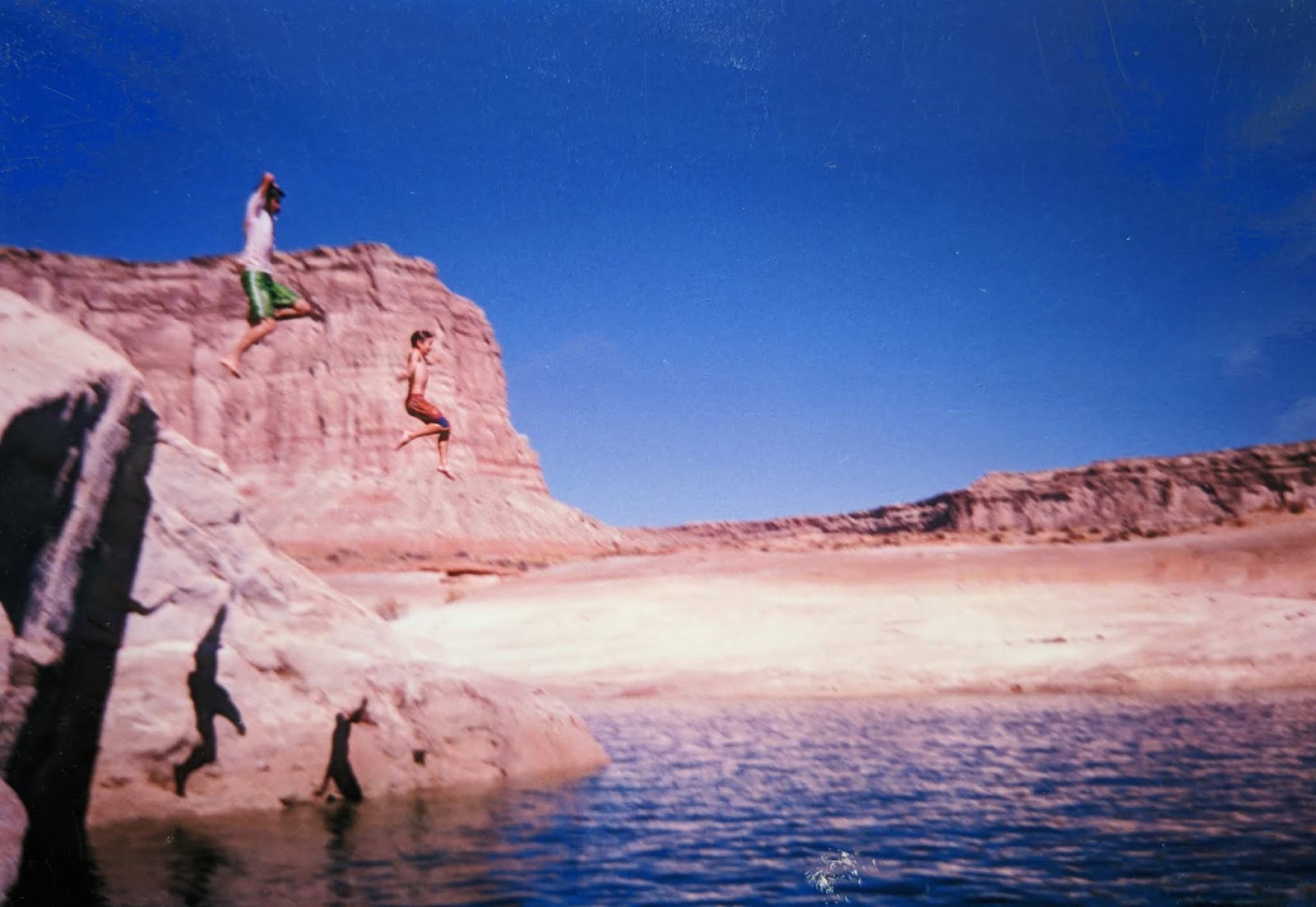
The first trips I ever took with Grandpa were to Lake Powell. He built a houseboat out of WWII drop-tanks (parked in the bottom-left of the picture).

Grandpa was gruff, but if you could stand his constant criticism, he was as fun as anyone I've ever met.

When I was 12 or 13, we started going down to Mexico. This was somewhere between Puerto Lobos and Desamboque, picking our way down the beach in Grandpa's homemade dune buggy. 

 Director and cameraman.  

Not a tourist for 200 miles. Just like Grandpa liked it. 

 Sam took this picture of me water-skiing from the dune buggy. Because the dune buggy was on the shore making no wake, you could ski on just inches of water and see everything below you. Grandpa always wanted to coordinate a turnaround without the skier having to restart, and Sam almost got it once.   

We would move camp at low tide because the beach almost disappeared at high. 

 Back in Benson after Grandpa got back from home teaching.

Grandpa and Grandma built this house on 40 acres in the high desert south of Tucson.

 When I first met him, he was a round man, but after a heart attack he lost a lot of weight.

This is maybe how I remember him most. Planning, packing, building, improvising, exploring, learning.

35 mm selfie. 


 Yelling at me for wasting time with a picture when we needed to be covering ground. We were totally self-sufficient for the whole trip, which sometimes lasted two weeks. One time he did run out of Digoxin and we followed the road until we found a Red Cross shack. They actually had the medicine. Expired and free. Just the way he liked it.

There weren't any established roads to the beach and we never took the same way down twice. He had a marine GPS, but I only ever remember him following his memory and instinct.

We spearfished and ate seafood every night. Mainly trigger fish but also stingray, puffer fish, and some blue/black algae eater that tasted like algae.  

Grandpa always woke up before me. He was so excited to be at the caves, so far away from distractions and rules, that he didn't want to miss any of it. He would stay up late watching the stars and wake up before dawn to go swimming or fishing. Ironic pose with a baby needlefish.

We would always stop outside of town so he could wash up and put on a clean shirt.
 
Grandma died of Alzheimer's, but she retained her personality until the end. She made you feel so special and included.

They raised desert tortoises on their Rancho de las Tortugas.

All of our kids, except Naomi, met them several times. Caspian takes after Grandpa in build and disregard for the rules.

Grandma was a scholar of the gospel and an example of Christ's love.

I found that hat in the bottom of the Provo River. Grandpa patched it until it wouldn't take any more patches. 

 
The smell of their house, the sound of the insects at night when we would arrive.

 Our first trip with Henry.

My cousin Rachel Frandsen and I went on several trips together, including this one with the big dune buggy (a modified Volskwagen bus instead of the normal bug). Grandpa would stop in Caborca on the way down and buy a big pack of wheat and corn tortillas. Egg and fish burritos with tapines to top it.

Just a man, his Aerostar, and a hat he got for free at a booth in downtown Magdalena.

 Grandpa took this picture of me one night after a long day of spearfishing and playing music in his cave by the sea. We played lots of songs, but he liked Mr. Tambourine Man and How Great Thou Art best. He told me I had something different than most artists, and I still think of that.
 
Ingrid returning some of the love Grandma so freely gave as she came near the end.

 On his last day, we sang Mr. Tambourine Man and a hundred other songs with Mom, Malachi, Kathy, Christie, Paige, and Sam. We sang How Great Thou Art at his funeral.

Together again. As I believe they are now.


And take me disappearing through the smoke rings of my mind
Down the foggy ruins of time
Far past the frozen leaves
The haunted frightened trees
Out to the windy beach
Far from the twisted reach of crazy sorrow
Yes, to dance beneath the diamond sky
With one hand waving free
Silhouetted by the sea
Circled by the circus sands
With all memory and fate
Driven deep beneath the waves
Let me forget about today until tomorrow

Sunday, February 17, 2019

Does information matter at all in politics?

One of the great mistakes is to judge policies and programs by their intentions rather than their results. -Milton Friedman

Politics determine who has the power, not who has the truth. -Paul Krugman

Last Friday, I attended the Natural Resources Committee meeting of the Utah Congress. I took the train up to Salt Lake to support House Concurrent Resolution 5 (HCR5), sponsored by Representative Ray Ward. The resolution is entitled, CONCURRENT RESOLUTION URGING POLICIES THAT REDUCE DAMAGE FROM WILDFIRES. After five whereas statements about the causes and consequences of wildfire in Utah, HCR5 has three resolutions:
  1. NOW, THEREFORE, BE IT RESOLVED that the Legislature of the state of Utah, the Governor concurring therein, urges the federal government to pursue policies that allow for common sense fuel load reductions in Utah's forests, including easier permitting of prescribed burns during times of the year with low fire risk and allowing for appropriate salvage logging to occur before timber loses its economic value.
  2. BE IT FURTHER RESOLVED that the Legislature of the state of Utah, the Governor concurring therein, urges the federal government to minimize additional climate change by pursuing policies that will lead to a reduction in carbon dioxide emissions.
  3. BE IT FURTHER RESOLVED that a copy of this resolution be sent to the members of Utah's federal delegation, the chief of the United States Forest Service, and the director of the United States Bureau of Land Management. 

Friday, February 15th. A stormy day on Utah's Capitol Hill.

Representative Keven Stratton chaired the meeting, sitting at the head of a large curved bench with six representatives on each side. I was really impressed with how Stratton led the meeting with a personable mix of poise, warmth, and professionalism. I felt he was sincerely interested in the opinions of all the representatives and grateful for the members of the public who had showed up. 

There were three bills and one resolution on the meeting agenda before HCR5, ranging from recycling regulations to a commemoration of the Golden Spike National Historic Park. The first issue elicited a detailed discussion about the tire recycling fee. Several representatives questioned the sponsor and his expert about the functioning of the recycling industry in Utah and the specifics of the fee.

As the meeting progressed, I organized my thoughts into a few bullet points:
  • Fire is a natural and necessary part of healthy Utah ecosystems. Among other things it is critical for aspen forest regeneration, wildlife habitat, soil health, and aquatic ecosystems. 
  • What can be damaging are intense and large megafires, which endanger communities, wildlife, water security, and air quality. 
  • Since the 1970s in the southwestern us, wildfire extent has doubled primarily because of climate change (longer burn seasons, dryer fuel, and higher temperature) and secondarily the legacy of aggressive fire suppression for much of the early 20th century
  • Returning to a more natural fire regime, with frequent, small burns, and mitigating climate change are the two actions that could reduce the risk of megafire in Utah
I wasn't the only one "multi-tasking" in the room. Many of the representatives were reading or writing, and several had to step out of the chamber temporarily to make appearances in other meetings or hearings.

One of the findings on the link between climate change and wildfire from the Trump Administration's National Climate Assessment.


Finally, Ward was up. He passed out a summary sheet with the details of HCR5 and then gave a five-minute pitch about how fire suppression in the past has increased fuel loads and how climate change was making burn seasons longer and fires larger and more intense. Stratton asked if there was anyone in the chamber who wanted to make a public comment. 

A physicist from Weber State spoke first, explaining the basic science of climate change. I spoke next, talking through the points above linking climate change with wildfire in Utah. A woman from Ogden spoke last, describing how reducing greenhouse emissions was important for human and ecosystem health. Stratton graciously thanked us for our comments and opened discussion in the committee.

Representative Timothy Hawkes pushed his button first, and proposed an amendment to strip all mention of climate change from the bill. He reasoned that establishing the causes of climate change was complicated at best and that because climate change was only tangentially related to wildfire, it would make for a "cleaner" bill to only address the forest management portion of the resolution. There was a debate on this point with representatives making claims about what we knew and didn't know about climate change and whether it made sense to encourage relatively vague federal action. After a few minutes, Hawkes amendment was passed and the committee passed the revised version of HCR5 with a large majority. Stratton was one of the few opponents of the amendment and the revised bill, but I couldn't tell if that was because he didn't want it debated on the floor at all, or if he opposed the idea of making an appeal to the federal government.

What surprised me most about the meeting was the clear separation of information from decision making. After the presentation of the resolution and the science supporting it, there was a total break or change of gears. As the discussion and vote went forward with no reference to the scientific information presented before, I felt like a child trying to weigh in on an upcoming family vacation. "Thanks for your input, now the adults are going to decide what to do." 

Maybe this gulf between information and policy was only surprising because I am so used to scientific discourse. At a conference or after you publish a paper, you are often confronted with new information that may not fit your hypothesis. Your methods and conclusions are almost always questioned and investigated, but there is a shared commitment to reproducible results. You can want to believe in whatever you choose, but at the end of the day, it's only science if someone else can independently demonstrate the same thing. At the committee meeting, I didn't get the feeling that anyone was disputing what I had said, I felt like they thought it was completely immaterial. My evidence was so distant from their decisions that it didn't have any standing at all.

Even my meager experience with politics reveals that things aren't always so dire. After all, why was there such a fruitful discussion about a $1 tire recycling fee but not a single question about the specifics of climate change, an issue that threatens our ability to grow food and find clean water? How could we improve the information content in our debates about issues that depend on thoughtful consideration of both evidence and values? I would love to know how many of the representatives accept the science of climate change but voted against the resolution because of its policy implications versus how many truly do not believe.

I don't have answers to these questions, so I guess I'll just have to keep walking back up Capitol Hill until I do.

Sunday, August 19, 2018

What climate change means for Utah

Last Wednesday three of my colleagues from BYU and I met with Congressman John Curtis to talk about what climate change means for Utah. The meeting was organized by the Citizen's Climate Lobby and RepubliEn.

 We met on the west side of Cascade with on the smoky morning. Photo courtesy of BYU Photo.

Representative Curtis was attentive and well informed. He brought up the point that we sometimes get too concerned about whether someone accepts that climate change is occurring and whether it is human caused. Climate change is enough of a polarizing issue that I tend to agree. I count anyone as an ally who is willing to work towards cleaning up our energy supply and using our resources responsibly. If someone is denying climate change and using that as a reason to keep consuming dirty fuels, then establishing the science becomes more important. In my experience, fighting about beliefs isn't terribly productive. If someone sincerely wants to investigate the scientific basis of climate change, John Cook has already done much of the legwork for her/him: https://www.skepticalscience.com/.

Neil, Sam, Zach, and I prepared a brief info sheet for Congressman Curtis, which I thought I'd share here.

How has Utah’s climate changed and what does the future hold?
  • It has warmed 2°F over the last century. An additional increase of 3.8°F is expected by 2050 (1). Summer and fall warming will be greatest.
  • Transition from snow to rain. Spring snowpack has decreased in Utah by ~30% on average, and more than 75% in some areas (Fig. 1). Precipitation is expected to decrease in central and southern Utah.
  • Wildfire in the Intermountain West nearly doubled from 1979-2015. More than half that change was due to manmade climate change (2).


What does climate change mean for Utah’s water?
  • Even without climate change, Utah is facing a water crisis (Fig. 2).
  • Utah has always been vulnerable to climate VARIATION, especially recurring drought. Climate change and population growth increase vulnerability to drought.
  • Decreased groundwater recharge (aquifer depletion), less reliable runoff (empty or overflowing reservoirs), and expensive water infrastructure because of increased evapotranspiration and changes to the amount and timing of precipitation


What does climate change mean for Utah’s ecosystems?
  • Fire will continue to increase in severity, extent, and frequency because of warming, lightning, invasive species, and dryer fuels.
  • Invasive species such as the pine beetle and cheatgrass are damaging ecosystems and costing millions of dollars a year3.
  • Loss of snowpack, more extreme weather, and increases in evapotranspiration are pushing many Utah ecosystems to the edge.

What does climate change mean for Utah’s people?
  • The annual human death toll from air pollution is 15 million worldwide (4), 200,000 in the U.S., and 2,000-5,000 in Utah (5). That is more than 10 times the number of Utahns who die in car accidents every year. Pollution from fossil fuels is responsible for 85% of this loss of life and 15% is from smoke, dust, and other sources, which will be worsened by climate change.
  • Quality of life depends on climate and healthy ecosystems
  • Longer hotter summers, less snow, worse summer air quality, degraded lands


What can we do about it?
  • Reduce production and consumption of fossil fuels. Most of the consequences of climate change can still be mitigated if human emissions are actively reduced.
  • Conserve water use (agriculture, industry, and domestic)
  • Protect integrity of natural systems: intact ecosystems are more resilient
  • The clean energy, technological innovation, and strong communities needed to respond to climate change are opportunities for Utah.

1. Naz, B. S. et al. Regional hydrologic response to climate change in the conterminous United States using high-resolution hydroclimate simulations. Glob. Planet. Change 143, 100–117 (2016).
2. Abatzoglou, J. T. & Williams, A. P. Impact of anthropogenic climate change on wildfire across western US forests. Proc. Natl. Acad. Sci. 113, 11770–11775 (2016).
3. Kurz, W. A. et al. Mountain pine beetle and forest carbon feedback to climate change. Nature 452, 987–990 (2008).
4. Landrigan, P. J. et al. The Lancet Commission on pollution and health. The Lancet 0, (2017).
5. Caiazzo, F., Ashok, A., Waitz, I. A., Yim, S. H. L. & Barrett, S. R. H. Air pollution and early deaths in the United States. Part I: Quantifying the impact of major sectors in 2005. Atmos. Environ. 79, 198–208 (2013).


 Neil Hansen talks about how water quantity and quality may change. BYU Photo.
 Zach Aanderud gets serious enough to take off his glasses.
I discuss the human health effects of air pollution and climate change from fossil fuels.
Sam St. Clair brings it home with an explanation of wildfire, invasive species, and forests.

Sunday, March 11, 2018

How to Become a Pirate Hunter

Tanner Lex Jones' concept album How to Become a Pirate Hunter is adventurous, fun, and surprisingly emotional. The songs tell the coming-of-age stories of Samuel, Charlotte, and Eric, characters from Marty Reeder's young adult novel of the same name. Using a hodgepodge of genres including sea shanty, alternative and classic rock, indiepop, nursery rhyme, and country western, Jones creates an engaging and, at times, epic musical experience.


How to Become a Pirate Hunter could have easily been a fan-fiction gimmick, only of interest to devotees, but Jones drew me in from the first tin-whistle melody of the first track, Samuel. Solid songwriting, production values, and polished but heartfelt performance come together in an uplifting and moving album.

As usual, Jones weaves candid and piercing lyrics with full but not over-orchestrated accompaniment. He 
shows more vocal and emotional range than in previous albums, particularly in the seven-plus minute long This Boy. Like in Reeder's novel, Jones snaps between mundane scenes in a suburban high-school to 18th century sea battles. While the songs stay true to the novel, Jones' storytelling transcends the details of the plot, addressing questions of how to find one's place, wrestling with external and internal expectations, and balancing fear with safety.

Jones multi-genre musical past is apparent in the album. Influences range from Flogging Molly, Coldplay, They Might Be Giants, Decembrists, Red Hot Chili Peppers, and Mason Jennings. Despite the sometimes abrupt transitions between styles, the album has a strong arc and cohesive presence. The musical diversity combined with honest storytelling kept me engaged from the first to the fifteenth listen. Jones has delivered a thoughtful and deep album that my kids like as much as I do. Five stars.