Letting some of it trickle out while trying to soak it all in

Monday, September 8, 2014

Archana

I went for a walk tonight to think about Archana. Two steps and I am off the road, setting across the neighbor's field. I've always been a trespass. I walk towards the moon, following the curve of the ground—following the tractor tires that followed the curve of the ground. Only the strongest stars are visible behind the gray cast of the full moon. I wonder where Archana's spirit is right now and what she is wondering.

Archana sat next to me in our trailer office. Not that she ever just sat. She was constantly up to something and the energy she pressed into it made you want to know what she was up to. She was working on caribou and mosquitoes but she looked forward to snow leopards. We had a weeklong argument once about whether big cats were an evolutionary dead-end. A superpredator too specialized to speciate. I thought it was rubbish but she had heard the idea from a prof in India and thought it might be true.

At the bottom of the field a line of five trees stand facing me. To my left a remnant of the great forest that used to cover this whole country. Corridors of oak, elm, and alder surround most of the fields in Brittany. These bocages protect the fields and pastures from the wind and also provide cover from Germans or Romans or French depending on who and when you are. I can hear the birds shifting above me and when I look up they are hunched over their branches, resentful that it's light enough to be seen but not light enough to forage.

When I told Archana I was allergic to mangos she said, "No, it is just the bad mangos you have here in the States." I explained that I get blisters all over my face. She brought me a ripe mango from India, yellow and small like a computer mouse. I held the thin-skinned fruit to my face and finally bit into the orange flesh. The flavor was impossibly colorful and complex, distilled earth and river dripped from my mouth. The next day my skin was fine.

The ground breathes out steam to the moon like smoke from a burnt offering and the five trees are stoic as sacrificateurs. I hop over the ditch running at their feet and walk out of the riverbottom through tall grass dotted with nettle and thistle. I realize I was in France the last time one of my close friends died. I got a call from President Hamilton, "Your mother was trying to get ahold of you to let me know that Syd Riggs passed away. I understand that she was very close to you." She was my other mother and her son Tim was my other brother. In a strange streak of autism or denial, the possibility of calling Tim didn't ever occur to me. He certainly had other things to deal with than a call from me, plus it wasn't Mother's day or Christmas so it didn't seem like an option.

This time I'd been meaning to call for weeks, to check up on Martin and Archana. Since we packed up our house in Fairbanks I just called once, to tell Archana I defended. I didn't tell her the defense was dedicated to her because it seemed hollow and braggart compared to the contribution she made to my years in the trailer looking for learning. The last five months of my Ph.D. we set goals together of when we would have drafts done. Neither of us kept to our timelines but we would pester each other into working longer. She had every excuse to stop: reactions to chemo, foggy thinking from the pain meds, a medieval prognosis. She never stopped though.

As I step out of the moonshadow onto the beaten dirt road I shiver and my face contorts involuntarily into a grimace as I realize that I won't share a meal with her again. That is the problem with living in France, I miss being there to hold Martin, to say goodbye to Archana, to talk through the night with Tim. Damn this world where we scatter like nervous wolves and everywhere is less than a day away. But were it not so I would not know my friend Archana. I would not have seen how one person's motherly kindness connects hundreds of strangers. She and Syd are the same that way: so fierce and so utterly focused on what is best for you. Hubs of the wheel, holding a constellation of life around them.

The horses are grazing as if it is day and I am bitter and so sad as I walk by them. I miss my friends and I am sorry to have missed their moving forward. But the night is douce as they say here, and the warm dark air makes me feel like I felt as a child when I would tangle myself in the heavy velvet curtains at the theater—hidden and safe. I do believe what the angel told Alma, that we will find each other again at home after this life. I believe it is a reality that our minds and our feelings are eternal as the water standing in the neighbor's pond.

It is black in the house. The windows are shut but I can see by the light around the doorframe. I open my computer and read what I wrote yesterday after Martin told me she was dying.

The sun has gone down here. The hedgerows are still glowing and the birds are looking for a place to sleep. Sleep my sweet Archana and go ahead, to the place where we all have been, that we all are in. And your eyes will clear and you will look back and smile and feel sad, that we will still be here in this windy and crowded isolation. But we will be together soon. We are alone in this together.

Behold, it has been made known unto me by an angel, that the spirits of all men, as soon as they are departed from this mortal body, yea the spirits of all men, whether they be good or evil, are taken home to that God who gave them life. Alma 40:11

Saturday, July 12, 2014

Why Joseph Smith Became a Mormon

Ingrid and Henry have been my life preservers this past few months as I've pushed through the final stage of my PhD. There is no better activity to put my academic struggle into perspective than to let them tackle and roll over me.

Yesterday was hot by Fairbanks standards (almost 80) and Ingrid spent most of the afternoon reading books to Henry. One of the books she picked up was about Joseph Smith's first vision. This was appropriate since she reads much like Joseph Smith translated: without knowledge of the language she is interpreting. She intermingles a little bit of a princess story in there and talks a lot about the Catholics (sorry Catholics--I think it's the only church name besides ours she knows) but does a darn good job overall in my opinion. The video is better with a little context so if you don't know much about the first vision here is the quick version and here is a more scholarly treatment.


In other news, I finished writing my PhD today. There is still some formatting to do, and in reality I'll still be writing it until all the papers are published, but shut up critical thinking! A complete draft exists and it feels great. My defense will be on August 4th at 10am AK time. Let me know if you'd like to attend remotely and I can get you the video info.

Monday, April 7, 2014

To race or to ride? 2014 White Mountains 100

I got my first sunburn of the year last week during the White Mountains 100.

Here is a video of the start taken by an NSA drone. They've been tracking me around 
since I told my high-school counselor that I wanted to learn Arabic.

The day was gorgeous, the trail was blazing fast, and I had three Little Debbie oatmeal cream pies in my pocket (along with about a pound of candy, a quart of pretzels, a pouch of my bowel buster bars, and three dark chocolate Ensures). Within 20 minutes of the start, Josh Chelf, Tyson Flaharty and myself had pulled away from the main group. All three of us were feeling great or at least pretending to feel great. We were chatting, Josh was taking pictures with his iPhone, and we were averaging 15 miles per hour.

Chelf took this pic from the hip. Paceline on the snow.

Tyson had the record times from previous years taped to his handlebar. Compared to how I felt last year, I figured we were going about the same pace and not working as hard. I almost spit out my gummy bears when Tyson announced at the first checkpoint that we were half an hour ahead of the fastest time. The trails were firm and our fat tires were just gobbling up the miles. When we got to Cache Cabin we caught Jason and the other snowmachines that were dropping off supplies for the race.

The course elevation profile.


My plan had been to stay near the front until after checkpoint 2 (CP#2) and then make my move on the 2,000 foot climb over the divide. I'm lighter than Josh and Tyson (Josh's thighs are as big around as my waist) and had been pulling ahead on the smaller climbs, so I felt good about the strategy. A few miles past CP#2 Josh kicked it up a couple of gears and started to pull away. Tyson looked over at me and grinned, "I guess the race just started." As I shifted my chain dropped onto my bottom bracket and Tyson and Josh disappeared around the corner while I slipped it back on. "You're the lightest guy but you're on the heaviest bike," I consoled myself as I tried to catch up. I was happy to pass Tyson near the top and stopped at the divide to ask Russ when Josh had passed. After I heard he had ten minutes on us I waited for Tyson--we'd have to work together to close a gap like that. The rest of the race was a Chelf chase.

A "Chelfie" as Josh said goodby to Tyson and I.

The descent down the divide was snowbiking at its finest. My favorite moment of the whole race was when Tyson and I hit the Ice Lakes--a mile long section where a spring fills the valley from wall to wall with overflow ice. Unless you have studded tires, going out on glare ice is kind of like pushing off into space. If you try to speed up, slow down, or turn, your tires are likely to sweep out from under you. The Ice Lakes form on a slant, so on top of not being able to turn, you slowly gain speed as you shoot down the valley (whether you are on your bike or on your side). It's like a mix of Zen meditation and introductory physics; you focus on staying loose and try to will your bike around the pits and pimples on the ice in front of you. You also realize how loud your tires had been in the snow when suddenly you can only hear the wind and your freehub. I could see Tyson out of the corner of my eye; twenty yards to my left, committed to a parallel trajectory. We swooped down the ice in silent formation. I felt like we were ravens on our way to a moose kill.

Our little raven pack after the ice.

Chelf still had 8 minutes on us when we got to CP#3. Tyson choked down meatballs, I slurped up rice broth and we jumped back on our spacebikes to pursue our speedy ex-friend. Fifteen minutes later I was starting to get sleepy. My legs felt fine, nothing hurt, but the late nights working on my dissertation were making me feel hollow and droopy. When it was Tyson's turn to pull, I couldn't maintain speed and dropped off the back. As he pulled away I shouted, "Go get him!" but he didn't hear me or look back. I felt empty enough I wasn't sure I would even hold my position in third (you never know how close the guy behind you is until you see him). I started getting serious about eating and worked my way through some moose jerky and strawberry licorice. I saw Tyson on the only big climb on that section and we were together again by CP#4.

When Josh still had 12 minutes on us at Borealis I realized that, unless he had a breakdown, Tyson and I were battling for silver and bronze. I decided that I would keep Tyson in sight and then attack at the top of the Wickersham Wall--a mile-long section of trail that climbs 600 feet. Thanks to the miracle of metabolism (here body, turn this junk food into kinetic energy) I was feeling great again. We pedaled up the whole wall, me 30 seconds behind Tyson. As we powered up the almost-vertical hill, it felt like that scene from the Princess Bride when they are climbing the Cliffs of Insanity. I got to the top a minute after Tyson, but it turns out he had the same plan as I did because he had cut the rope and was gone. He was in sight most of the last six miles but he held me off and finished two minutes ahead.

Tyson and I give each other a fistbump of consolation while Josh looks on
(we aren't intentionally crushing the Chelf child's face I promise) Photo by Tupper.

So here's where I wax philosophical. I have always had a hard time pushing myself to the limit in races. I settle too easily and when the pace passes my comfort zone I say to myself, "Everybody who is out here is a winner! I'll just enjoy the ride today!" and I totally mean it. When I finish a race feeling fine (like last week) I often feel bad, because I know I could have pushed harder. This year I've been trying to develop the ability to take my body to the edge, to really push my physical and mental limits. A big part of this is a matter of desire. You have to want the win if you're going to be motivated to almost make yourself puke and burn your legs for hours on end.

I've had some success with this and have won a few races this year, but I wonder if there is a danger, or at least a tradeoff, in cultivating that competitiveness. I got into biking for two reasons. 1. You see a heck of a lot when you're out on a bike. You can cover large distances but you're going slow enough to hear, smell, and notice things around you. 2. It is the most efficient mode of transportation ever devised (more efficient than walking, mules, barges, trains, the space shuttle, or bike-powered helicopters), and is therefore the most ecologically sound (and cheapest) way of getting around.

Racing doesn't maximize either of these values. You don't see much besides the trail in front of you and the people you are chasing or being chased by. Racing usually involves considerable fossil fuel consumption driving to the start, supplying checkpoints etc. Finally, racing can be intensely materialistic with a lot of focus on expensive gear. Fancy bike stuff is exciting (if you're going to splurge it might as well be on this awesome sport/mode of transportation) but it leaves me feeling extravagant and icky. I'm reminded of Jacob's words, "Wherefore do not spend money for that which is of no worth, nor your labors on that which cannot satisfy" 2 Nephi 9:51.

Don't get me wrong, I love racing. There is something deeply childlike and playful about seeing how fast you can go and trying to go pass your friends. I love how signing up for a race makes you make time to ride even when you are busy, and I love the community aspect of moving together across long distances.

As I think about the race, while it was exciting to be at the front battling with the giant from Anchorage for first, my favorite section was the Ice Lakes where I was riding with someone instead of against them. My favorite rides have been those I've done with my family and friends, not miles or minutes ahead of them. I do want to have the self discipline and rigor to give it my all, but I don't want to be sucked into having to win or even feeling bad when I don't.

Happy non-competitive Ben thinking about the amazing 100 mile ride he just finished.


Enraged competitive Ben about to punch Tyson's glasses from his face to see if he is human or part cyborg.

I don't know the best route forward but I am grateful to have been able to ride this past week. Thanks to Rachel for supporting my racing habit this winter, Becker Design for making my awesome poagies and framebag, Martin and Archana for driving me to the start, Joseph and friends for the ride home, Tyson and Josh for making me ride harder, Jeff for betting on me (sorry you lost), and all the organizers and volunteers at Endurance North. If you get a chance to race (or just ride) any of their events you won't regret it. They put on the best races around. 

Oh yeah, all our claims to toughness were invalidated when Elliott finished the course on a unicycle.

p.s. None of these pictures are mine. Thanks to those I stole them from (most are from the White Mountains 100 FB page).

Sunday, March 16, 2014

Just our share of sun and more than our share of moon

As we approach the equinox, I am reminded about the only fair thing on earth. Whatever latitude you live at, you receive the same duration of illumination from the sun annually: 4,380 hours. Whether you live on the north pole where the sun rises and sets once a year or on the equator where the length of day is interesting as American Idol, half the time the sun is up, half it is down averaged over a year. This justice is afforded by the passionless geometry of a tilted sphere*.

Thanks Cornell for the diagram. I don't agree with all their 
scaling and color choices but it gets the point across.

Here in Fairbanks we take our sunshine lumpy. We are two degrees shy of the Arctic Circle which is defined as the lowest latitude that experiences at least one day a year without sunset. But we get reasonably close with almost 21 hours of sunlight on June 21st and just over three hours of low-slung sun on December 21st (that is literally a dark day here in Alaska).

Though our annual allotment of sunshine is completely fair (in a Solomon sort of way), it doesn't agree with everyone who lives here. That's why I'm here today to tell those who live at high latitude that there is an important, and as far as I can tell, completely overlooked luminous advantage to living in the far north (or south). Because the moon is more closely aligned with the earth-sun axis rather than with earth's equator, during the darkest months, the farther north you are, the more moon-time you get.

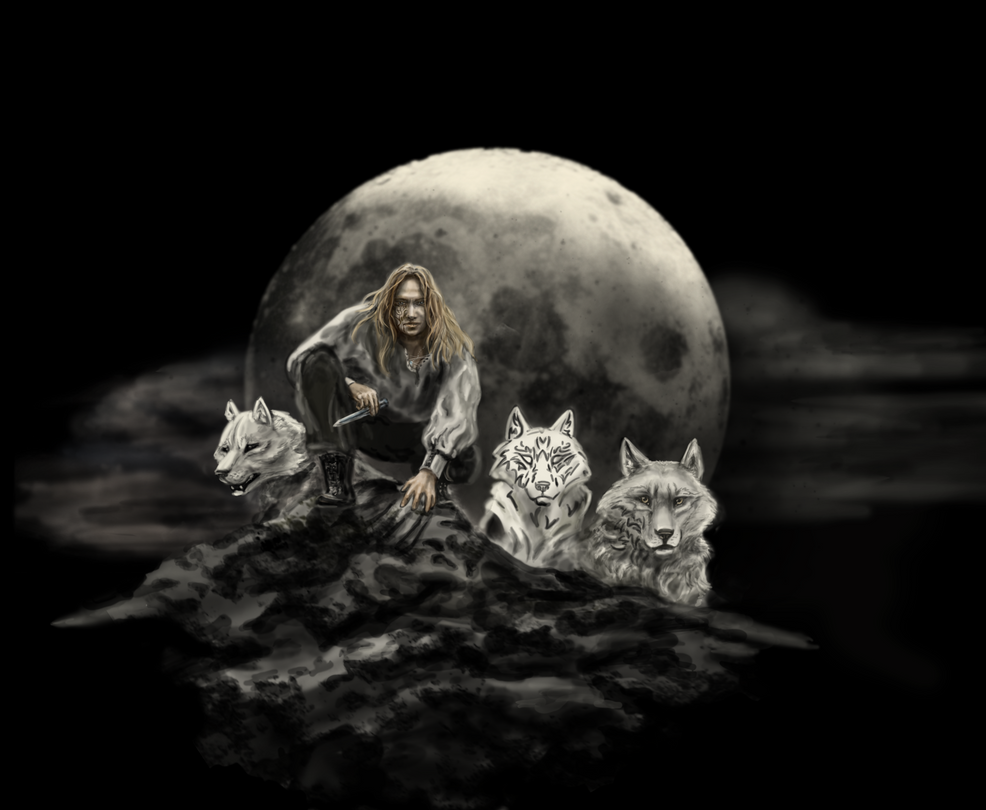
Long haired-man and the three wolves of justice bearing news 
that the moon spends more time looking at high latitudes.

Since the moon is illuminated when it is on the opposite side of the earth from the sun, and because during winter the earth is tilted in that same direction, at high latitudes the moonlight is out more. Over the course of a year this results in high latitudes facing a larger proportion of illuminated moon than lower latitudes.
All made possible by the quirky moon being more closely aligned with 
the sun than the tilt of the earth (awesomely termed latitudinal libration).

To make this clearer we need to specify what we mean by the moon being out. The moon is technically "out" or in sight 50% of the time at all latitudes. But at high latitudes a larger portion of that "out" time occurs when the moon is illuminated, giving us less "wasted" new moon time. Consequently, we have less daytime moonlight than lower latitudes when the moon is out (and illuminated) at the same time as the sun. The farther from the equator you travel, the more illuminated and out time you get.

For example, on the shortest day of the year in Fairbanks, the full moon rises at 2:40 pm as the sun goes down. The frosty moon then follows the same arc across the sky that the midnight sun followed exactly six months before on the summer solstice, providing the brightness of the full moon for 21 hours until it sets the next morning at 11 when the sun rises.

Sorry if this post reads more like a word problem than a stimulating diversion, but hey, it's near midterms and this is good practice.

As a warning, I have never heard anyone talk about this phenomenon so there is a chance I am missing something in my reasoning and am wrong. Let me know if you figure that out, but until then here's to mood swings, seasonal affective disorder, and moonlight!


*While this is true at a continental level, local topography strongly affects actual length of direct sunlight. For those of you behind a mountain or hill, you might have hundreds of hours less than your allotted 4,380 hours of sunshine. And this even though the earth is relatively smoother and more spherical than a pool ball.

Monday, February 17, 2014

Susitna 100 Race Report

The Susitna 100 this weekend was a race. "Big duh!" you might say, "it says, 'Race across frozen Alaska,' right on their logo." But many wilderness competitions are more endurance than race. This one was complete with wipeouts, wagers, performance-enhancing substances, and a large helping of strategery.

For me, the planning started long before the race when I could have been working on my dissertation, enjoying the beautiful outdoors, or even watching the olympics with my wife, but instead I decided to weigh my bike.
Stripped down and still not as light as the new carbon machines. It did survive that car crash though (thanks Martin).

Not just my bike though, I weighed my sleeping bag, pad, mittens, sunglasses, and even my socks (in case I determined having toes was worth less than shaving off 175 grams of wool) in a strange obsessive flurry. Then the trail report came in.

"The trail conditions are estimated at about 80% hard packed snow, 10% icy crust over snow and 10% glare ice (most of the glare ice is avoidable)."

What had started as an innocent post on Facebook soliciting a lightweight bivy sack, quickly degenerated into a "what wheels should I use" scramble and I ended up borrowing wheels from half of Fairbanks (thanks Kevin, Josh, Cody, and Jay).

At the pre-race meeting Heather quipped, "You could put studs on your cross bike with this trail and that would be the ticket."After further deliberation with the Francoms and Kriegers, our generous Mat-Su valley hosts, I settled on my studded commuter wheel up front and Kevin's Weirwolf/Snowcat rear tire/wheel combo.
Notice those skinny tires behind the huddling family. Thanks to Becker-Design for the poagies and frame bag.

At the raceline the only two skinny-tired rigs were mine and somebody on a department-store mountain bike. Andrew from Anchorage rolled up, "Snowcats huh? That looks like the ticket. Though I would have studded the back too, but maybe you didn't have the tire for it." Ben lent me his chapstick and we lined up at the start line.
They counted down from ten and 118 racers filed down the icy driveway at Happy Trails Kennel onto 100 miles of snowmachine trails. The pack quickly strung out as we clipped along at 10-15 mph. 


After twenty minutes of winding trail and swamp mounds it was Carey, Kevin, and I enjoying the 14 degree morning air (perfect for not overheating and not freezing anything off). We rode together through the first checkpoint but as we approached Flathorn Lake things got icier. Whenever we crossed a creek or bog, my companions would back off or speed ahead to avoid my studless rear end, which was wagging and jumping between ruts and cracks like a broken robotic dinosaur. The Ice-Spiker-Pro did an amazing job keeping the front from slipping out, but the slop out back was a little disconcerting. As Kevin and Carey cut across the glare ice at Flathorn, I picked my way around the edge of the lake and lost site of them. 

With lots of pretzels, gummies, and Rachel-made moose jerky I was feeling sugared and salted up and I made up some ground on the rolling trail before the Dismal Swamp. The wind was steady on the swamp and as soon as I hit the open ground I hit the ground hard. My front tire screwed its courage to the sticking place, acting as a pivot, and I spun around 180 degrees before slamming into to the polished ice. I drug my bike to the side of the ice patch and assessed the damage. Luckily, besides a bruised knee and some spilt pretzels, I was fine. I got back on the bike and soft-pedaled until Justin and Clint caught me (no sense in riding in the wind alone). Over the next fifty miles I would crash so many times that Hansel and Grettle could have found their way home blindfolded for all the piles of gummy bears and Honey-Stinger waffle crumbs I left whenever the trail got icy (though they might have caught diabetes from it). Once we got onto the wide Susitna River the wind completely died and we pedaled for thirty miles under beautiful blue skies surrounded by the the Alaska Range and Mount Susitna. 

Pulling up to Eagle Quest lodge, a biker on a carbon 907 with HED carbon rims blew past us. 
"Who was that?" I asked Justin.
"I don't know." We pedaled hard and caught Mark, a self-described old, fat guy from Wisconsin. His seat bag was huge and loose and swung from side to side with every pedal.
After 15 miles behind the hypnotic bag and when Mark was out of earshot I quipped to Justin, "We know each other well enough that you would let me know if something was swinging from my bike like that right?"
"It's kind of freaking me out actually. Not the bag, just how well he's doing." He was hammering, and seemed totally unfazed by the 75 miles we'd done so far. I started thinking I'd be fighting for fifth, not third, with this new addition to the up-front crowd.

But then Mark didn't stop at Cow Lake. It was the last major checkpoint, just over 20 miles from the finish, and the snow had started to fall. Justin and I refueled with some sodas and some Cup-A-Noodles. The warm salty soup must have been "heaven" flavored because they filled every corner of our bodies with a celestial light and sense of wellbeing. We knew then that we would catch Mark.

I felt as fresh as the beginning of the race the next 20 miles. The same sequence of events played out four times. I would catch Justin and then wipeout when we hit the ice (once ripping my front wheel from the dropouts). He'd regain a little lead and then I'd catch him again. We caught Mark at the trail shelter 10 miles from the finish. "What are you guys on?" he asked as we passed him.

With the ice at the finish I didn't have a chance to pass Justin, but I sure enjoyed the course, the company, and the fine family that accompanied me. Nice to finish a hundred miles in Alaska and not need to use your headlamp.

Note: I just found out that Mark wrote an account of the race too that you can read here.

Wednesday, February 5, 2014

Honest difference or intentional deception?

A couple months ago my friend Daniel asked me about how scientists were responding to the following Fox News article, Arctic sea ice up 60 percent in 2013. The article points out that the minimum extent of arctic sea ice increased dramatically by more than a million square miles from 2012, reversing the trend of ice loss, and now some scientists are worried about global cooling.

Before I responded, I looked up the data the article was based on from the National Snow and Ice Data Center (NSIDC). Here is the figure from that report.

Inline image 1
As you can see, the article is technically correct. Compared to 2012 (the all-time lowest year on record), 2013 was a bumper year for ice. On the other hand, if this is how Fox News reads long-term trends, let's be glad they're not in the financial sector.

So my question is, did the authors see this figure and really think it represented a recovery, or did they intentionally misrepresent the trend? I believe that people can look at the same data and honestly arrive at very different conclusions (Taylor Swift and Mackelmore both know what the Bieber has done but they don't agree on whether he should be deported). However, that is a very different phenomenon than intentionally pitching a twisted story.

My friend Martin, the famous walrus researcher (as famous as you can get studying walrus I suppose), got a flurry of inquiries about this article, including from several high-ups in local and state government. A report that clearly confirmed the trend of decreasing sea ice, identifying 2013 as the 6th lowest on record, and noted that ice was more than a 1.5 million square miles below average, became a propaganda tool denying the reality of human-caused climate change with a wave of the magic mass media wand.

So again, my question is, who or what is perpetuating (or perpetrating) this bad journalism? Is it simply news agencies headlining to increase sales, editors catering to the world-views of their audience or sponsors, or is it a symptom of too much or too little regulation of what can be called journalism? I don't have an answer but I'd love to hear what you think. Comment fast before the globe cools down and the internet turns off.

Tuesday, January 14, 2014

The Fairy Shrimp Trilogy

Filmed, produced, and narrated by Ben Abbott at the Toolik Field Station in 2007, this documentary was forgotten as quickly as it was filmed, produced, and narrated.
Part I 
The four chapters of the trilogy represent retakes rather than sequential scenes as Abbott developed the narration and learned how to focus a camera.
Part II
Like most of Abbott's ventures, the film is simultaneously boring and unfinished. However, like other bad movies, the documentary has attracted a cult following of at least two arctic limnologists and ecologists.
Part III
At the end of the field season, Ken Fortino and Cody Johnson, two of Abbott's supervisors, discovered the series on the lab computer and entered it into the Toolik Talent show unbeknownst to Ben. It didn't win, but the public display before eminent arctic scientists revealed the fact that the subject organisms in the film were in fact amphipods (Hyalella azteca), not fairy shrimp (Branchionecta paludosa).

Part IV
While this mixup is the crustacean equivalent of mistaking a milking cow for a dachshund, (for those two organisms are more closely related than fairy shrimp to amphipods).
Once he knew what his movie was about, Abbott began a PR campaign to rebrand a species that has been maligned in popular culture for over 100 years. From the Wikipedia article on amphipods we learn of this century-old bias:

Although they are very abundant, widespread and diverse, amphipods do not feature strongly in the public imagination. Thomas Roscoe Rede Stebbing wrote in 1899:
No panegyrist of the Amphipoda has yet been able to evoke anything like popular enthusiasm in their favour. To the generality of observers they are only not repelled because the glance which falls upon them is unarrested, ignores them, is unconscious of their presence.
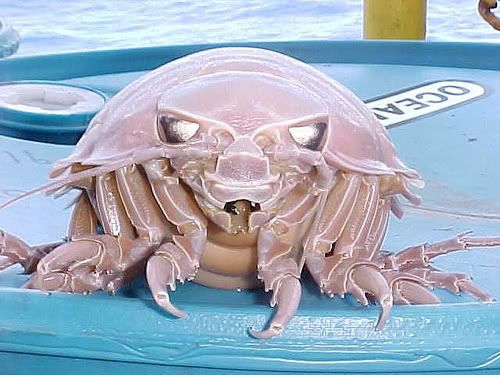
Last year a giant species of amphipod was discovered by the researcher wearing the grumpy shirt above. It was more than four miles below the surface at the bottom of the Pacific and would likely have made for a better poster child for the movement. Even the biggest amphipod, however, can't compare with the charismatic isopods. These relatives of the potato bug have been favored by humans for more than 300 million years, mostly because, as you can see in the picture below, they don't give a crap. 
As my brother Sam always says, "The less you pretend you are into them, the more they will be into you."