Letting some of it trickle out while trying to soak it all in

Thursday, June 30, 2022

Preserving permafrost ecosystems is crucial to humanity: faster decarbonization is essential

This month, our most recent permafrost study came out in Frontiers in Environmental Science. Because of the Utah Lake lawsuit and general craziness, I wasn't able to get a press release together before the study was published, but I thought I'd release it now. I'd love to hear your thoughts and questions.

Permafrost affects only 10% of the Earth’s surface—mainly in the far north. However, changes in these distant regions should concern all of us. According to a study published this week in Frontiers in Environmental Science, rapid warming is causing cascading changes in permafrost regions that are threatening biodiversity, the stability of global climate, and the wellbeing of over 1.5 billion people.

A team of 33 international experts summarized more than 200 recent studies about how climate change and permafrost are interacting. The science and policy experts focused on four key permafrost regions: the Arctic Ocean, the Boreal Forest, the Arctic Tundra, and the Tibetan Plateau. Together called the permafrost domain, these areas are especially vulnerable to climate change because of their dependence on ice. This is a problem because they are warming three-times faster than the global average, with many regions already 2 to 5 degrees Celsius warmer than before the Industrial Revolution.

“This is one of the biggest and most complex parts of the Earth system, and it’s hard to grasp how fast things are changing,” said lead author Ben Abbott, a professor at Brigham Young University, U.S.A. Abbott said, “The permafrost domain regulates the Earth’s energy balance and affects ocean circulation and habitat for people and wildlife worldwide.”


Arctic researcher Sarah Godsey digs a snow pit to measure water and gas content beneath the surface. Loss of snow cover and sea ice are resulting in rapid warming in many permafrost regions. North Slope of Alaska, 2011. 

The study estimates that the permafrost domain contains between 2.5 and 3 trillion tons of organic carbon; more than all of Earth’s other life, soil, and atmosphere combined. As this plant and animal material begins to decompose, microorganisms produce CO2, CH4, and N2O, the three most important long-lived greenhouse gases. Under more extreme warming scenarios, permafrost rot could produce hundreds of billions of tons of emissions.

“Ignoring permafrost is essentially like leaving a major greenhouse gas emitting country like the United States out of climate negotiations, which is not a good idea,” said study author Susan Natali from the Woodwell Climate Research Center in a TED talk on the topic earlier this year. Another study author Jens Strauss from the Alfred Wegener Institute said, “Today the permafrost regions are already releasing nearly the same amount of greenhouse gases as Germany’s annual emissions.”

The study reveals that dramatic changes are progressing decades faster than expected. Sea ice and snow cover have plummeted, storms have intensified, soils and coastlines are eroding, and wildfires are burning through the winter.

However, the experts insist that a “time bomb” scenario of runaway greenhouse gas release is unlikely. Instead, they explain that the faster we reduce emissions, the more the permafrost domain remains stable and healthy. Rather than an abrupt belch, greenhouse gas release from the permafrost domain could last hundreds of years and occur across millions of square kilometers. This results in a slower climate feedback but also makes it extremely difficult to stop.

As important as permafrost climate feedbacks are, the experts emphasize that the permafrost domain is more than just “a pile of greenhouse gas precursors.” It is home to tens of millions of Indigenous and immigrant people, and it supplies water and resources to billions more, largely around the Tibetan Plateau.

Natali said, “Right now across the Arctic, people are having to make extremely difficult decisions about where and how to live in order to protect themselves and their families from the hazards of climate change.” The authors conclude that permafrost preservation is both a practical and a moral issue. “People living in the permafrost domain have done very little to cause climate change, but they’re particularly hard hit by it,” said Strauss.

A permafrost exposure near the Arctic Ocean with exposed, Pleistocene-aged ice. North Slope of Alaska, 2013. 

In line with last year’s State of the Cryosphere report, this study concludes that current climate mitigation targets are inadequate. “We sometimes treat 1.5 degrees as a safe level of warming, but that is not true for permafrost,” said Abbott. “Right now, we’re at 1.2 degrees globally, and the permafrost domain is already in full-on transition. The energy choices we make over the next decade could either open pathways toward recovery or lock us into a future of loss and degradation.”

The authors propose that policy action is needed both within and beyond the borders of the permafrost domain. They advocate for the rapid reduction of fossil fuel use globally and support for Indigenous and immigrant permafrost communities who are already dealing with the consequences of climate change.

On the question of how to reduce greenhouse gases the fastest, the authors provide two recommendations. They write, “recent breakthroughs in renewable energy production, transmission, and storage now allow much faster decarbonization than previously believed possible,” and call for a global commitment to abrupt decarbonization. At the same time, they warn that many geoengineering “climate hacks” are not viable and could cause unintended consequences in the permafrost domain and beyond. Strauss said, “We don’t want to demonize all these approaches, but we need to be realistic about potential benefits and possible side-effects.” 

Researchers hike back to the Dalton Highway after collecting soil and gas samples to measure the response of permafrost to climate change. The Trans-Alaska Pipeline can be seen in background carrying crude oil for export. North Slope of Alaska, 2010. 

Rather than climate mitigation (making things less bad), the authors propose “climate restoration”—a return to pre-industrial climatic conditions. They claim this is possible through the rapid rollout of renewable energy, the conservation of intact ecosystems, and the development of negative emissions technologies. Abbott said, “We’ve got a choice between fossil fuel use and the continued existence of permafrost ecosystems. If we pick wrong, the consequences for human rights, biosphere integrity, and global climate will be severe.”

This study was supported by the U.S. National Science Foundation and Department of Energy. The work grew from two international research efforts: The Permafrost Carbon Feedback Action Group and the Permafrost Carbon Network—an international research network funded by half-a-dozen U.S. and international agencies and organizations.

Figure 1 from the publication showing the extent of the permafrost domain. The extent and example futures of the permafrost domain (A) Our definition of the domain includes marine and terrestrial regions substantially affected by perennial frozen material, including oceans and seas above 50°N, subsea permafrost on the continental shelves, Arctic tundra, Boreal forest, and Alpine permafrost. The figure shows potential permafrost futures for (B) a rapid decarbonization scenario and (C) a continued fossil energy scenario. Panel B depicts: 1. Resilient biological communities in marine, coastal, and terrestrial environments, 2. Persistence of sea ice, especially crucial multiyear and landfast ice, 3. Maintenance of net greenhouse gas uptake in the permafrost domain, 4. Recovery of permafrost and a shallow active layer, and 5. Preservation of human cultural activities and infrastructure. Panel C depicts: 6. Expansion of fossil fuel extraction and marine navigation, 7. Disruption of food webs, migrations, and biological communities on sea and land, 8. Accelerated coastal erosion, aquatic and marine primary productivity, ocean acidification, and erosion of terrestrial material, including pollutants, 9. Transition to net release of greenhouse gases (CH4, N2O, and CO2), 10. Extensive permafrost degradation, including active-layer thickening and lake formation and draining, 11. Intensifying terrestrial disturbances including wildfire, hydrological extremes, thermokarst, vegetation shifts, and invasive species, 12. Profound disruption of human culture and infrastructure.

Tuesday, May 31, 2022

Through-hiking the Narrows with algae and an EV

 A couple days ago, my childhood friend Devin invited me to through-hike the Narrows. He is an expert dentist and canyoneer, and he finally drew the coveted permit for the 16 mile hike. His brother pulled out last minute, and he had three available spots on the permit. Between the lawsuit and three summer research campaigns, my instinct was to decline. But as we talked, Devin mentioned offhand that there had been cyanobacterial blooms in the Virgin River (coverage here). That is the main river that carved the system of canyons that make up the Narrows. You don’t have to mention harmful algal blooms twice to get me on excited, so I immediately started preparing. My daughter Ingrid volunteered to be a field assistant, and another high-school friend Jason agreed to come along as well.

We needed two cars for the shuttle, so we split into two teams. Ingrid and I took Highway 89 down, so we could charge the Chevy Bolt in Richfield (best free level 3 charger in the state IMO). However, we neglected to account for traffic on the east side of the park and ended up almost two hours late! Devin and Jason picked up the permit and found a friendly RV park that agreed to let them leave the car. Because we had just applied GM's software update to the Bolt, which limited charging to 80%, we arrived with only 60 miles of range. Thankfully, the Best Western in Springdale let us charge for an hour while we ate lunch.

The drive to the Narrows Upper Trailhead is a spectacular ascent from the deep sandstone canyon to the high pine mesa. We left the Bolt in the dusty parking lot with 40 miles of range left.


For some shots, it pays to be short. We hit the trail around 2pm.

The hike starts on a mild double-track across the mesa.

There was a lot of modification of the river channel going on, with new diversions, leaky pipes, and heavy equipment.

Many of the Ponderosa showed fire scars. A natural fire regime is crucial for the persistence of these ecological communities.

A few miles in, the canyon narrows and starts to descend into a multi-level forest wonderland. From here on out, the river was our trail.

Just before crossing into the official national park, someone had bolted this land-sale sign onto the canyon wall. It made me wonder if anyone had proposed to build and sell islands in the canyon to solve the river's algal bloom problems...

I was taking water chemistry measurements every half-mile or so. The multiprobe measures temperature, atmospheric pressure, dissolved oxygen, conductivity, pH, oxidation-reduction potential, and the concentrations of chlorophyl and phycocyanin (indicators of algal and cyanobacterial activity, respectively).

My companions were patient with me.

The texture and sound of the water were immersive.

When you're a teenager, apparently, it's still super cool to hang out with three dads.

With our heads down to find our footing, deepening of the canyon caught us by surprise.

Ingrid had been struggling with a bone spur in her left knee, but between the ski poles and the relatively gradual gradient, she hardly complained.


Waiting for the probe to equilibrate.

The lighting got diffuse as we got closer to Campsite 1, where our permit required us to stop for the night.

We hadn't see a soul since leaving the car, which made the canyon seem even wilder and more immense.

Zoomed out view of the last pic for scale. I'm not a geomorphologist, but let's just say that the canyon was deep.

Devin carried a tarp big enough for all of us. I carried the stove, but it ended up malfunctioning, and we had to heat up our water from the flame spewing from the fuel line. You might start seeing a pattern: my life is a mess right now :). The campsite was right at the confluence of the North Fork of the Virgin and Deep Creek.

In the morning, it was still dark and cold in the deep canyon.

The water was 10 degrees colder, so we started our second day with lots of layers on.

Foot and bed gear for the win.

The concentrations of phycocyanin were higher than what we usually see in the Utah Lake watershed, though they were still quite low. The colors of the water, plant, and stone however were saturated and stunning.

Patiently waiting on another measurement.

A relatively recent rock fall created a pretty big pond. We could swum, but we decided to scramble along the edge.

Contemplating whether to descend on foot or on bottom.

The river was only at 39 CFS-well below it's normal springtime level. Even so, the vegetation was lush.

The river grew as we got closer to Big Springs, the upper limit for day hikers.

Because of the cyanobacteria, the Park Service recommends only filling up at springs. Devin had a cool fast filter that filled up our bladders in just a few minutes.

Warming up.

Dragon flies, dippers, suckers, tadpoles, frogs, and strange long worms.

From this point on, there were others in the canyon.

Skirting a deeper pool

By now, the sky was only a sliver hundreds of feet above. The GPS on my sensor had a hard time finding itself.

Ingrid took a couple of spills in this section. The deeper water and smoother stones...

Way to go gimpy knee!

A tree and its man.

Snacking in an alcove. The seeping groundwater and the freeze-melt cycles of the water are just as important as the fluvial erosion of the river.

By now, there were lots of people in the river.

Cute overload.

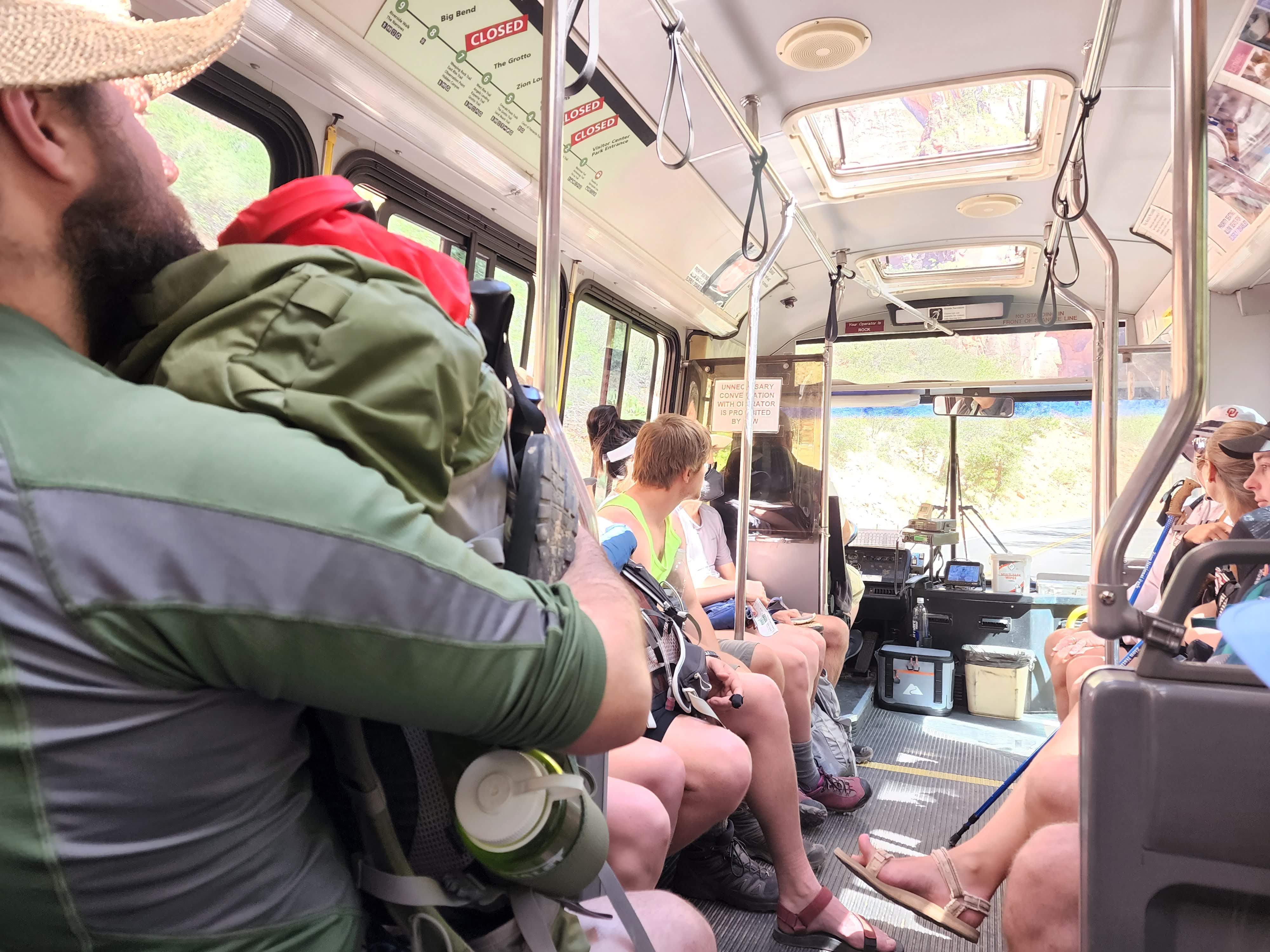
On the shuttle out of the park, strict signs forbid unnecessary conversation. After 16 miles, we were happy to sit for a moment.

Millions of years of history in every escarpment.

Rather than driving back through the park, we decided to take the dirt road to Highway 14. This would let us descend directly into Cedar City, shaving off an hour or two. The road climbed much more than I expected, transitioning into a maple-aspen community.

Just a few miles from the pass, our Bolt ran out of juice. I hadn't accounted for the thousands of feet of vertical and deep sand. I'd never run the car to complete depletion before and wasn't sure how it would behave. We were about to try a pusher-configuration with Devin's car, but thankfully a couple from Nevada pulled by us. They were the only other vehicle we'd seen on our traverse. They had a tow chain and offered to pull us into Cedar City. I initially thought we'd only need a tow to the top of the pass, but because I'd completely depleted the battery, it wouldn't switch into regen mode until charged (see the pattern). I coasted down the canyon, and then Brian reconnected and towed me to a charging station in Cedar.

We offered to pay for their gas and time, but the good Samaritans just told us to pay it forward. Walmart and Electrify America to the rescue!

It was such a blessing to experience this corner of creation, and I'll share the scientific results as soon as I have them entered.

Sunday, April 24, 2022

The life and legacy of Kay Bradford

When we moved to Orem, Utah in late 2017, we had no idea that a national treasure lived just a few doors down. Our first week in the Orem 3rd ward was pretty typical of a first week anywhere…until we walked into Sunday school. An elderly woman on the front row bedecked in at least 50 pounds of jewelry and shiny shoes leapt to her feet and proclaimed to the whole class, “You must be new in the ward! Tell me your names, and I’ll introduce you to everyone!”

Kay Bradford was born in Huntington Utah in December 1923, making her a sprightly 93 when we first crossed paths. During our brief years together, Kay made an indelible mark on our hearts and lives. She was irrepressibly positive, intensely hopeful, eternally effervescent, and deliberately joyful. Though Kay was undeniably showy (her favorite colors were glitter and sparkle after all!), these virtues were not a show. She embodied a love of life and exuded a Christlike love for all of God’s children that disarmed all suspicion and division.

Kay enjoying a sunny Sunday afternoon with Ingrid and Caspian.

I was privileged to serve Kay and her children Dorothy and Robert first as a home teacher and then as a ministering brother. The minor acts of service my companions and I were able to render were completely eclipsed by the wealth of wisdom and number of candies we received in return. Kay’s kindness and generosity were such that you couldn’t spend five minutes with her without a rejuvenated view on life and a baggie of caramels, chocolates, popcorn, or starbursts. She would often have an arsenal of treats prepared for our children and the other families we had lined up after visiting her.

During the pandemic, Kay and Dorothy invited us to prepare and share the sacrament each week in their home. The visits were touchstones in my week. The time was sacred because of the ordinance and the privilege of sharing a few moments in conversation and prayer together. She would often have a quote or insight from one of the many books she read, and she always sent us away with an admonition to express gratitude and see the good in the world around us. 

Though she was no stranger to loss and hardship, she told us to wake up every morning looking forward to something fabulous. "Something wonderful is going to happen today." She would often ask, "Aren't we so blessed?" while holding your hand and beaming into your face.

Two weeks ago, Kay passed away with her family by her side. She leaves behind almost a hundred children, grandchildren, great grandchildren, and great, great grandchildren. She leaves behind thousands of friends and acquaintances who are better because of her example.

We couldn’t attend her funeral, and I have been trying to find a way to process the grief and gratitude I feel at her passing. The video below is my small memento of a woman who changed my life. In October of 2018, I brought our kids to her place to ask her some questions. She agreed to let me record the interview. I was going to edit it down to a 5-minute video, but I couldn’t bring myself to cut any of her words or movements. Here is all 33 minutes of the uncut interview. Let Kay take you on a tour of her home and share some insights about how to stay happy in a challenging world.

I love you Kay, Dorothy, and Robert. I’m so grateful for what you taught me and my family, and I pray for all of you in this time of transition and change.