| Part of my legal team testing the waters on Utah Lake earlier this month. |
| Part of my expert legal team holding a confidential meeting at an undisclosed location on the north side of Utah Lake. |
| Part of my legal team testing the waters on Utah Lake earlier this month. |
| Part of my expert legal team holding a confidential meeting at an undisclosed location on the north side of Utah Lake. |
Last month Jay Griffith and Andi Pitcher invited me to participate in an online conversation about how the coming of Christ changes our relationship with Earth and all living things. It was part of the Think Again Faith Again series, so I jumped at the opportunity. They asked me to write some thoughts as a primer, which I ended getting to them less than 24 hours before the actual event because…of course I did (sorry Jay and Andi).
Here is the recording:
And here are the preparatory paragraphs and some thoughts about what Jesus teaches us about ecology:
Ecology is the study of how living and nonliving parts of the Earth system interact. Rooted in the Greek word for home (oikos), ecology tries to understand how the household of God is run. We usually think about what Jesus taught us about our relationship with self, society, and God. But Christ’s example is rich with teachings about proper attitudes and behavior in ecological communities (populations of different species) and ecosystems (all life and environment).
Pope Francis wrote, “how inseparable the bond is between concern for nature, justice for the poor, commitment to society, and interior peace.” This congruence between love of God, creation, and neighbor is taught in every book of scripture and most perfectly typified in the pattern of Christ’s life. His birth among peasants, beasts, and Earth. His disdain for hierarchy and insistence on reconciliation. His interpretation of dominion as service and love. Most importantly, his demonstration that all life depends on death. In a world of nearly 8 billion neighbors, how can we apply Christ’s ecology today? In this conversation, we hope to ask, what can we do as a faith community to return to a place of obedience to Earthly laws? We will explore how the life and teachings of Jesus could heal our personal relationships, patterns of consumption and reciprocity, and the structure of our societies.
Perhaps more than any other choice we make, the relationship we cultivate with our earthly home affects our ability to keep the two great commandments: love of God and love of neighbor. We live in a time of unparalleled human dominion of the Earth’s great cycles and life—an epoch called the Anthropocene or time of humans. Though our relationship with the Earth is obscured by industrial supply chains and carefully controlled indoor lifestyles, our dependence on ecological community—relationship with creation—is more immediate and absolute than ever before. Indeed, our abuse of the environment is now the leading cause of human sickness and death—pollution accounts for 1 in 4 deaths every year, more than all communicable diseases, dietary disorders, and human violence combined.
Economic and ecological sciences typically assume that human nature is immutable. Christ’s Gospel of radical transformation—his invitation to abandon all our wealth and be released from the burdens of our careers—challenges this assumption. Jesus showed us that each individual, community, and ecosystem has unique and sacred attributes. No one and no place is dispensable. We must meet our temporal needs in ways that do not poison or exploit the Earth. What can we learn from Christ’s example and teachings about how to live in community with creation? How can we share this gospel in time to save our sisters and brothers across all the branches of the tree of life?
Here are ten lessons from Christ’s life and teaching that are relevant to how we treat other humans, other life, and all creation.
Additional readings:
Robin Wall Kimmerer 2014, “Mishkos Kenomagwen: The Teachings of Grass”.
Pope Francis 2015, “Laudato Si’—our care for our common home”.
Wendell Berry 2012, It all turns on affection.
Ben Abbott 2020, How close are we to the edge?
Joseph Smith 1834, Doctrine and Covenants 104
As you may have heard, there is a truly epic project brewing in Utah Valley. In 2017, a limited liability company proposed to build 20,000 acres of artificial islands in Utah Lake, claiming this would somehow help the ecosystem. In 2018, the Utah legislature passed House Bill 272, which opened the door to transferring the lakebed from the people of Utah to a private corporation. Since that time, the lake developers have been solidifying political support and lining up financing, including a $10 million loan guarantee approved by the legislature last year without any public vetting. They are having a major lobbying dinner at the state capitol next week. The company says they are motivated by a desire to restore the lake, describing their project as a “comprehensive restoration.” Here is the full text of their proposal.
After interacting with them for years, I have major doubts about their intentions and methods. While there are literally hundreds of ecological, financial, and legal problems with their proposal, I’ve summarized seven of my main concerns below. If you want to dig deeper, check out this new article called “Getting to know Utah Lake.” There are also several op-eds that have been written on this topic, including The present, future and past of Utah Lake in the Deseret News and Keep Utah Lake shallow and wet in the Salt Lake Tribune. If you prefer video format, here is a presentation I gave at the Salt Lake Watershed Symposium earlier this month: Is Utah Lake a Steaming Failure or a Gleaming Success?
Problem
#1. The project is built on false premises. The developers claim that 1. Utah Lake’s condition is
bad and getting worse, 2. The lake needs to be dredged, and 3. The lake used to
be deep and clear. These claims couldn’t be farther from the truth. Utah Lake has
always been shallow and cloudy. In fact, these are some of the attributes that
make the lake so remarkably resilient. Multiple studies have found that Utah
Lake’s status is better than most water bodies in the U.S., and its sediment is
not contaminated—it is clean and crucial to the health of the lake. Dredging
would cause immense damage to the lake ecosystem while not providing any ecological
benefit.
Hundreds of science-based restoration projects have put the lake on the road to recovery. Cooperative agreements with farmers and other water users have restored river flow to the lake, and upgraded wastewater treatment plants are decreasing nutrient flows to the lake. Invasive species removal has been effective, reducing carp biomass by 80% and restoring native plants along the lakeshore. The Hobble Creek and Provo River Delta restoration projects have been immensely successful, increasing public access to the lake and improving habitat. In response to these efforts, algal blooms are decreasing, native species are returning, and public use of the lake is on the rise. Thanks to this progress, the native June Sucker was downlisted from endangered to threatened just this year. Why would we make such a drastic change when things are finally going the right direction?
Problem #2. Building islands would destroy the attributes that make Utah Lake resilient and reduce ecosystem services it freely provides. The unique characteristics of Utah Lake have helped it maintain much of its function despite decades of abuse. First, about a third of the water that enters the lake evaporates to the atmosphere. This causes the constant formation of calcite (the source of the lake’s beautiful cloudy color), which makes nutrients in the lake unavailable to algae. Second, the water’s cloudiness slows the cyanobacterial blooms that affect most water bodies more often and intensely than Utah Lake. Third, the lake’s shallowness prevents the worst effects of algal blooms when they do occur. In deep lakes, blooms consume all the oxygen in the deep water, which causes fish kills and massive release of pollutants from the sediment.
The islands
proposal would destroy all three of these attributes: reducing the lake’s
surface area, allowing more light to stimulate algal growth, and creating
multiple deep channels in the lakebed. This would damage the invaluable
ecosystem services the lake freely provides us, including increasing local
precipitation, cooling the valley during summer extremes, removing nutrients, providing
world-class opportunities for recreation and photography, and creating habitat.
Indeed, the lake is currently a hot spot of biodiversity, providing habitat for
nearly 1,500 species, including 10 million fish, 35 million water birds, and 69
kinds of mammals, amphibians, and reptiles. How would a project that directly
destroys the resilient qualities of the lake make things better?
Problem #3. This proposal would permanently deface our valley and dishonor the legacy left by our ancestors. Anyone who has hiked Timpanogos or any of the surrounding mountains knows that Utah Lake is the centerpiece of our community. The developers propose to build massive islands housing half a million people in the shape of arches, beehives, railroad spikes, and seagulls. This would destroy views of the lake and make our valley unrecognizable to our ancestors. Before European contact, Utah Lake supported the Timpanogos Nation for generations—we now know that people have been living in this area for more than 20,000 years. When the Mormon Pioneers arrived, fish from the lake saved the settlers along the Wasatch Front during crop failures in 1855 and 1856. After disasters during the Dust Bowl, our ancestors carefully regulated water diversions to make sure Utah Lake would be preserved. Will we honor that legacy or desecrate a lake that so many have worked to protect?
Harvest of June Sucker and other native fish from the shore of Utah Lake in 1855. Courtesy of the June Sucker Recovery history.Problem
#4. The project is very likely impossible. It is very common for developers to underestimate the
technical challenges and economic costs of projects they are pitching. The
larger the project, the greater the potential for overconfidence. Let’s compare
this proposal to similar large projects. The world’s largest dredged island is
the Kansai International Airport, which was built in Osaka Bay in Japan. The
island is around 2,500 acres. It took 23 years to plan, permit, and build, costing
around $20 billion. Despite careful engineering and environmental surveys, when
they began building on the island, it sunk 27 feet into the sediment. The Utah Lake
islands would be 20,000 acres: 8-times larger than Kansai island. Additionally,
the bed of Utah Lake is unconsolidated marl—which has much less structural
integrity than the Holocene clay in Osaka Bay.
On the
dredging side, the Hudson River Cleanup currently holds the record for the
largest freshwater dredging project: 2.7 million cubic yards of sediment
removed over 10 years for a cost of $1.6 billion. According to the island developers, dredging
Utah Lake would involve removing 1 billion cubic yards of sediment, making the
project 370-times larger than the already enormous Hudson River project.
Despite the truly unprecedented size of this project, the developers are claiming they can do it for $2.6 billion in just 8 years. This seems like either a textbook case of engineering hubris or intentional false advertising. Independent estimates suggest the project could cost $10 to $90 billion while providing no ecological benefit to the lake system.
Problem #5. The project is very likely illegal and will probably never get permitted. By law and precedent, Utah Lake must be managed according to the public trust doctrine. This legal framework requires the state of Utah to act as a trustee to hold the lake (and other waterbodies) for the benefit of all Utahns—present and future. This doctrine has been challenged multiple times in other water bodies around the state, but the Utah Supreme Court and U.S. Supreme Court have defended it quite fiercely. This is why the island developers’ first step was to lobby the legislature to change the law. In January of 2018, Representative Mike McKell of Spanish Fork introduced the Utah Lake Restoration Act (H.B. 272), which would allow the state to dispose of sovereign lands in exchange for “comprehensive restoration” of the lake system. Despite the law’s clear constitutional problems and the infeasibility of the island proposal, H.B. 272 passed with overwhelming support in both the house and senate. This law hasn’t yet been tested in court, but if the legislature attempts to transfer large portions of the lakebed to private parties, they would almost certainly be sued.
Previous disputes over Utah Lake and other nearby waterbodies provide a hint of how that might go. In 1990 the Utah Supreme Court ruled that the “essence of [the public trust] doctrine is that navigable waters should not be given without restriction to private parties and should be preserved for the general public for uses such as commerce, navigation, and fishing.” The court specified that even leasing of these lands can be challenged. A 2019 ruling by the Utah Supreme Court specified that “the abdication of the general control of the state over lands under the navigable waters of an entire harbor or bay, or of a sea or lake. . . is viewed as a gross infringement of the public trust doctrine.”
Even if the project didn’t get tangled in state and federal court, there is still the question of permitting. All such projects are required to do an environmental impact study, which typically takes 10 years or more (this legal panel at the Utah Lake Symposium discussed the law and permitting challenges this project will face).
Problem #6. The project has no scientists on its team. This is one of the strangest and most troubling aspects of this proposal. For any legitimate restoration project, you assemble a team of researchers, engineers, and legal experts to ensure an efficient, effective, and safe process. While there are several engineers and lawyers involved, the team appears to be primarily real estate entrepreneurs. There are no PhD-level environmental or ecological scientists on the team, though their “senior scientist” did earn a master’s degree in biology in 1996. The developers know this is extremely unusual for a project this size because they have been trying to recruit researchers from all over Utah. They have made job offers to several faculty at BYU and even tried to snatch a graduating Ph.D. student from my department to lend some credibility to their proposal.
The fact
that no researchers are willing to take their generous salary highlights another
particularity about this project: no one in the research or management communities
thinks it is a good idea. With most environmental proposals, there is heated
debate and disagreement about pros and cons. I have spoken with more than 100
researchers from across the state and beyond, and all of them think this
project is a horrible idea. It has dozens of poison pills and no upside for Utah
Lake or the people of Utah.
Problem
#7. The project has shady foreign funding. The developers claim to have $6.4 billion lined up in
investments. This money ostensibly comes from Dubai, where the famous Palm
Islands were constructed in the early 2000s. Those islands have been both a,
ecological and economic failure. They have caused massive erosion of Dubai’s
coastline, extensive algal blooms, and widespread asphyxiation of corals and
other marine life. Though $6.4 billion is woefully inadequate to complete the
described work (see problem 5), it would still make the Utah Lake islands the
largest private restoration project in history. More to the point, if they have
so much money lined up, why are they still fundraising? Last year, they tried
to raise $15 million on the SEC but ended up with only $200,000—potentially from
a single investor. They told the state legislature that they had applied for $200
million from the EPA (rejected this fall), which helped them get a $10 million
loan guarantee slipped into the Utah state budget last year. Now they are
working with a PR firm Halcyon host a series of fundraising events with celebrity
concerts costing $1 million.
These kinds
of “moonshot” projects with outside investors have been proposed before. Right
here in Utah Valley, we flirted with the idea of a ski resort behind Y Mountain
for more than 30 years. The investors never showed up and the proposal ended with
nothing but bankruptcy and a heap of wasted taxpayer dollars to show for it.
These large miracle solutions are always just what they seem: too good to be
true. True ecological restoration takes scientific evidence, community
engagement, and persistent collaboration. If we allow the island developers to
start this project, we may end up with an injured lake and an enormous mess of
half-built islands to clean up.
Light from Saratoga Springs reflects off a partly frozen
Utah Lake (Mandy Jensen).
So what can we do? The best way to permanently stop this dangerous proposal is to repeal H.B. 272. This is the law that allows the legislature to dispose of our public trust lands in exchange for the islands project. It was passed in 2018 without much opposition or fanfare (coverage here), but it has left the door open for foreign investors to .
A more complicated issue is the Utah Lake Authority bill, which failed earlier this year. A revised version will be considered in the 2022 session starting in January. The bill would create an independent body, similar to the Inland Port Authority, to oversee projects within and around Utah Lake. It is not associated with the islands project, but my concern is that it completely reworks the governance of Utah Lake right when we are making measurable progress. While the revised bill has not yet been made public, I worry that it could threaten the important gains that have been made over the past decade. While increased coordination among stakeholders around the lake could be a plus, the authority could also make modification of the lakebed and surrounding area more likely. Utah Lake has been saved from the costly and damaging alterations that have been made to the Great Salt Lake (diversions, causeways, and artificial bays have resulted in major hydrological and toxicological problems).
Perhaps most importantly, we need to share the positive message of a lake in recovery. Utah Lake is a beautiful and sacred place, and it needs our support and love. We will only convince the legislature and the people of Utah Valley to turn their hearts back to the lake if we can show them its value and central role in our history and future. Please share the Getting to know Utah Lake article with your family, friends, and representatives at the city and state level. Please visit Utah Lake and share its unique beauty with all you know.
Utah, I ask that you please take heed to what the experts opposing this project have to say. Our people and the reeds around this lake give you your name. We stand in favor of restoring the lake to its natural beauty but have to oppose privatizing and desecrating this historic sacred site.
-Mary Murdock Meyer, Chief Executive of the Timpanogos Nation, August 2021
Utah Lake Sunset (Preston Holman).
Sign this petition by Conserve Utah Valley and a coalition of community and conservation groups to stop the island developments.
Ben Abbott is a professor of aquatic ecology at Brigham Young University. He has been studying reservoirs, lakes, and river networks throughout Utah and Idaho since 2009. The scientific and legal claims made in this blogpost are based on a synthesis of over 70 studies and reports on Utah Lake, which was published this August: “Getting to know Utah Lake.”
This year has been the most spectacular sequence of missed deadlines and unanswered emails. Life turned what I intended to be a deliberate deceleration into a focused flurry of new projects and ventures. The current state of my life (and my inbox) brings me consternation, and I do hope to soon pare down my commitments. However, I take great consolation that my behindness is because of what I believe to be needed and meaningful projects.
After a year of COVID-19, I was pretty caught
up. I’d finished a couple of long-simmering research projects and was starting
to feel on top of this whole professor thing. Then the environmental science
capstone class that I was teaching decided to do their group project on rapid
decarbonization pathways. Because fossil fuel combustion is fueling both air
pollution and climate change, this is a really important topic. It’s also
totally different than my typical ecological research. The students really dug
in, and it grew into a major project with collaborators in Germany, Finland,
and across the U.S. It also took much longer than a semester, and we are just
now getting ready to submit the findings for peer review. One of the students
even made this awesome poster with our slogan.
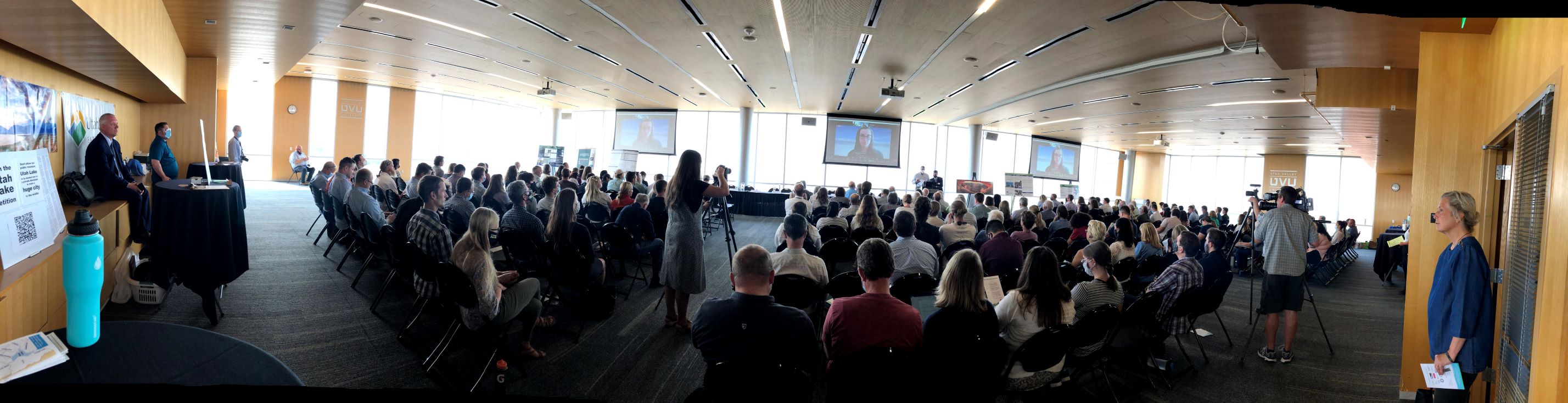
During a meeting of our Utah Lake monitoring project, one of our collaborators mentioned that the proposal to build artificial islands on Utah Lake had reared its head again. We learned that the island developers had taken the legislature out to lunch in April and presented their two-hour dog and pony show about how the real way to restore Utah Lake was to destroy it. I was still working on the renewable energy project and supervising a team in Alaska, but this islands proposal is level-11 crazy. In 2018, they convinced the legislature to pass a law that would allow the state to give the lakebed of Utah Lake to a private corporation. In 2020, they weaseled a $10 million loan guarantee slipped into the state budget. We went into full emergency mode and organized a symposium to bring researchers, managers, lawmakers, and concerned citizens together to discuss the lake. In just a few weeks the plans and funding came together, and 500 people gathered at UVU and virtually to participate in the Utah Lake Symposium. It led to ongoing talks with the legislature and will hopefully conclude with the permanent protection of this unique and important water body.
Since then, a half-dozen other “side projects” and opportunities have kept me from feeling on top of things. However, I am honestly deeply grateful for the chance to contribute, even in a small way, to issues that go beyond my personal professional development. We are living in a period of extreme change, and there isn’t time for career building and navel gazing. Or at least that’s what I tell myself when I’m feeling really ragged and resentful about not having the time to watch the newest True Facts video.
I was cruising my favorite news app yesterday when an add came up claiming that beef was actually super sustainable and good for the environment. I couldn’t help but click. It was funded by the Beef Farmers and Ranchers association—the group responsible for the “Beef, it’s what’s for dinner” campaign. The website was a tossed salad of half-truths and incomplete reasoning. Beef has a big carbon footprint, but smaller than a flight to London. Cattle are “up-cyclers” taking useless plants and turning them into calories and leather. Meat is a nutrient dense food that supplies 9% of U.S. calories but (wait for it) a whopping 10% of our protein and some vitamins.
My favorite part was that they showcase their “Environmental
Stewardship Award,” which, it turns out is an annual award given exclusively to
cattle producers and funded by McDonalds among other conflicted sponsors. The meat
industry is so committed to greenwashing that they bought the URL www.environmentalstewardship.org
and use it to shower an award on themselves every year.
While this vein of greasy propaganda was particularly rich,
it isn’t unique. I am frequently forwarded Alan Savory’s TED talk on how grazing
could halt desertification and solve climate change too. As an aside, TED talks,
like Wikipedia articles, are a great place to start your research, and a very
bad place to draw your conclusions1. Just this week, I was called
a “shame and a sham” (kind of a nice ring to that actually) for suggesting that
eating a plant based diet would be good for the environment.
Over the past three years, I’ve been talking a lot with politicians. It started with the Voices for Science program, which pairs scientists with their senators and representatives to help lawmakers understand how research benefits society. I went to DC and met with the offices of Senators Lee and Romney. I shared my story about how scientific research creates jobs in Utah and leads to innovation that benefits our economy and quality of life. I was surprised how accessible they were.
I was also surprised at the differences in Romney and Lee’s voting records and approaches. As a junior senator, Romney was tucked into a basement office with borrowed filing cabinets. Despite the tight quarters, his team was working tirelessly to create or support meaningful legislation on everything from child poverty to climate change. Lee had a sumptuous office with heavy leather couches and professional flyers inviting donors to eat jello with him. Like their leader, his team seemed to be scrupulously avoiding anything meaningful, instead spending their time flailing in the culture wars while complaining they weren’t being treated fairly.
When I got back to Utah, I couldn’t kick
the habit. Some BYU students put our program in contact with Representative John
Curtis. We met on the mountain, discussing how climate change was threatening
everything from our forests to our economic future. Curtis knew his stuff and seemed
to be playing the long game—educating and working with a diverse coalition.
Next thing I knew, my student Isabella and I were traveling to the Utah Capital to share the findings of a statewide study on the health and economic costs of air pollution in Utah. The bipartisan Clean Air Caucus listened to our findings and provided feedback and guidance on how to move forward. I was impressed by their sincerity, wisdom, and generosity.
During the pandemic, we changed tack and worked on COVID itself, summarizing research on what interventions are effective for the broader community and in school settings. When we found out that the insane Utah Lake islands proposal was still on the table, we changed course again, organizing what turned out to be an extremely stimulating and productive Utah Lake symposium earlier this month.
Through all these forays into translational
science, one topic seems to always come up: fossil fuels. Dirty energy is at
the nexus of so many of the challenges we are facing. There are multigenerational
problems like climate change and the socioeconomic instability of the oil
world. There are immense and immediate tragedies like the 10.2 million people
who lose their lives each year to pollution from coal, oil, and gas. Fossil
fuels played a crucial role lifting billions from poverty in the 19th
and 20th centuries. But two hundred years later, it’s time to move on.
Every time I speak with a policymaker, I
try to bring up how beneficial the transition to clean and renewable energy
could be. If there are a thousand reasons to not like fossil fuels, there are a
million to like clean energy. From cheap and equitable power to quiet and
comfortable neighborhoods, the renewable revolution is going to be better than
even Captain Picard imagined. Plus it is rolling in at warp 9, with a host of
plausible scenarios getting us to decarbonization of the electricity grid by
2030 or 2035.
Not everyone believes this.
This email from a state representative is pretty typical in my experience:
Thanks for the energy data. I’m still not sold on the tech being there yet, but I hope it will be. California has been a cautionary tale on their energy management and the ability to handle the various loads. The tech could get there, but I can tell you that the appetite to put Utah at risk of rolling blackouts or anything close to it is pretty low. But we do believe in technology and I am hopeful it will get there and that it will be perceived as getting there (which is important in politics).
I appreciate sincere skepticism. Heck, my
job literally depends on checking assumptions and thinking through things
differently. However, skepticism is a pernicious form of damnation if it’s not
married to a thirst for knowledge and light. There is nothing that can more
completely shield us from basic truths and moral opportunities than
self-serving skepticism.
If the technology isn’t there yet,
then it follows that it’s not anywhere. Turns out that fully renewable, or near
fully renewable systems are popping up all over the planet. Let’s take one of
my favorite examples, which you may have never heard of: the state of South Australia.
A little bit bigger than Texas, South
Australia is home to only 1.8 million people. Last year, it briefly reached
100% renewable energy (this temporarily created a negative cost to electricity
of 9$ a MWh!), though it is averaging around 70% renewable electricity in 2021.
True, the power is extremely cheap (2.9¢ a
kWh!). True, the grid is substantially more reliable and resilient than our
fossil fuel one. However, the thing I find most thrilling and encouraging about
South Australia is how quickly they got there. In just 12 years, they’ve gone
from a coal and gas system like ours to a renewable system that is superior in almost
every way. They have done so while growing their economy and earning huge
dividends on their infrastructure investments.
To be fair, the legislative groundwork did begin in the early 2000s, when they set a modest renewable energy target. However, it wasn’t until 2008 that they started working on this in earnest. They rolled out feed-in tariffs, which encouraged distributed power generation such as rooftop solar. They set renewable portfolio standards, which ensured predictable conditions for investment and business creation. They offered low-cost financing to individuals, organizations, and businesses to purchase and install the renewable tech.
But what about the
intermittency problem!? What are you going to do when the sun doesn’t shine and
the wind doesn’t blow!?
The assumption that I
hear parroted by many (including Bill Gates in his recent book), is that energy
storage is not economical. South Australia has both utility scale and
distributed battery storage, including the world’s (second) largest chemical
battery: the Hornsdale
Power Reserve. The project paid for itself in two years. That’s an ROI that
even the summer sales bros can’t compete with.
The combination of
distributed and centralized production has decreased strain on the power grid,
allowing South Australia (and other areas that have decarbonized) to reduce
maintenance and extend equipment lifetimes. It’s harder to shuffle electrons
from a single location through a whole network than produce and consume it
locally.
As their transportation and heating sectors electrify, South
Australia has a goal of 500% renewable power by 2050 (that is to say they will
be creating 5-times the electricity that they are today, and it will all be
renewable). Really, really cool.
But what about California!?
On the topic of our friend to the west, I actually agree that
California is a cautionary tale. They have high power prices and low
reliability. However, I see that as a bureaucratic and administrative failure,
not a technological one. They still primarily have centralized energy
production, a large amount of interstate importation, inadequate distributed
storage, and vulnerable long-distance transmission that often must be shut down
because of fire risk (exacerbated by climate change).
Renewables get blamed for every grid problem, though their net
effect is a large increase in resilience and reliability. Take the Texas power
crisis in February. Natural gas and coal failed at twice the rate of wind, but
everyone from Greg Abbott to Marjorie Taylor Greene blamed the renewables (Reuters fact check here).
Unlike California, Utah could be a national leader in this space
with local production, multiple storage solutions, and an open energy market.
Unfortunately, the current producers have effectively stifled deployment with
anti-competitive tactics and regulation at the county to state level. Here in
the valley, both Rocky Mountain Power and UMPA are doing their darndest to
penalize rooftop solar, and the gas lobby scored a win last session by
requiring hookups in all new developments.
There are lots of effective legislative actions that could improve the situation, including the following
I went in an airplane for the first time in 18 months. I flew over the Great Salt Lake—what was left of it. It looked like the Aral Sea. Antelope Island was connected to the mainland on three sides. The antelope were halfway to Saratoga Springs. There was hay growing in Farmington Bay. Foxes and coyotes were nearly across the new land bridge to Gunnison Island to visit the 10,000 pelicans they insisted were kin.
The bottom of the Great Basin. This is the place that floods when God sends the snow. This is the place that dries up when we divert the rivers.
Some of us get lulled into thinking that this drought is just more of the same. Some of us are wrong. The current conditions the Southwest is experiencing are called a megadrought—a dry period that lasts more than 10 years. This megadrought has been going on for so long that if you were born in the 90s or later, your entire life may have unfolded during the big dry.
Lake Powell is so low the dock just broke loose. At the Utah Water Task Force meeting, I learned that reservoirs in the Weber River usually have 80,000 acre feet of water storage. This year, they hold 2,700. Now that humans dominate the global water cycle, this story is stuck on repeat almost everywhere on Earth (Abbott et al., 2019a).
I think it's really important to provide some context to this drought. Tree rings show that we are in the driest 20-year period since trees started keeping records some 2,000 years ago. I think it’s even more important to identify what is causing these conditions. Our megadrought is directly a consequence of human-caused climate change. This isn't a natural disaster. This is an unnatural consequence of our overuse of fossil fuels. We have supercharged the summers, disrupted the wet winds from the Pacific, and made snow and rain less reliable. I don't blame climate change in a generic way, there is solid science on this megadrought specifically (Williams et al., 2020). These conditions have also caused a doubling of annual wildfire extent across the West, setting the stage for megafires that burn whole valleys and mountainsides.
I believe in the power of prayer, but how does God feel when we pray for our actions to have no consequences? To solve this part of the megadrought, we need to dramatically decrease fossil fuel combustion so the climate can get back to normal. The best way individuals can do that is by pressuring their elected officials to stop climate change, changing their transportation to bikes and public transport, and eating a plant-based diet (cartoon Ben says it best). Doing these things would leave us healthier, wealthier, and much more secure (check out this recent post on the ongoing global decarbonization).
The natural response to scarcity is to try to increase supply. We build pipelines, dams, and canals so there is more water available when we want it. This has been the response of Utah as a state. I hear from state legislators all the time that we should build more dams, and the state just created a new River Authority that is going to fight with our neighbors in Nevada, Arizona, and Colorado for more water. They'll be fighting over water that doesn’t exist.
The problem with this supply-side approach is that demand can always grow faster than supply (Abbott et al., 2019, Ellison et. al., 2012). Demand is
basically limitless. Building more dams won't help in any way if the rain and
snow never come. Suing California won't help if there is no water in the river
or aquifer to take.
We need to manage our demand as individuals and as a society to live within our means. Much of Utah, including where I live, is in the Great Basin. This is a huge internally draining part of the Earth with no rivers to the ocean. Areas like ours are extremely sensitive to climate change and human water use. Consequently, endorheic basins all over the world are experiencing hydrological collapse (Wurtsbaugh et al., 2017). We need to recognize that we have limited water resources and change our behavior to live within those limits.
So what are we using our water for? More than 80% of Utah's water use is agricultural. Some of this water use is totally justified and important, such as the water used to grow food for people. I love Utah cherries, watermelon, corn, and essential oils. Unfortunately, the production of Utah fruits has dropped by half since the mid 80s. Over the same time period, alfalfa production has increased by 300,000 tons per year (USDA). Today, 70% of our agricultural water goes to grow alfalfa, most of which is exported to China to feed livestock. Does it really make sense to subsidize an economically marginal activity that doesn't increase our food and water security? If you think it doesn't, I invite you to stop eating meat and talk with your legislators about supporting water reform.
Of the remaining non-agricultural use, most is outdoor water use. There are plenty of beautiful native plants that grow happily without irrigation. However, for some reason we have decided that we need turfgrass in front of every house and building, even though this non-native species needs huge amounts of water and fertilizer. As individuals and as a part of various corporate, educational, city, and state communities, we need to change the way we landscape.
There is also an economic solution to this problem: let the price of water increase. Currently we heavily subsidize water, paying one of the lowest prices per gallon of anywhere in the U.S (Utah Rivers Council). If the price reflected the cost, we would all waste a lot less water.
There are also problems with water law that cause a lot of waste. Under current water law, if you don't use your water rights, you lose them. That means there is a huge disincentive to conserve. For example, Provo is considering piping water from the Provo River and releasing it up Rock Canyon. They could simply let Rock Canyon flow, but they have water rights in the Provo River that they need to find a beneficial use for. I wonder if the river could use the water beneficially. There are thousands of counterintuitive inefficiencies like this going on every day in our state that we need to resolve. We should have water law that encourages conservation and strategic agriculture while ensuring the health of our ecosystems. Call your legislators or provide feedback here to encourage scaling up the water banking pilot program.
I grew up in Utah, and I love this place with all my heart. We need to change our laws, policies, and behaviors to stop climate change and water waste in our beautiful state. This will make a better world for all of us and make us much more prepared for the next drought. Or for this drought, if it lasts another twenty years.